







Definition & Meaning
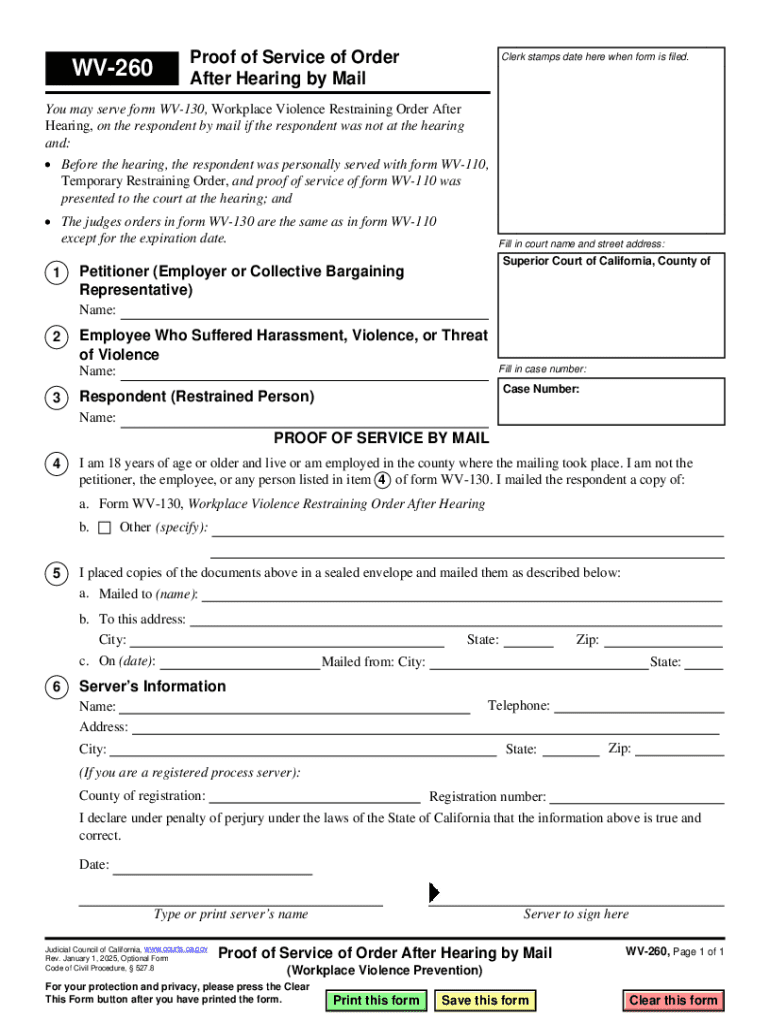
The WV-260 Proof of Service of Order After Hearing by Mail is a legal document used in California to confirm that a Workplace Violence Restraining Order After Hearing (form WV-130) has been mailed to the respondent. This document is crucial for ensuring that the respondent is officially notified of the order and adheres to its conditions. It serves as an official record indicating that the notification process complied with legal requirements, verifying that due process has been maintained. The form outlines necessary details such as the involved parties, the court issuing the order, and the specifics of the mailing process.
How to Use the WV-260 Proof of Service Form
To effectively use the WV-260 form, it is important to follow a structured process to ensure compliance with legal standards:
- Fill In Details: Include information about the court, the parties involved, and the presiding judge's decision.
- Prepare for Mailing: Ensure the Workplace Violence Restraining Order (WV-130) is ready to be mailed. Confirm that all necessary documents are included in the package.
- Mail the Documents: The mailing must be conducted in accordance with the legal requirements set by California law, which typically involves certified or registered mail to maintain a record of delivery.
- Complete the Declaration: The person mailing the documents must accurately fill in the declaration section, including their own details and affirming the truthfulness of the information.
- File the Form: Submit the completed form with the court to establish that the service of documents was completed as required by law.
Steps to Complete the WV-260 Form
Completing the WV-260 form involves several precise steps to ensure that it is filed accurately:
-
Court Information: Provide the name of the court, case number, and names of the petitioner and respondent.
-
Details of the Order: Indicate the specifics of the order that has been served, including any associated temporary orders and their respective case numbers.
-
Mailing Information: Clearly state the address to which the documents were sent, ensuring it corresponds to the address listed on the court documents.
-
Server’s Declaration: The individual responsible for mailing must include their name, contact information, and relationship to the case. They must also declare under penalty of perjury that the information is accurate.
-
Sign the Form: The server should sign the form, completing the declaration of service under penalty of perjury, certifying that the service was carried out as claimed.
Key Elements of the WV-260 Form
The WV-260 form contains several critical components that must be completed with attention to detail:
- Court and Case Identification: Includes the case number and the names of the petitioner and respondent.
- Description of Documents Sent: A comprehensive list of the documents mailed to the respondent.
- Declaration of Service: Includes the server’s information and their attestation that the service was performed legally.
- Mailing Record: Details of when and how the documents were mailed.
State-Specific Rules
The WV-260 form is governed by California law, which has particular requirements for serving legal documents:
- Previous Personal Service Required: Before mailing, a temporary restraining order (form WV-110) must have been personally served.
- Type of Mailing: Legal documents must be mailed by a method that provides confirmation of delivery, such as certified mail.
- Timeliness: The forms should be mailed promptly after the court hearing to ensure compliance with any deadlines set by the judiciary.
Who Typically Uses the WV-260 Form
The WV-260 form is generally used by:
- Legal Professionals: Attorneys and their staff typically complete this form as part of their duty to serve court orders.
- Court-Appointed Servers: Individuals authorized by the court to ensure that service of process is conducted legally and effectively.
- Individuals Involved in Legal Proceedings: Parties to a workplace violence prevention case may use the form to show proof of service compliance.


Important Terms Related to WV-260
Understanding key terminology related to the WV-260 form ensures accurate completion:
- Respondent: The individual receiving the Workplace Violence Restraining Order.
- Petitioner: The individual requesting the restraining order.
- Proof of Service: Documentation that verifies how and when legal documents were delivered.
Legal Use of the WV-260 Form
This proof of service form is legally used within the context of workplace violence prevention to demonstrate compliance with court requirements. It is essential for maintaining the legality of the order by ensuring the respondent is adequately informed and given the opportunity to respond within legal frameworks. Failure to properly serve the order can result in delays or invalidation of judicial actions.
Form Submission Methods
The WV-260 form can be submitted through:
- Mail: Sending the completed forms to the court via certified mail.
- In-Person Submission: Hand-delivering the form to the appropriate court clerk.
- Online Portals: If the court provides electronic submission options, the document can be uploaded directly.
Why Use the WV-260 Form
The use of the WV-260 form ensures that all parties comply with legal protocols in the service of a restraining order, helping protect the rights and safety of individuals in workplace-related disputes. Providing concrete proof of service is crucial for legal clarity and protecting against future disputes about whether a respondent was properly notified.




