




01. Edit your form online
Type text, add images, blackout confidential details, add comments, highlights and more.

Type text, add images, blackout confidential details, add comments, highlights and more.

Draw your signature, type it, upload its image, or use your mobile device as a signature pad.

Send it via email, link, or fax. You can also download it, export it or print it out.
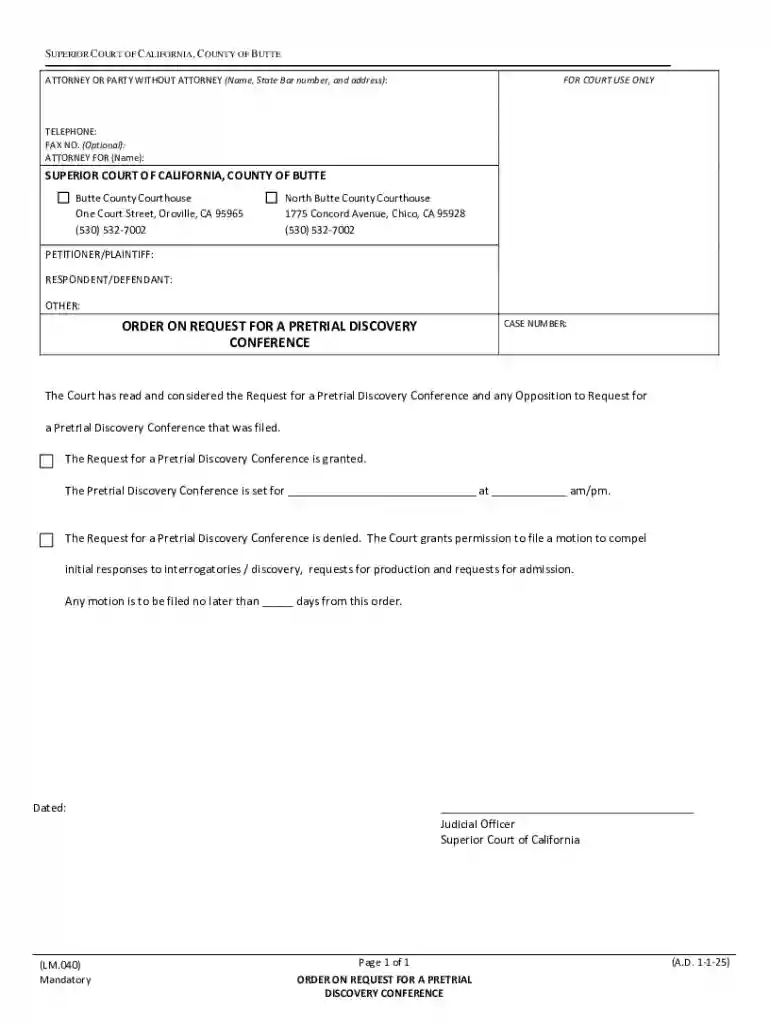
The "Order on Request for a Pretrial Discovery Conference" is a formal court order used primarily in legal proceedings within the Superior Court of California, County of Butte. Its primary function is to address requests related to pretrial discovery conferences. This document states whether a party’s request for such a conference is granted or denied. By detailing the necessary steps and actions to follow, it facilitates the smooth progress of pretrial discovery, which includes evidence-gathering and information exchange among parties. These conferences aim to foster cooperation between opposing parties, minimizing disputes and clarifying issues before the trial.
Review the Form Instructions: Start by thoroughly reading the instructions accompanying the form to understand its purpose and the information required. This step ensures you know the criteria that your request must meet to be considered.
Provide Your Case Details: Complete the section of the form related to your specific case. This will include information such as the case number, the names of the involved parties, and details about the legal representatives, if applicable.
State the Request Clearly: Clearly articulate the reason for requesting a pretrial discovery conference. Describe the issues you aim to address and any relief or resolutions you're seeking through this conference.
Attach Supporting Documentation: Add any relevant documents that support your request. This could include previous correspondence, discovery requests not yet fulfilled, or any other pertinent legal documents.
Sign and Date the Form: Ensure that you sign and date the form to verify the authenticity and accuracy of the information provided.
Submit the Form to the Court: Follow the specified submission guidelines, whether online, by mail, or in person. Confirm that the form is filed with the correct court office to avoid processing delays.
Requesting a pretrial discovery conference can be strategically important for your case management. It provides an opportunity for both parties to discuss the status and scope of discovery with a judge present, which may help resolve any disagreements and ensure that discovery proceeds efficiently. The conference can also actualize more precise documentation, streamline future proceedings, and potentially bring attention to novel legal issues before the trial.
When using the "Order on Request for a Pretrial Discovery Conference," legal representatives must effectively articulate the necessity of the conference. Utilize the form to address any obstacles encountered during the discovery process. This can help clarify ambiguous requests, narrow down the scope of required information, and manage timelines. The form should be used strategically to resolve disputes and ensure a fair discovery process.
Legally, this order plays a significant role in managing litigation. Pretrial discovery conferences are an integral part of California's case management protocols, allowing for smoother transitions into trials. Legal practitioners employ this form to foster transparency and cooperation between parties, thus adhering to procedural fairness and achieving a balanced courtroom environment.
In a case where party A believes party B has not adequately disclosed necessary documents, the form can be utilized to request judicial oversight in a discovery conference. For example, if party A's legal team feels that certain evidence has been withheld, submitting the order could prompt the court to facilitate discussions thus ensuring compliance with discovery requirements.
While the focus here is on California, different states may have varying protocols for pretrial discovery conferences. It is important to consult local rules for possible variations in procedure, format requirements, and specific legal standards that might apply to a case similar in another jurisdiction.
We've got more versions of the Order on Request for a Pretrial Discovery Conference form. Select the right Order on Request for a Pretrial Discovery Conference version from the list and start editing it straight away!
| Versions | Form popularity | Fillable & printable |
|---|---|---|
| 2025 | 4.2 Satisfied (49 Votes) |
At DocHub, your data security is our priority. We follow HIPAA, SOC2, GDPR, and other standards, so you can work on your documents with confidence.





the filing of the Request for a Pretrial Discovery Conference tolls the time for filing a motion to compel discovery on the disputed issues
Aug 1, 2024 I find that defendants have failed to demonstrate good cause for their failure to bring their motion on the schedule initially set by the CourtRead more
Apr 25, 2019 (b) Request for Court Action. After the discovery conference, one or both parties may ask the court to determine or modify the time, place,Read more


