
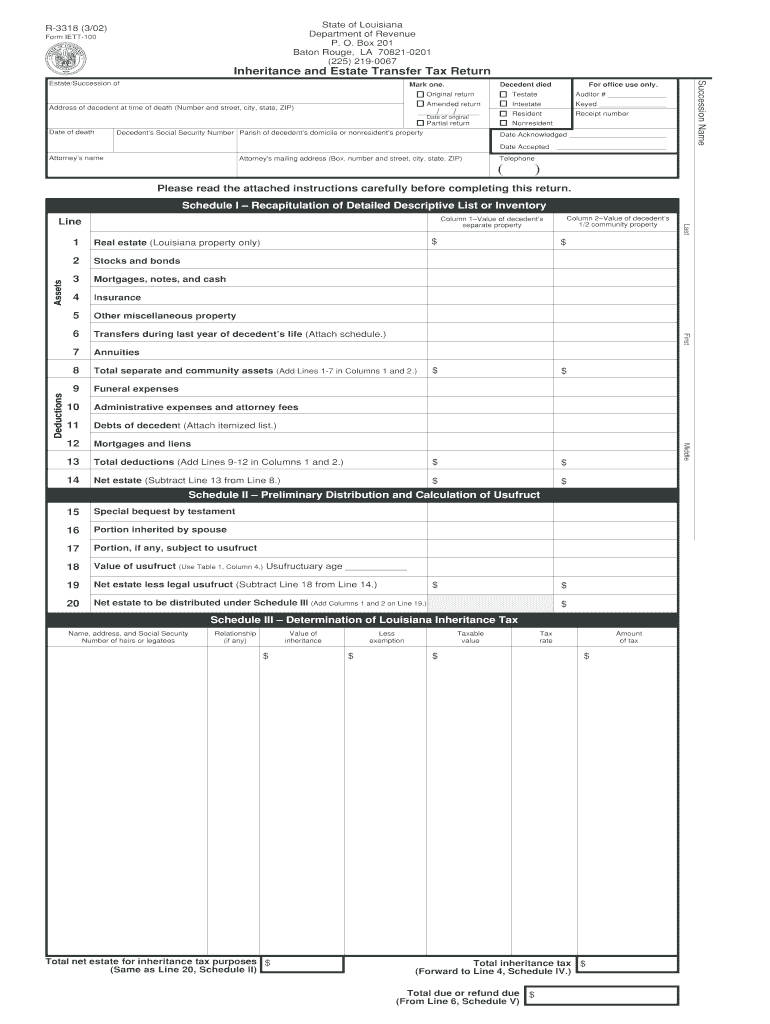







Definition and Purpose of the Inheritance and Estate Transfer Tax Return
The Inheritance and Estate Transfer Tax Return, designated as form IETT-100 by the Louisiana Department, serves as a critical document for reporting the estate of a decedent. It provides a structured format for executors and administrators to detail various components of the decedent's estate, including assets, deductions, and inheritance tax calculations. This form ensures compliance with Louisiana state tax regulations and plays a pivotal role in the legal transfer of estate assets following a person's death.
How to Use the Inheritance and Estate Transfer Tax Return
Using the IETT-100 form involves a comprehensive understanding of the information required. Executors are tasked with accurately detailing assets such as real estate, investments, and personal property. Each entry must be supported by proper valuations and accompanied by documentation as evidence. The form also includes sections for deductions, which cover debts and expenses like funeral costs. Precise completion is critical to avoid legal repercussions and ensure a smooth transfer of the estate.
Detailed Instructions and Sections
- Asset Reporting: Executors must list all estate assets, providing details on their nature, value, and any associated documentation.
- Deductions and Debts: Items such as debts, funeral expenses, and other deductible amounts must be specified.
- Tax Calculations: A methodical approach is necessary to compute the inheritance tax, using the form's guidelines and current state regulations.
Steps to Complete the Inheritance and Estate Transfer Tax Return
Completing form IETT-100 requires a step-by-step approach to ensure accuracy and compliance. The process begins with gathering all relevant documentation and continues with careful input of data into each section of the form.
- Gather Necessary Documents: Obtain all relevant financial documents, including asset valuations, debt records, and beneficiary information.
- Fill Out the Asset Section: Record each asset, including real estate and personal property, with detailed descriptions and values.
- List Debts and Deductions: Enter debts and eligible deductions, providing documentation for each item to substantiate the claims.
- Calculate the Inheritance Tax: Use the provided schedules and tables on the form to calculate the tax obligations accurately.
- Review and Submit: Double-check all entries for accuracy before submitting the form through the appropriate channels.
Importance of the Inheritance and Estate Transfer Tax Return
The primary importance of the IETT-100 form lies in its role in complying with state tax laws. It ensures that the estate’s tax responsibilities are met and facilitates the legal transfer of assets to heirs. Accurate completion of this form can prevent potential penalties and legal disputes, making it an essential document for executors handling a decedent's estate in Louisiana.
Who Typically Uses the Inheritance and Estate Transfer Tax Return
The IETT-100 form is predominantly used by executors and administrators responsible for settling the estate of a deceased individual. These individuals must possess a detailed understanding of the decedent's financial affairs and ensure compliance with all legal requirements related to estate transfer and taxation.


Key Elements of the Inheritance and Estate Transfer Tax Return
Understanding the components of the IETT-100 form is crucial for accurate completion:
- Asset Listing: A comprehensive section detailing all estate assets.
- Liabilities and Deductions: Sections covering debts and allowable deductions.
- Tax Calculation Schedules: Guidelines and tables for calculating the correct amount of inheritance tax.
State-Specific Rules for the Inheritance and Estate Transfer Tax Return
Louisiana imposes specific rules and guidelines that govern the submission and completion of the IETT-100 form. Executors must adhere to these regulations, which differ from federal requirements, to ensure accurate calculation of the inheritance tax and timely submission of the form.
- Valuation Methods: Accepted ways to value different types of assets according to Louisiana law.
- Deductions: State-specific allowances for various deductions, such as debts and funeral expenses.
- Tax Rates: Unique state tax brackets and rates applicable for inheritance calculations.
Filing Deadlines and Important Dates
Executors must be acutely aware of the deadlines associated with the filing of the IETT-100 form. Missing these deadlines can result in penalties and interest charges, adding financial burdens to the estate:
- Filing Deadline: The standard period after the decedent's death by which the form must be submitted.
- Payment Deadline: Specific dates by which any taxes owed must be paid to avoid additional charges.
Required Documents for Form Completion
Successful completion of the IETT-100 form requires the attachment of various documents to support the entries:
- Asset Valuation Reports: Documentation proving the listed value of properties and investments.
- Debt Documentation: Papers proving outstanding debts and liability records.
- Beneficiary Information: Legal documents listing beneficiaries and their relationship to the decedent.
Penalties for Non-Compliance with the Inheritance and Estate Transfer Tax Return
Non-compliance with the proper completion and submission of the IETT-100 form can have serious consequences, including financial penalties and legal action:
- Late Filing Penalties: Charges imposed for failure to meet filing deadlines.
- Tax Evasion: Legal consequences of underreporting estate assets or offering false information.
- Interest Charges: Accrued costs on unpaid tax amounts due to delayed payment.




