01. Edit your form online
Type text, add images, blackout confidential details, add comments, highlights and more.

Type text, add images, blackout confidential details, add comments, highlights and more.

Draw your signature, type it, upload its image, or use your mobile device as a signature pad.

Send it via email, link, or fax. You can also download it, export it or print it out.
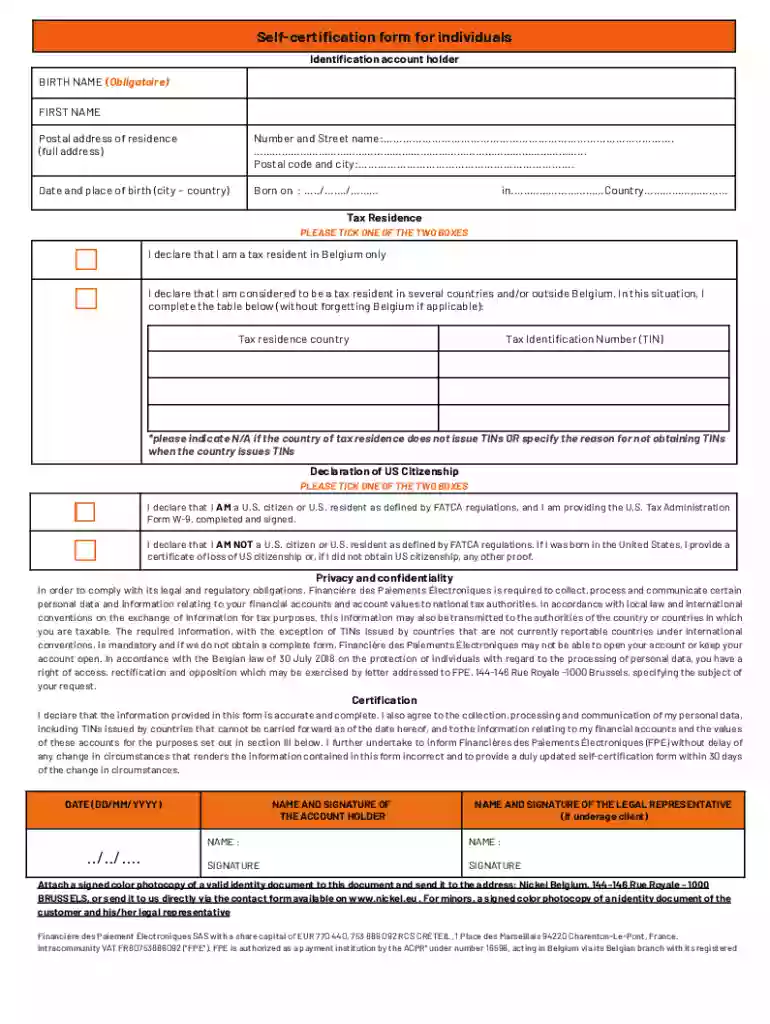
The Self-certification form FATCA AEOI - Nickel Belgium is a document used primarily for declaring tax residency and citizenship information. Its purpose is to ensure compliance with the Foreign Account Tax Compliance Act (FATCA) and the Automatic Exchange of Information (AEOI) standards. These regulations are designed to improve transparency and prevent tax evasion by mandating individuals to disclose their tax residency status. The form requires the submission of personal identification details alongside tax residency information, specific to individuals with financial accounts at Nickel Belgium.
The main components of the Self-certification form include:
These key elements ensure comprehensive data collection and compliance with international tax standards.
The process is straightforward but demands careful attention to detail to ensure compliance.
Completing the Self-certification form is crucial for several reasons:
These factors highlight the significance of accurate and timely completion of the form.
The legal implications of the form are significant as failure to comply can result in penalties. Financial institutions like Nickel Belgium are legally obligated to collect and report tax residency information to authorities. As an account holder, you must ensure that all provided information is truthful and complete. The form also outlines your rights concerning personal data protection, conforming to privacy regulations.
Non-compliance with the form submission can lead to:
These penalties underscore the importance of timely and accurate form submission.
Consider common scenarios where the form might be used:
These examples illustrate typical use cases for the form in a financial setting.
While the exact deadlines can vary, generally:
Staying informed of these timelines is critical to maintaining compliance with FATCA and AEOI rules.
Financial institutions may offer both digital and paper forms, providing flexibility:
Choosing the right format depends on your convenience and the institution's processing capabilities.
At DocHub, your data security is our priority. We follow HIPAA, SOC2, GDPR, and other standards, so you can work on your documents with confidence.