Periodontal chart form 2026

Get Form
perio charting form Preview on Page 1

Here's how it works

01. Edit your perio charting form online
Type text, add images, blackout confidential details, add comments, highlights and more.

02. Sign it in a few clicks
Draw your signature, type it, upload its image, or use your mobile device as a signature pad.

03. Share your form with others
Send perio chart form via email, link, or fax. You can also download it, export it or print it out.

Understanding the Periodontal Chart Form

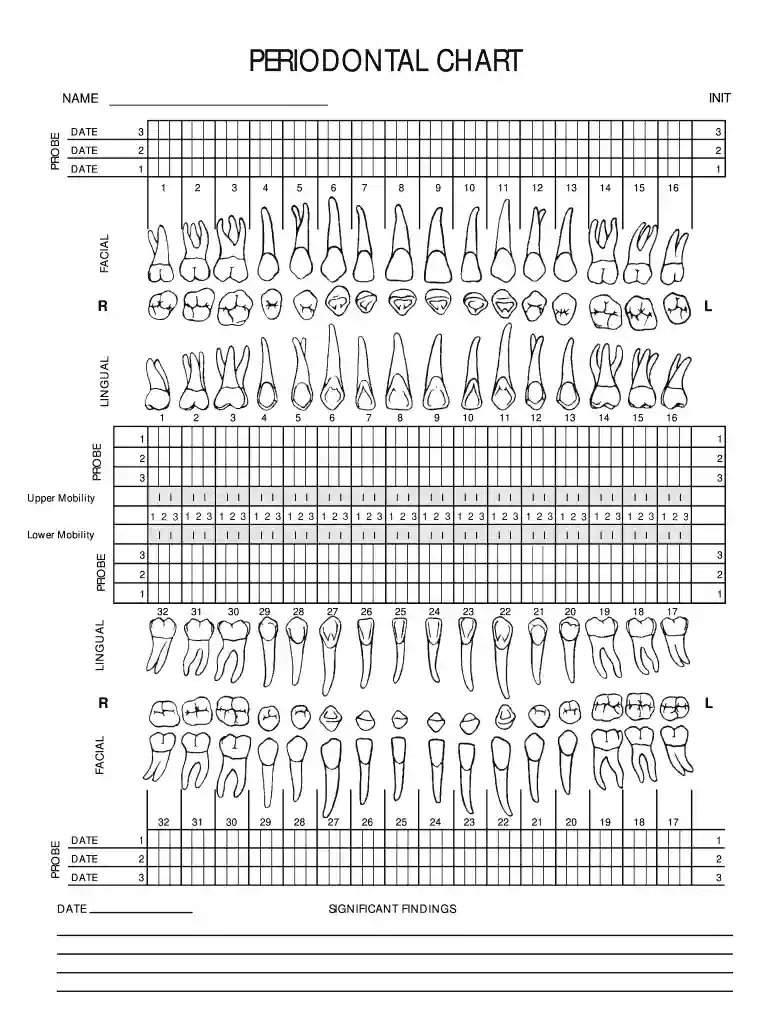
The periodontal chart form is a critical document used in dental practices to assess and record a patient’s periodontal health. This charting tool is essential for maintaining comprehensive dental records and for planning appropriate treatments based on the condition of gums and supporting structures of the teeth.

Definition and Purpose of the Periodontal Chart

The periodontal charting form systematically captures vital information regarding a patient's periodontal status. It includes:

  • Patient Information: Name, date of birth, and contact information.
  • Charting Measurements: Probing depths, recession, and furcation involvement.
  • Tooth Mobility Assessment: Grading tooth mobility on a scale.
  • Clinical Findings: Record of bleeding on probing and plaque index.

The main purpose of this form is to monitor changes in periodontal health over time, helping to evaluate disease progression or remission. By incorporating standardized measurements, dental professionals can effectively compare readings and track improvements following treatment.

How to Use the Periodontal Chart Form

Using the periodontal chart form involves a few systematic steps:

  1. Obtain the Form: Access an official periodontal charting template, either online or in paper format.
  2. Fill in Patient Information: Begin by entering the patient’s demographic details. This information is crucial for identifying records and for follow-up treatments.
  3. Conduct Periodontal Examination:
    • Measure Probing Depths: Use a periodontal probe to measure the depth of the sulcus around each tooth.
    • Assess Tooth Mobility: Evaluate the mobility by gently moving the tooth in different directions and classifying it on a scale from 1 (slight mobility) to 3 (severe mobility).
    • Note Clinical Findings: Document any signs of gum disease such as bleeding or suppuration.
  4. Record Findings on the Chart: Mark measurements directly on the chart form. This may include color coding significant findings for quick reference.
  5. Review and Plan Treatment: Discuss the findings with the patient and establish a treatment plan based on the recorded data.

Key Elements of the Periodontal Charting Process

The periodontal charting process is thorough and includes several specific elements:

  • Probe Depth Measurement: Typically ranges from one to nine millimeters; deep pockets indicate periodontal disease severity.
  • Bleeding Points: Mark where bleeding occurs during probing to assess tissue health.
  • Furcation Involvement: Indicates loss of bone between multi-rooted teeth, which is critical for treatment planning.
  • Mobility Assessment: Classifying mobility helps determine the treatment approach.

Digital vs. Paper Version of the Periodontal Chart

Periodontal chart forms can be created and maintained in both digital and paper formats, each with distinct advantages:

  • Digital Periodontal Charts:

    • Allow for easier data management and sharing between practitioners.
    • Can be linked to patient management software for integrated care.
    • Enable real-time updates and patient chart access from multiple devices.
  • Paper Periodontal Charts:

    • Useful in practice settings where digital tools are not available.
    • Provide a traditional record-keeping approach preferred by some practitioners.

While digital formats enhance efficiency, paper charts may still be relevant in specific practices.

Who Typically Uses the Periodontal Chart Form?

The use of periodontal charting forms is widespread among dental professionals, including:

  • Dentists: For diagnosing and planning treatment for periodontal disease.
  • Dental Hygienists: Frequently use these charts during cleanings to record gum health.
  • Periodontists: Specialize in treating advanced gum diseases and extensively rely on these forms to track patient conditions.
decoration image ratings of Dochub

Periodontal Chart Templates and Availability

To facilitate effective periodontal charting, various templates are available:

  • Printable Periodontal Charts: These are widely available online and can be printed for immediate use in practice environments.
  • Interactive Online Periodontal Charts: Tools that allow practices to input data digitally streamline workflows.
  • Customizable Chart Forms: Available in various software solutions that allow practitioners to tailor fields to their specific needs.

By utilizing a periodontal chart form properly, dental professionals can maintain detailed and accurate records that foster better patient outcomes and enhanced treatment strategies.

be ready to get more

Complete this form in 5 minutes or less

Get form

Got questions?

We have answers to the most popular questions from our customers. If you can't find an answer to your question, please contact us.
Contact us
What Is Periodontal Pocket Charting? Use a thin periodontal probe marked with millimetre measurements. Gently insert the probe between your tooth and gum at six points around each tooth. Measure the depth of any pockets formed where the gum has detached from the tooth.
Periodontal probing can cause some discomfort, especially if your gums are inflamed. However, its usually described as more of a pressure than a sharp pain. Dentists are trained to use gentle techniques.
It is common clinical practice, to begin periodontal charting of pocket depths in patients at 16 years old, although depending on patients individual conditions, periodontal charting can begin sooner.
Periodontal charting is the process of measuring pockets the space between a tooth and the gum tissue surrounding it. Your dentist or dental hygienist uses an instrument known as a probe and carefully inserts it into this space.
Grading of tooth mobility GradeDescription 0 Physiological mobility measured at the crown level. 1 Increased mobility of the crown of the tooth to at the most 1 mm in a horizontal direction. 2 Increased mobility of the crown of the tooth exceeding 1 mm but less than 2 mm in a horizontal direction.1 more row

Security and compliance

At DocHub, your data security is our priority. We follow HIPAA, SOC2, GDPR, and other standards, so you can work on your documents with confidence.
Learn more
ccpa2
pci-dss
gdpr-compliance
hipaa
soc-compliance

People also ask

Once measurements are obtained, they are systematically documented in a periodontal chart, which typically includes columns for tooth number, probing depth, gingival margin, bleeding on probing, plaque index, tooth mobility, and furcation involvement.
Your dental professional takes six measurements per tooth to ensure that all areas are accounted for. Along with the measurements, they also check for bleeding of the gum tissue and areas of gum recession. Your periodontal measurements will tell your dentist or hygienist if you have gum disease and how advanced it is.
A Periodontal Chart is also referred to as a gum chart. It is a graphic chart dental professionals use for organizing the information about your gums. Periodontal charting is the best way to uncover the difference between patients that are periodontally healthy and those with periodontal disease.

periodontal charting pdf