




01. Edit your form online
Type text, add images, blackout confidential details, add comments, highlights and more.

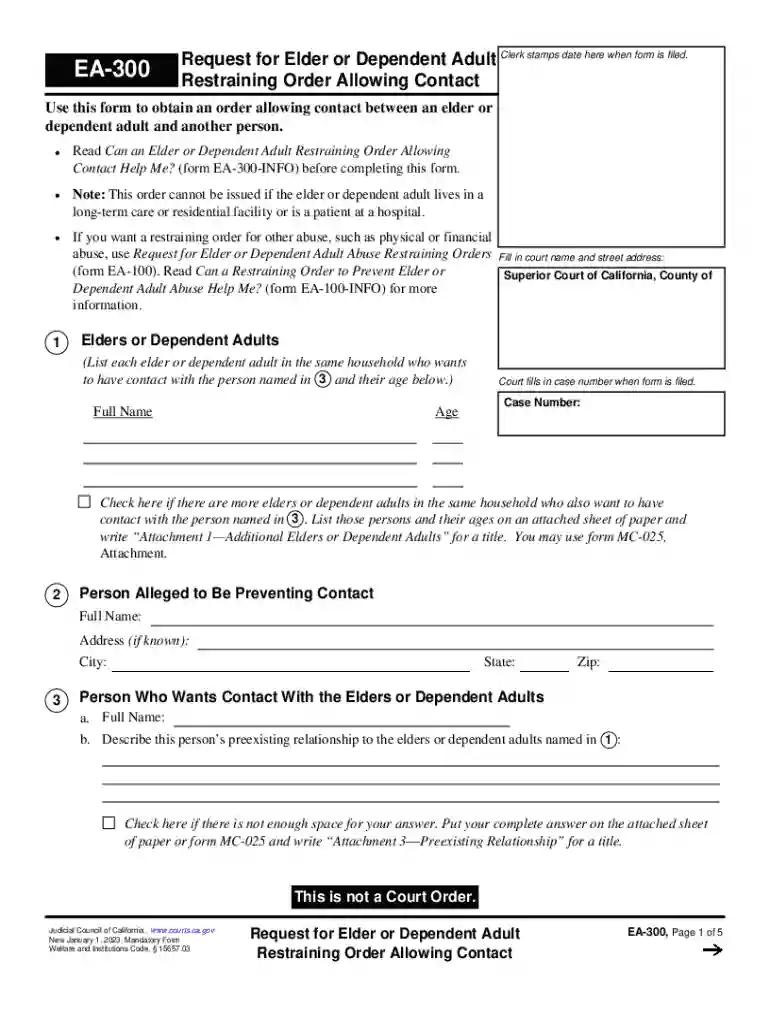
Type text, add images, blackout confidential details, add comments, highlights and more.

Draw your signature, type it, upload its image, or use your mobile device as a signature pad.

Send it via email, link, or fax. You can also download it, export it or print it out.
The EA-300 form is specifically designed for requests related to elder or dependent adult abuse restraining orders. This legal document allows family members or concerned parties to petition the court for a restraining order to protect an elder or dependent adult from physical, emotional, or financial abuse. The form collects vital applicant and respondent information, details of the alleged abuse, and the type of protection requested.
Securing the EA-300 form involves accessing it through official channels. The form can be obtained from the local courthouse, legal aid offices, or state judicial council websites. For accessibility and efficiency, many jurisdictions provide downloadable PDFs of the form online.
Filling out the EA-300 requires precision and care to ensure all necessary sections are completed correctly. The form comprises several parts that must be filled out with factual and accurate information pertaining to the elder or dependent adult, the abuse incident, and the respondent.
The EA-300 form is a legally binding document that facilitates the judicial process to ensure protection for vulnerable adults. The law mandates that these forms are used exclusively for cases involving elder or dependent adult abuse to streamline and address the protection requisites effectively.
Understanding the critical components within the form can enhance accuracy in completion and efficiency in processing. Each section of the form serves a specific function in establishing a clear case for the restraining order.
Regulations can differ from state to state when dealing with elder abuse restraining orders. Familiarizing yourself with state-specific rules ensures the form's correct application and adherence to mandated protocols.
This form is predominantly used by family members, caretakers, or close acquaintances of the elder who suspect or witness abusive behavior. It serves as a tool for advocates or relatives standing up to protect vulnerable adults from harm.


Understanding real-world applications of the EA-300 form can offer insight into scenarios where it becomes an indispensable tool for protection against abuse.
Each section of the EA-300 form serves a strategic purpose aimed at ensuring the safety and well-being of elders or dependent adults facing abusive conditions. By understanding its structure and requirements, petitioners can maximize the efficacy and legal protection it offers.
We've got more versions of the EA-300 Request for Elder or Dependent Adult Abuse Restraining Orders Judicial Council forms form. Select the right EA-300 Request for Elder or Dependent Adult Abuse Restraining Orders Judicial Council forms version from the list and start editing it straight away!
| Versions | Form popularity | Fillable & printable |
|---|---|---|
| 2023 | 4.6 Satisfied (49 Votes) |
At DocHub, your data security is our priority. We follow HIPAA, SOC2, GDPR, and other standards, so you can work on your documents with confidence.




California Judicial forms EA-100: Request for Elder or Dependent Adult Abuse. Restraining Order and DV-100: Request for Domestic Violence Restraining Order,.Read more
Request for Elder or Dependent Adult Restraining Order Allowing Contact (EA-300) How-to instructions for Elder Abuse Elder Abuse Form Packets.Read more


