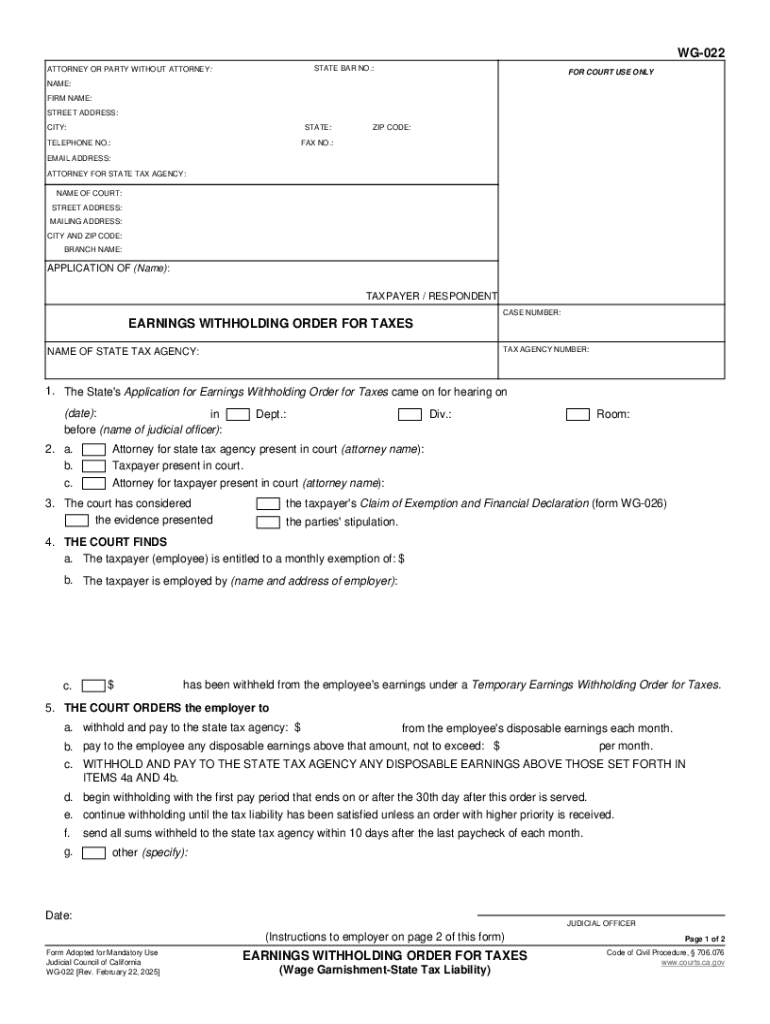







Definition and Purpose
The WG-022 Earnings Withholding Order for Taxes, often used in California, serves as an official court directive. This form is primarily used when an employer is ordered to withhold a specified portion of an employee's earnings to address outstanding state tax liabilities. This wage garnishment aims to collect unpaid state taxes directly from the employee's earnings.
Legal Implications
- The form outlines the legal obligation of employers to comply with court orders.
- It specifies the amount to be deducted and remitted to the state tax agency.
- Non-compliant employers may face legal penalties or fines.
How to Use the WG-022 Form
Employers must follow a structured process to implement the WG-022 form effectively. This ensures that the wage garnishment is executed in accordance with legal requirements.
Steps for Employers
- Receive the Order: Employers receive the WG-022 form from the court or state tax agency.
- Review the Details: Verify the taxpayer information and the amount to be withheld.
- Calculate Deductions: Determine the withholding percentage based on the employee's earnings.
- Remit Payments: Send the withheld amounts to the designated state tax agency as instructed in the form.
- Maintain Records: Keep detailed records of all transactions related to the wage garnishment.
Obtaining the WG-022 Form
The WG-022 form is usually issued by the court or state tax agency when there is a need to enforce wage garnishment for tax liabilities.
Process to Access the Form
- Typically distributed by the court following a tax collection case.
- Can be requested from state tax agencies if needed for specific legal proceedings.
Completing the WG-022 Form
Filling out the WG-022 accurately is crucial to comply with legal standards and avoid penalties.
Key Steps for Completion
- Fill In Court Details: Enter the correct court name and case number as specified.
- Provide Taxpayer Information: Include the name, Social Security number, and address of the taxpayer.
- Specify Employer Information: Complete details about the employer mandated to withhold earnings.
- Detail Withholding Amount: Clearly state the garnishment amount or percentage.
Common Mistakes to Avoid
- Incorrect personal or court information may result in processing delays.
- Failing to understand exemption guidelines that could affect the garnishment amount.
Important Terms and Concepts
Understanding specific terms related to the WG-022 can prevent misinterpretation and ensure accurate filing.
Key Terms
- Wage Garnishment: A legal process where earnings are withheld to settle debts.
- State Tax Liability: The amount owed in state taxes by the taxpayer.
- Earnings Withholding Order: An official command to deduct from earnings.
Legal Use of the WG-022 Form
This form is a legal instrument that upholds the authority of the state to collect unpaid taxes.
Conditions for Use
- Generally initiated by a court order or state tax authority action.
- Utilized when traditional methods of tax collection fail.
Compliance and Penalties
- Employers must follow the withholding instructions or face enforcement actions.
- Non-compliance or improper handling can lead to legal action against employers.
State-Specific Rules
The rules for implementing the WG-022 can vary by state, with California-specific guidelines often specified in the form.
Understanding Variations
- California residents need to follow particular state guidelines regarding exemptions and withholding procedures.
- Each state may have additional requirements or exemptions impacting workers.
Penalties for Non-Compliance
Failing to comply with the provisions outlined in the WG-022 can result in serious consequences for employers and employees.
Possible Repercussions
- Employers may face fines or legal action for not following the withholding order.
- Employees being garnished could see penalties if they attempt to evade garnishment or provide incorrect information.
Examples of Using the WG-022 Form
Practical applications and real-world scenarios provide insight into how the WG-022 form operates in various situations.
Case Scenarios
- Employer Perspective: A payroll manager receives the WG-022, adjusts the payroll system, and ensures funds are directed to the state accordingly.
- Employee Perspective: An individual sees a portion of their wages withheld each pay cycle, assisting in settling outstanding state taxes efficiently.
By understanding these aspects, users of the WG-022 form can navigate its complexities, ensuring compliance and accurate processing.