






Definition & Meaning
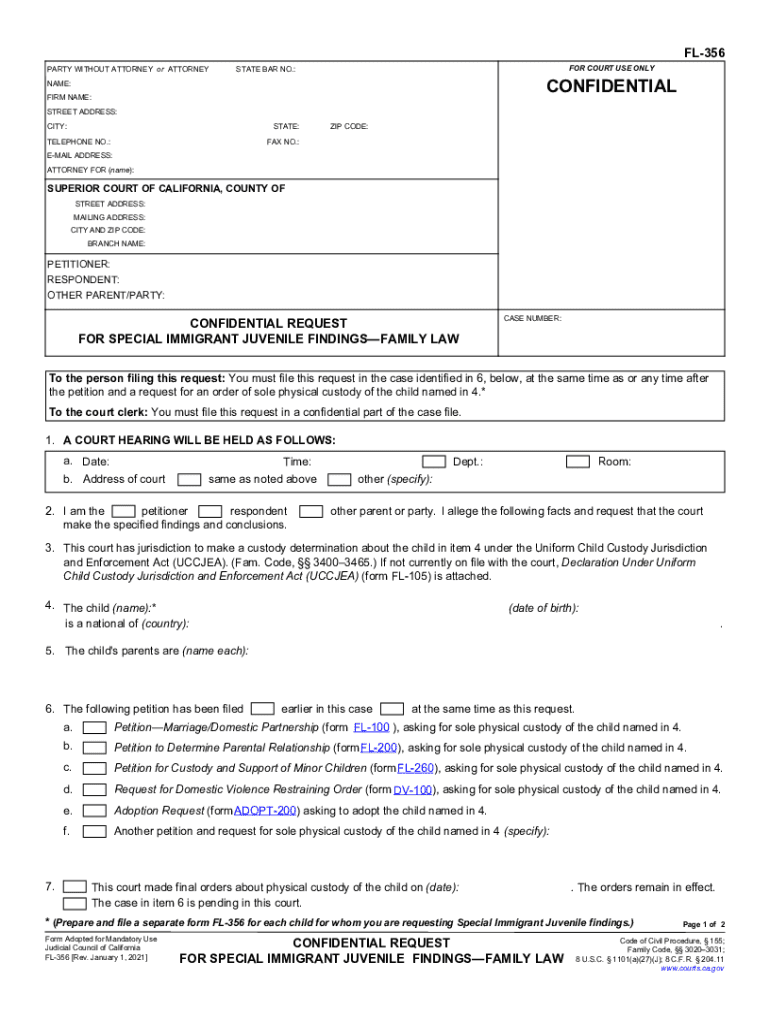
The FL-356 form, officially titled "Confidential Request for Special Immigrant Juvenile Findings - Family Law Judicial Council of California," is a legal document used in California family law proceedings. Its primary purpose is to request findings for Special Immigrant Juvenile (SIJ) status, which can influence custody arrangements and other legal aspects concerning a minor's welfare. The form is critical for petitioners seeking legal determinations that support immigration applications for minors who are unable to reunite with one or both parents due to abuse, neglect, abandonment, or a similar basis.
Special Immigrant Juvenile Status provides a pathway for eligible minors to obtain legal residency in the U.S. This form ensures that the necessary judicial findings are recorded, allowing the United States Citizenship and Immigration Services (USCIS) to process and consider the SIJ application in a federal context.
How to Use the FL-356 Form
The FL-356 form is used in family court proceedings and involves several steps to ensure its correct application:
- Identify the Jurisdiction: Ensure that the case is filed in a California family court with jurisdiction over the child's current location or address.
- Understand the Child's Eligibility: The child in question must be under 21, unmarried, and present in the United States.
- Prepare Supporting Documentation: Collect information regarding the child's history related to abuse, neglect, abandonment, or similar issues that prevent reunification.
Completing the form requires a comprehensive understanding of the child's circumstances and the requirements stipulated by U.S. immigration law. Legal professionals specializing in immigration or family law are often involved in this process to ensure that all details are accurately captured.
Steps to Complete the FL-356 Form
Filling out the FL-356 form requires meticulous attention to detail. Here’s a step-by-step guide:
- Personal Information: Start by entering the petitioner’s and child's personal details, including names, dates of birth, and contact information.
- Provide Case Details: Clearly outline the family law case information, including the case number and any related proceedings.
- State the Grounds for SIJ Findings: Articulate the reasons that reunification with one or both parents is not viable, supported by evidence or documentation.
- Document Requested Findings: Specify which findings you are requesting from the court—such as sole custody or non-reunification—to facilitate the SIJ application.
- Signature and Certification: The form must be signed and dated by the petitioner, and often by their legal representative.
Each step demands precision and adherence to court procedures to avoid delays in processing the form or the SIJ application.
Key Elements of the FL-356 Form
The form contains essential sections that must be carefully addressed:
- Identifying Information: Both petitioner and juvenile details are crucial for legal identification.
- Case Jurisdiction and Venue: This section ensures the court has authority over the case.
- Factual Allegations: This involves the presentation of evidence justifying the findings.
- Order Sought: Specific requests for findings and conclusions from the court.
Understanding these components aids in the accurate completion and submission of the form, ensuring it aligns with legal requirements.
Legal Use of the FL-356 Form
The FL-356 form is utilized in legal scenarios where a minor's best interest necessitates a petition for Special Immigrant Juvenile Status. Courts review these requests within the context of family law, determining whether the minor's circumstances meet the criteria for SIJ findings. This involves weighing evidence related to issues such as abuse or neglect.
The form’s outcome directly influences the immigration process, granting eligible minors the opportunity to regularize their immigration status in alignment with U.S. immigration laws.
Eligibility Criteria
The primary criteria for utilizing the FL-356 form include:
- The minor must be under 21 years of age.
- The minor is unmarried and present in the United States.
- There is a finding of parental abuse, neglect, or abandonment.
- The court finds it is not in the minor's best interest to return to their country of origin.
These criteria ensure that only eligible minors benefit from the provisions afforded by Special Immigrant Juvenile Status.


Who Typically Uses the FL-356 Form
Legal professionals, specifically immigration attorneys and family law practitioners, commonly use this form when representing minors who seek SIJ status. It is also used by guardians and caretakers seeking legal determinations that support the juvenile’s immigration case.

State-Specific Rules for California
California family courts have jurisdiction over SIJ findings, and the FL-356 form is used specifically within this framework. Courts require detailed petitions and evidence that justify the requested findings, ensuring that all procedural and substantive requirements under both state and federal law are met.
Knowledge of California family law specifics, such as the Uniform Child Custody Jurisdiction and Enforcement Act (UCCJEA), is essential for properly navigating these cases.
Examples of Using the FL-356 Form
The form has been applied in various cases, such as:
- A minor fleeing domestic abuse who seeks protection and the chance to remain safely in the U.S.
- An undocumented juvenile facing parental neglect and requiring legal intervention for stability and security.
Real-world cases highlight the impact utilizing the FL-356 has on minors’ futures, underscoring its significance in family and immigration law.