






Definition & Meaning
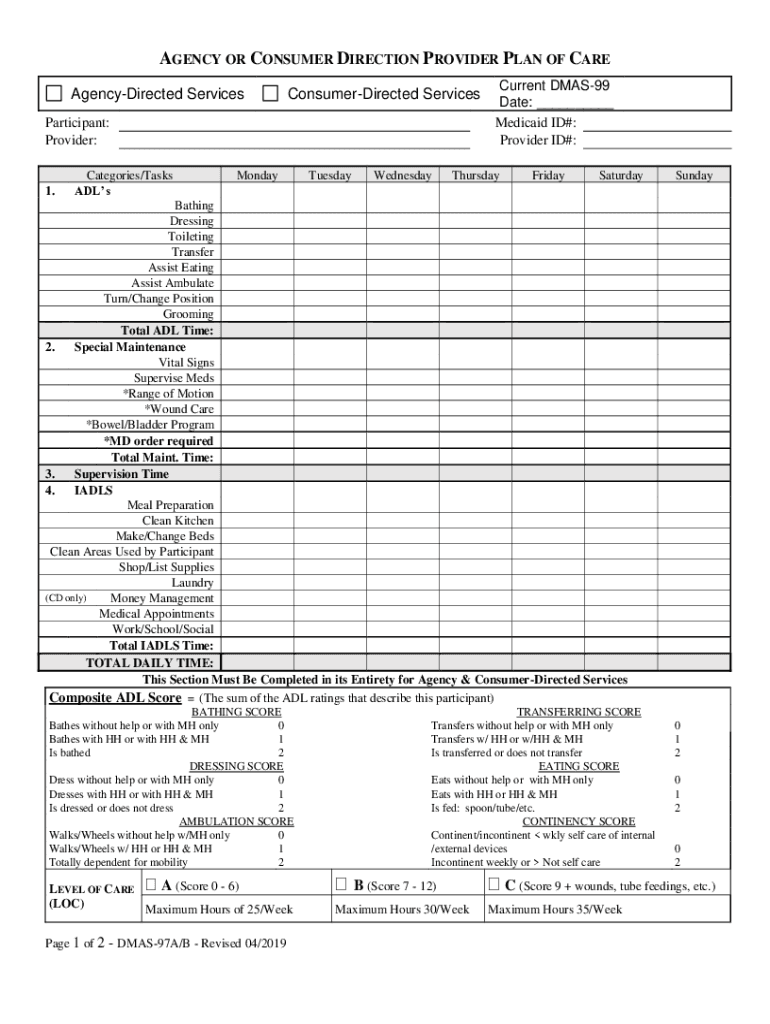
The VA DMAS-97A B 2 form serves as a Plan of Care and assessment tool utilized by the Virginia Department of Medical Assistance Services. Its primary purpose is to outline the assistance required by participants in adult and consumer-directed services, focusing on detailed care planning based on specific medical and daily living needs. It includes criteria for scoring the level of care required, helping in the allocation of services like Activities of Daily Living (ADLs) and Instrumental Activities of Daily Living (IADLs).
How to Use the VA DMAS-97A B 2
The form is employed by healthcare providers and service coordinators to document and plan the care needs of Medicaid participants in Virginia. It involves:
- Identifying the specific needs and level of support required by the participant.
- Recording assistance categories across ADLs and IADLs.
- Establishing maximum allowable service hours based on the assessment scores.
This systematic approach ensures that participants receive the appropriate level of care tailored to their unique circumstances and qualifications.
Steps to Complete the VA DMAS-97A B 2
Filling out the VA DMAS-97A B form involves several key stages to ensure accuracy and compliance:
- Initial Assessment: Begin by conducting a thorough assessment to understand the participant's daily care needs.
- Information Collection: Compile all necessary personal and medical information about the participant.
- Input Assistance Details: Record specific needs in ADLs and IADLs, ensuring every requirement is captured.
- Scoring and Evaluation: Use the form's criteria to score the participant's needs and determine service hours.
- Approval Signatures: Obtain signatures from both the participant and healthcare provider to validate the plan.
Considerations such as ensuring all required fields are filled and accuracy of provided information are crucial to avoid delays or issues in service implementation.
Who Typically Uses the VA DMAS-97A B 2
This form is primarily used by:
- Healthcare Providers: To assess and plan participant care.
- Service Coordinators: To ensure alignment with Medicaid service requirements.
- Medicaid Participants: To receive a documented plan that guides their care provision.
Such users engage with the form to facilitate proper support and align with regulatory requirements in the state of Virginia.


Key Elements of the VA DMAS-97A B 2
Key components of the form include:
- Participant Information: Detailed fields capturing the participant's personal and medical data.
- Assessment Categories: Defined sections to log assistance needs across various activities.
- Scoring System: A structured method for calculating the level of aid required.
- Service Hours Allocation: Determination of care hours based on evaluation outcomes.
Each element is crucial in developing a comprehensive care plan aligned with individual participant needs.
Legal Use of the VA DMAS-97A B 2
The form fulfills a critical legal and regulatory role by:
- Establishing Compliance: Ensuring participant care plans adhere to Medicaid rules.
- Formalizing Agreements: Providing a legally binding document that outlines agreed-upon care measures.
- Documenting Care Decisions: Offering a record of care decisions, changes, and beneficiary consent.
Compliance with these legal facets is essential for both care providers and participants to ensure state and federal Medicaid requirements are met.
Important Terms Related to VA DMAS-97A B 2
Understanding specific terminology is vital:
- ADLs (Activities of Daily Living): Basic daily tasks that participants may need help with, such as eating and dressing.
- IADLs (Instrumental Activities of Daily Living): More complex activities that aid in daily living, like managing medications or finances.
- Assessment Score: A numerical value representing the level of care needed.
Grasping these terms contributes to more effective use and interpretation of the form.
Examples of Using the VA DMAS-97A B 2
Real-world application scenarios include:
- Elderly Care: Assessing and planning for the needs of an elderly Medicaid participant needing assistance with mobility and medication management.
- Disability Services: Outlining care strategies for individuals with disabilities requiring support in daily routines.
- Chronic Illness Management: Detailing care requirements for individuals managing long-term health conditions through coordinated healthcare services.
These examples underscore the form's utility in creating tailored care approaches for diverse Medicaid populations.