






Definition and Meaning of EA-316
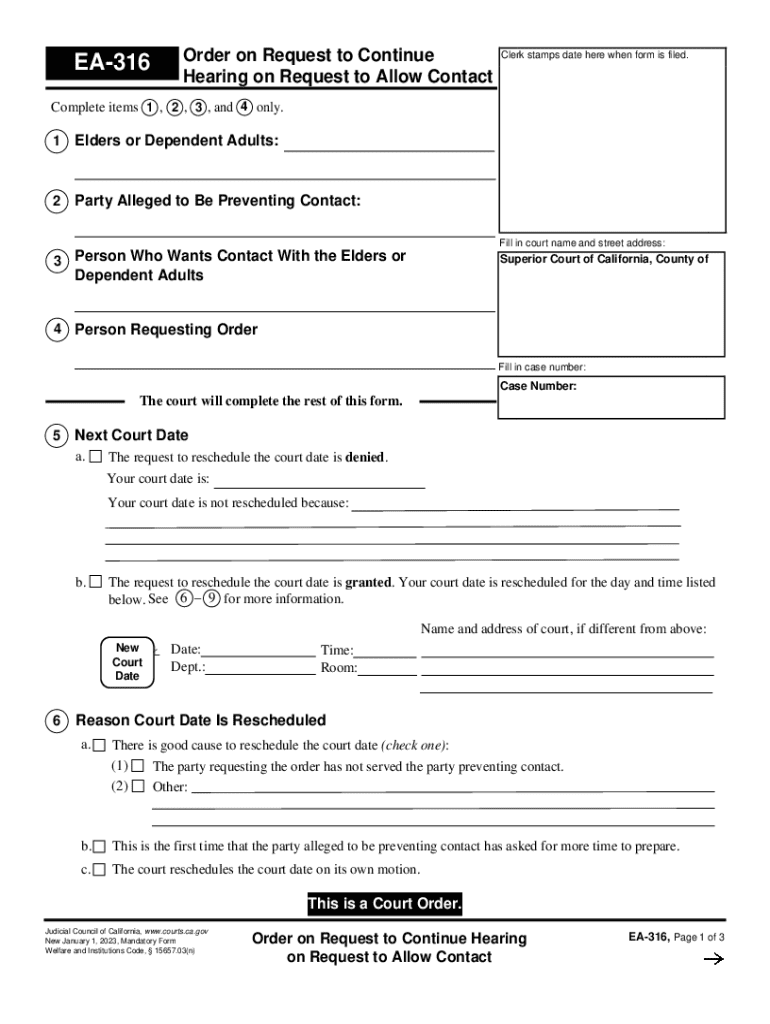
EA-316 is a legal form used in California courts to request the continuation of a hearing that pertains to allowing contact with elders or dependent adults. This form is integral to the judicial process, particularly when adjustments in court scheduling are necessary. It provides a detailed framework for participants to formally apply for rescheduling a hearing, specifying valid reasons and the necessary steps involved.
The form is part of the protective measures in place to ensure fair treatment and procedural justice for all parties involved. It encompasses detailed sections where applicants must fill in case information, reasons for the reschedule, and other relevant details required by the court.
How to Use the EA-316
Using the EA-316 involves correctly filling out each section of the form to ensure compliance with legal requirements. The main steps include:
-
Gathering Necessary Information: Collect all relevant case details, including court names, case numbers, and contact information for all parties involved.
-
Stating Reasons for Rescheduling: Clearly articulate why the hearing needs to be postponed. Common reasons include scheduling conflicts, new evidence, or needing more time to prepare a case.
-
Notifying Involved Parties: Ensure that all relevant parties are informed about the intent to request a continuance. This may involve serving notice well in advance of the proposed date changes.
-
Submitting the Form: The form can be submitted to the appropriate court either in person, by mail, or through an approved electronic method, depending on court guidelines.
-
Confirmation and Follow-Up: After submission, confirm receipt with the court and check for any required follow-up actions, such as attending a short hearing or submitting additional documentation.
Steps to Complete the EA-316
Completing EA-316 requires attention to detail to safeguard the process. Here are the steps involved:
-
Fill Out Personal and Case Information: Start by completing sections that ask for the full names of parties involved, dates, and existing case numbers.
-
Detail the Request: Explicitly describe the request to continue with the hearing, making sure to include the existing hearing date and the proposed postponement dates.
-
Provide Rationalization: State valid and acceptable reasons for needing the hearing to be postponed, supported by any documentation or evidence that may be relevant.
-
Affirmation and Signatures: Ensure that the form is signed by the applicant, and if possible, notarized to validate its authenticity and compliance with court rules.
-
Review All Entries: Before submission, thoroughly review to ensure all sections are correctly filled and nothing is omitted, which may delay proceedings.
Key Elements of the EA-316
Several critical elements must be addressed in the EA-316 form to ensure its acceptance:
-
Reason for Request: A well-outlined justification for why the reschedule is necessary, which is fundamentally important for judicial consideration.
-
Legal Indications: Any statutory or legal precedents that support the request for a new hearing date should be detailed in this section.
-
Supporting Documentation: Attach any necessary exhibits, affidavits, or letters that substantiate the reasons for the request.
-
Required Signatures: The form must be signed by concerned individuals and sometimes a representative from the legal team, if applicable.
Legal Use of the EA-316
The EA-316's primary legal objective is to provide a structured means for rescheduling court proceedings in a way that respects the judicial process and the rights of all involved. This legal tool:
-
Safeguards Due Process: By allowing for the rescheduling of hearings, it helps maintain fairness and the proper administration of justice.
-
Accommodates Unexpected Changes: Legal cases are subject to various unpredictable factors; the EA-316 allows for flexibility in accommodating these changes.
-
Ensures Compliance: The structured format of the EA-316 ensures that all parties follow a standardized legal procedure when requesting a delay, minimizing misunderstandings.
State-Specific Rules for the EA-316
Given its usage in California, the EA-316 must comply with state-specific regulations and judicial protocols. Key points to consider include:
-
Authorized Usage: EA-316 is specifically designed for hearings involving contact with elders or dependent adults within California.
-
Submission Protocols: Each court may have its nuanced submission methods, whether electronically or in-person, which must be adhered to.
-
Jurisdiction Requirements: Ensure that the court to which the form is being submitted falls under the correct jurisdiction related to the case.
Examples of Using the EA-316
For illustrative purposes, consider the following scenarios where EA-316 may be applied:
-
Medical Emergencies: A party involved in the hearing has experienced a medical emergency and requires additional time for preparation or recovery.
-
New Evidence: Critical new information has come to light that may affect the case outcome, necessitating a postponement to review and prepare.
-
Legal Representation Changes: If there is a change in legal counsel, additional time may be necessary for the new attorney to become familiar with the case.
These examples underscore the form's flexibility in accommodating real-world challenges while maintaining due process.
Important Terms Related to EA-316
Understanding key terminology associated with the EA-316 can aid in effectively navigating its completion and submission:
-
Continuance: The formal legal term for postponing a scheduled court hearing.
-
Notice of Hearing: The formal notification provided to parties regarding scheduled dates and any changes to the court's schedule.
-
Parties Involved: Refers to all individuals, entities, or legal bodies directly affected by the court proceedings.
-
Affidavits and Exhibits: Documents that provide additional evidence or sworn statements supporting the need for rescheduling.