






Definition and Meaning of Boundary Line Adjustment, Lot Consolidation, and Exempt Subdivision
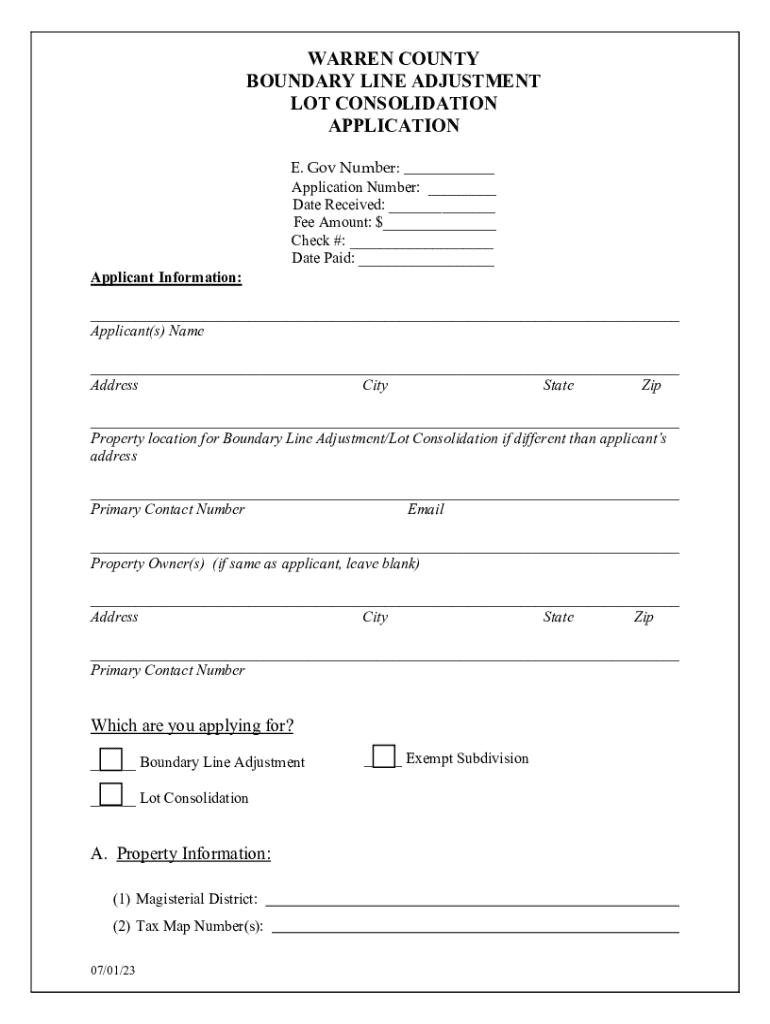
Boundary line adjustment, lot consolidation, and exempt subdivision refer to specific processes used in land development and management. These are typically invoked when a property owner wishes to make minor alterations to the layout or ownership of land parcels. A boundary line adjustment adjusts the legal property lines between adjacent lots without creating a new lot. Lot consolidation merges two or more contiguous parcels into a single parcel under one ownership. An exempt subdivision, on the other hand, involves dividing a parcel in a manner that is exempt from subdivision regulations due to specific circumstances defined by local ordinances.
Practical Examples
- Boundary Line Adjustment: A homeowner wishing to slightly modify the boundary between their property and a neighbor's to accommodate a new driveway would use a boundary line adjustment.
- Lot Consolidation: A business looking to expand its operations by consolidating several small parcels into a larger plot for building purposes would undergo lot consolidation.
- Exempt Subdivision: If a large piece of land is divided into lots where each one is larger than the minimum size required by local zoning laws, it might qualify as an exempt subdivision.
How to Use Boundary Line Adjustment, Lot Consolidation, and Exempt Subdivision
The use of these processes is often initiated to make property more functional or to align it better with legal requirements. Each process has its own steps and regulations, typically governed by local planning and zoning authorities.
Typical Use Cases
- Enhancing Property Value: Adjusting boundaries or consolidating lots can increase the usability and value of a property, making it more attractive for sale or development.
- Compliance with Legal Requirements: These processes ensure that property modifications are in accordance with local land use policies, avoiding potential legal issues.
- Infrastructure Development: Developers often use these procedures to align property features with construction plans, such as roads or utility lines.
Steps to Complete the Boundary Line Adjustment, Lot Consolidation, and Exempt Subdivision
- Consultation with Planning Staff: Meet with local planning staff to understand specific requirements and obtain relevant application forms.
- Submission of Required Documents: Prepare and submit necessary documents, which may include survey plats, application forms, and fees.
- Review Process: The submitted application is reviewed by planning officials to ensure compliance with local regulations.
- Approval and Recording: Once approved, the changes are recorded with the appropriate local government office to update public records.
Required Documents
- Completed Application Form: Must be filled out accurately and completely.
- Survey Plat: Details the existing and proposed changes to the property boundaries.
- Application Fee: A fee is typically required, scaled based on the number of lots or complexity of the request.
Legal Use of Boundary Line Adjustment, Lot Consolidation, and Exempt Subdivision
The legal framework for these processes is generally dictated by state and local laws. Compliance is critical to ensure the changes are recognized and enforceable.
Key Legal Considerations
- Zoning Compliance: Ensure that any adjustments or consolidations comply with existing zoning laws.
- Subdivision Regulations: Understand the criteria for exempt subdivisions and how these apply locally.
- Public Notice: Depending on local laws, there may be requirements for public notice or hearings before approval.
State-Specific Rules for Boundary Line Adjustment, Lot Consolidation, and Exempt Subdivision
While the processes are generally similar, specific rules can vary significantly by state and locality. It's essential to check with local authorities to understand jurisdiction-specific requirements.
Notable Differences by State
- California: Often has detailed environmental review requirements for larger consolidations.
- Texas: May have more lenient rules for exempt subdivisions in rural areas compared to urban settings.
- New York: Requires public hearings for most boundary adjustments, especially those that affect public access or utility rights-of-way.
Examples of Using Boundary Line Adjustment, Lot Consolidation, and Exempt Subdivision
To provide a clearer picture of how these processes are applied, consider the following scenario:
Example Scenario
A property developer in Warren County plans to acquire two adjacent ten-acre parcels. The aim is to consolidate them for a new residential development while also adjusting the boundary lines to accommodate road access and utility easements. The developer consults with local planning staff, submits the required plat maps showing the proposed changes, and pays the necessary fees. Once the application is reviewed and approved, it is recorded with the county clerk, allowing the developer to proceed with infrastructure development.
Why Should You Use Boundary Line Adjustment, Lot Consolidation, and Exempt Subdivision
These processes offer significant advantages for property owners and developers. They allow for greater flexibility in property development and effective management of land resources.
Benefits
- Optimized Land Use: Supports maximizing the use of property in line with owner or developer goals.
- Increased Property Value: Enhances attractiveness and potential market value of property.
- Simplified Development Pathways: Facilitates easier navigation through regulatory requirements and mitigates the risk of disputes over land use issues.
Key Elements of Boundary Line Adjustment, Lot Consolidation, and Exempt Subdivision
Understanding the essential components of each process aids in preparation and successful completion.
Core Elements
- Accurate Surveys: Critical for determining exact boundaries and ensuring compliance with local rules.
- Compliance Checklists: Use these to ensure all application elements meet jurisdictional requirements.
- Official Approvals: Must be obtained from relevant land planning and zoning authorities to make changes legally binding.