






Definition and Meaning
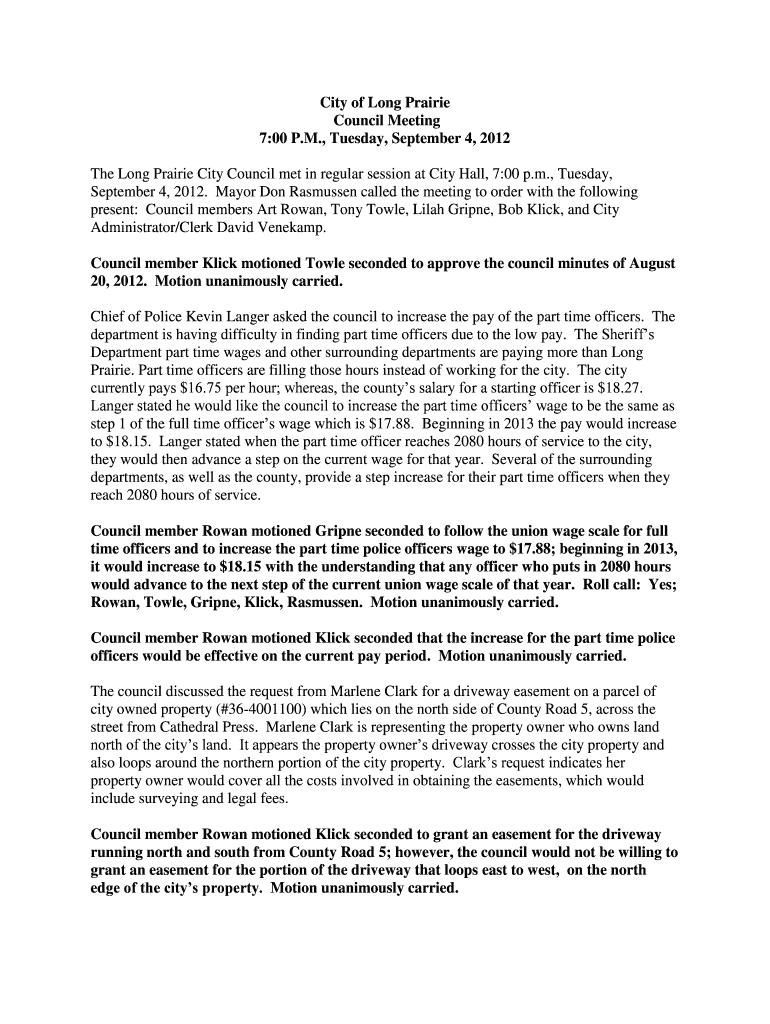
The "September 4 2012 Council minutes - Long Prairie" document provides a detailed account of the discussions and decisions made during the Long Prairie City Council meeting on that date. It captures significant topics addressed, such as wage adjustments for part-time police officers, enhancements in sidewalk accessibility, and the approval process for local projects. Keeping these records allows residents and stakeholders to understand the local government’s actions and decisions that affect community welfare.
How to Use the Document
The council minutes serve as an official record for community members, researchers, and policymakers. They provide insights into municipal management practices and civic issues such as proposed budget allocations and community improvements. Stakeholders might use the document to:
- Review past decisions and their impacts on the community.
- Prepare for upcoming meetings with background information.
- Hold the council accountable to public commitments.
How to Obtain the Document
The minutes can usually be obtained through the Long Prairie city office or its official website. Here’s how:
- Visit the City Hall: Inquire in person for physical copies.
- City’s Official Website: Search for meeting archives or council minutes under public records.
- Request via Mail or Email: Contact the city clerk's office to send a request officially, ensuring to attach an ID for verification if required.
Key Elements of the Document
The document encapsulates several important details:
- Approval of Wage Increase: Deliberation on raised wages for part-time officers to attract candidates.
- Driveway Easements: Discussions for granting construction permissions.
- Budget Proposal: Presentation of the new city budget, including planned tax levy adjustments.
- Infrastructure Projects: Plans for improving sidewalk access and wastewater treatment facilities.
- Community and Civic Process: Gambling application approval for local organizations.
Legal Use of the Document
The council minutes are public records and provide legal documentation of decisions impacting the community. Their use is to:
- Ensure transparency in government processes.
- Support localization advocacies or contest municipal decisions.
- Aid in legal cases where municipal decisions are questioned.
Who Typically Uses the Document
This document is particularly useful for:
- Residents and Local Activists: To stay informed about community decisions and air their voices during subsequent meetings.
- Journalists and Researchers: For reporting, analysis, or case studies on local government processes.
- Businesses and Developers: To understand zoning changes, budget allocations, or community projects impacting business operations.


Examples of Using the Document
Community groups might reference these minutes to:
- Petition for or against new policy initiatives.
- Advocate for or challenge expenditure on local projects.
- Engage in fundraising or awareness campaigns about municipal concerns.
For instance, if sidewalk enhancements are a recurrent issue, advocacy groups may monitor progress through these records and drive action from there.
Important Terms Related to the Document
Some key terms frequently associated with council minutes include:
- Easement: Legal right to use another’s land for a specific purpose.
- Levy: Taxes imposed to raise municipal revenue.
- Ordinance: A local law enacted by the city council.
- Resolution: Formal expressions of opinion or intention agreed on by the council.
Digital vs. Paper Version
Both digital and paper versions of the council minutes are accessible. The digital version is found on the city's website and provides a convenient, searchable format, while hard copies are acquired by visiting city offices. Electronic formats ensure wider access and preservation.
Form Submission Methods
Unlike forms requiring submission, the "September 4 2012 Council minutes - Long Prairie" acts as a public record and thus remains accessible rather than submitted. However, public engagement comments derived from these minutes can be submitted online or in person for upcoming meetings.
Versions or Alternatives to the Document
Council minutes from different dates or cities could offer comparative insights into municipal governance. Variations might include special sessions or budget-only meetings. These variations can help track policy evolution over time.
By understanding the nuances and applications of the "September 4 2012 Council minutes - Long Prairie," stakeholders can engage more effectively in their community's governance.