






Definition and Purpose of the EFT Authorization Agreement
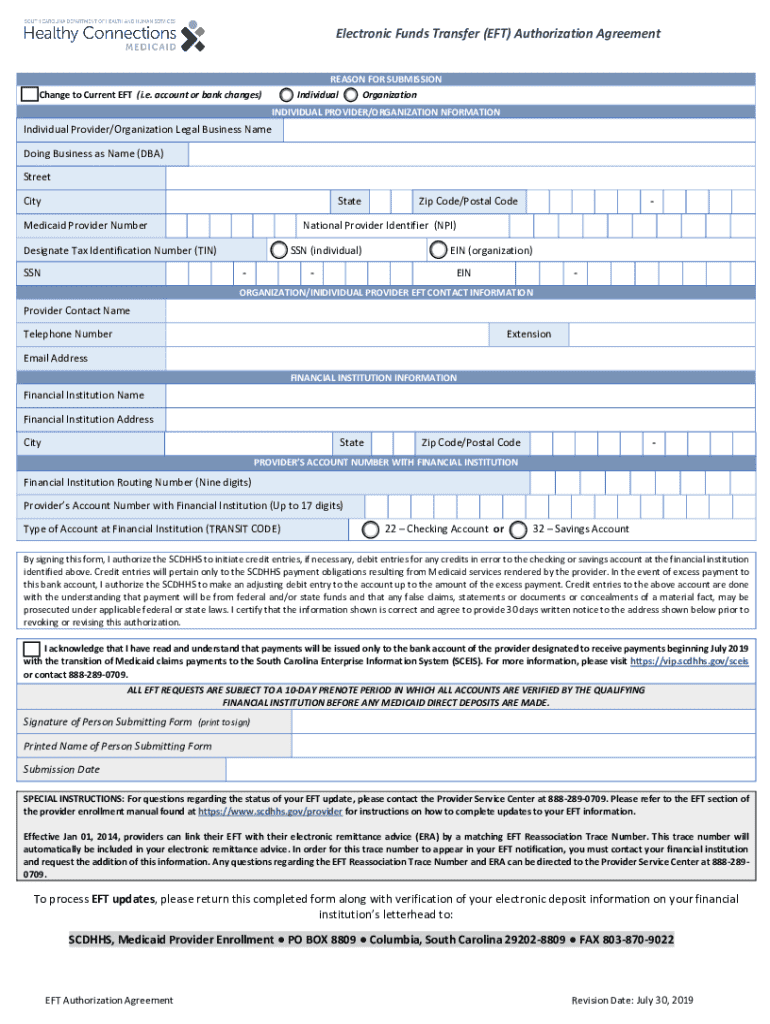
The "Appendix D - Authorization Agreement for EFT" plays a crucial role in managing electronic funds transfers. It is a document that allows individuals or organizations to consent to the transfer of funds electronically, specifically in relation to Medicaid payments. This agreement is vital for ensuring a streamlined and efficient payment process by eliminating the need for paper checks and manual entry. By utilizing electronic funds transfer (EFT), payments can be direct-deposited into the recipient's financial institution account, reducing delays commonly encountered with traditional mail services. The authorization agreement typically includes key details such as the provider's identification, banking information, and authorization for pertinent agencies like the South Carolina Department of Health and Human Services (SCDHHS) to carry out credit and debit transactions. This establishes a framework for secure and timely payments while enhancing bookkeeping accuracy for both payers and recipients.
How to Use the EFT Authorization Form
To effectively utilize the Appendix D - Authorization Agreement for EFT, it is essential to comprehend its layout and content requirements. Users must accurately complete several sections to ensure the agreement's efficacy:
- Provider Identification: Clear and precise identification details of the individual or entity receiving the funds must be furnished.
- Banking Details: The form requires exact information about the recipient's financial institution, including the account number and routing number.
- Consent for Transactions: An explicit agreement authorizing relevant entities, like SCDHHS, to initiate the EFT transactions.
- Prenote Verification: Before final activation, a trial period is often engaged, allowing for the verification of bank account details, ensuring no errors during the actual transactions.
Accurate completion and submission of this form facilitate a smooth transition to electronic payments, offering a more secure and efficient method than previously used paper-based processes.
Steps to Complete the Authorization Agreement
Completing the Appendix D requires careful attention to detail. Follow these comprehensive steps for accurate submission:
-
Gather Necessary Information:
- Ensure you have your provider details at hand, including any relevant registration or identification numbers.
- Obtain accurate financial institution details, including the account and routing numbers.
-
Fill Out the Form:
- Enter provider identification information meticulously.
- Provide complete bank details in the specified fields.
-
Authorization Signature:
- Sign the agreement to confirm your authorization for electronic transactions.
-
Submit the Prenote:
- Enable a prenote transaction as part of the setup process to verify the accuracy of the provided financial data.
-
Submit the Completed Form:
- Send the fully completed form to the designated department, ensuring you meet any specific submission requirements, whether it's through mail or electronic delivery.
Failure to thoroughly complete any of these steps might result in delays or errors in transaction processing, so attention to detail is critical.
Key Elements of the Authorization Agreement for EFT
The form includes essential components that ensure proper authorization and effectiveness of the electronic funds transfers:
- Provider Identification Section: Contains detailed personal or organizational information required to identify the individual or entity engaging in EFT transactions.
- Financial Institution Information: Key details such as the name of the bank, account number, and routing number.
- Authorization Consent: A clear section where users express consent for credit and debit transactions related to Medicaid services.
- Prenote Verification: A mandatory process where account information undergoes a trial verification to prevent potential errors during real transactions.
Each component must be carefully reviewed and completed to facilitate an error-free setup of electronic payments.
Example Use Cases of the EFT Agreement
The "Appendix D - Authorization Agreement for EFT" finds its application in various scenarios:
- Medical Providers: Physicians, clinics, and hospitals that regularly receive Medicaid payments can benefit from the expediency and security of EFTs.
- Non-Profit Organizations: Those managing Medicaid-funded programs or services can optimize their financial operations by employing EFT for secure and timely fund transfers.
- Administrative Efficiency: Organizations handling bulk transactions can greatly reduce manual processing upon adopting EFT, thereby lightening the clerical workload and minimizing errors.
These examples reflect the form’s capability to streamline financial operations across sectors heavily reliant on prompt and secure payments.
Eligibility and Requirements for EFT Authorization
Eligibility for completing the EFT Authorization Agreement generally requires:
- Medicaid Providers: Individuals or entities that are duly registered as Medicaid providers.
- Valid Banking Information: Accurate banking details to ensure funds are directed to the correct account.
- Authorization Verification: Signatory consent confirming the acceptance of all terms associated with electronic funds transactions.
Completing these eligibility criteria ensures legitimate and seamless access to EFT services.
Important Terms and Definitions
Understanding the various terms within the EFT Authorization Agreement helps demystify the process:
- Electronic Funds Transfer (EFT): A system for transferring funds electronically without the use of paper checks.
- Prenote Verification: A test transaction carried out to validate banking details before the actual transfer of funds.
- Routing Number: A nine-digit code used to identify a bank during transactions.
- Account Number: A unique number associated with an individual's bank account to guide fund transfers correctly.
Familiarity with these terms ensures users can navigate the form and communicate effectively when engaging in EFT processes.
Legal Considerations and Compliance
Using the EFT Authorization Agreement involves adhering to certain legal protocols:
- Data Security: Ensuring all personal and financial data is securely handled, complying with applicable privacy laws and regulations.
- Consent and Authorization: The irrevocable consent provided acts as a legal right for the concerned fiscal body to perform payments.
- Record-Keeping: Maintaining a copy of the signed form and acknowledging all transactions can be crucial for audits and future disputes.
Understanding and following these legal considerations are important to ensure compliance and to safeguard personal and institutional interests.