
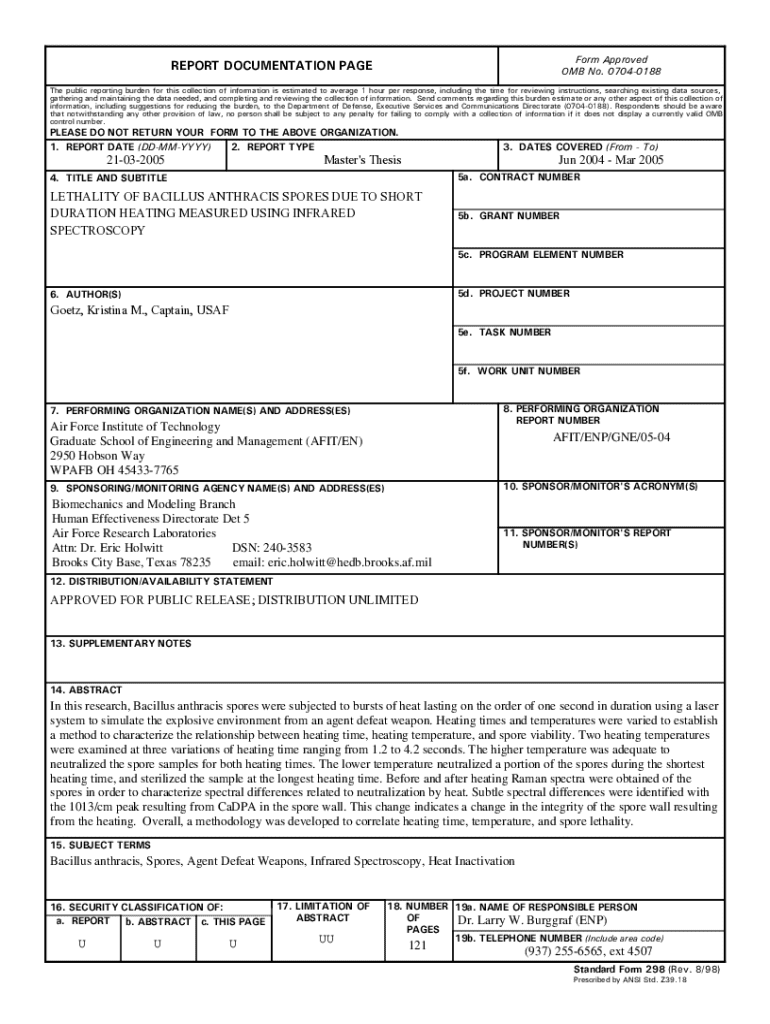







Definition and Meaning of Lethality of Bacillus anthracis Spores Due to Short Duration
Understanding the lethality of Bacillus anthracis spores due to short-duration heating involves scientific exploration into how spore viability is impacted by brief exposures to high temperatures. This study, primarily using infrared spectroscopy, delves into the mechanisms by which heating time and temperature interact to affect spore survivability. By examining Bacillus anthracis, a pathogen known for its resilience, the research aims to define optimal conditions for neutralizing spores, contributing to biosecurity and sterilization processes. The findings can significantly influence health and safety regulations concerning biohazard containment and mitigation strategies.
How to Use Findings on Lethality of Bacillus anthracis Spores
Utilizing research on the lethality of Bacillus anthracis spores can guide the development of protocols in various domains:
-
Public Health and Safety: Understanding thermal inactivation parameters helps in designing sterilization procedures for environments susceptible to contamination.
-
Biosecurity Measures: Organizations can enhance containment strategies to prevent the spread of anthrax in the face of potential bioterrorist threats.
-
Scientific Research: Future studies can build upon this research to further explore spore viability under different environmental conditions, improving existing methodologies.
-
Industrial Application: Industries involved in food processing or pharmaceuticals might adapt these findings to ensure product safety.
Steps to Analyze Lethality of Bacillus anthracis Spores
-
Experiment Design: Use controlled environments to simulate different heating durations and intensities.
-
Temperature Observation: Monitor variations at critical points, specifically between 1.2 and 4.2 seconds, to observe sterilization effects.
-
Spectral Analysis: Apply Raman spectroscopy to assess changes in the spore wall, focusing on specific peaks such as 1013 cm-1 related to CaDPA.
-
Data Correlation: Establish correlations between spore viability and the time/temperature profiles documented.
-
Report Findings: Compile comprehensive reports detailing the methodology and conclusions, providing valuable data for related fields.
Who Typically Uses the Lethality of Bacillus anthracis Spores Data
Professionals and researchers in the following fields frequently engage with this data:
- Microbiologists: To study pathogen resistance mechanisms.
- Public Health Officials: For planning disease outbreak responses.
- Biosecurity Experts: Enhancing strategies against biological threats.
- Environmental Scientists: Understanding ecological impacts of spore propagation.
- Industrial Hygienists: Designing safer workplace environments.


Important Terms Related to Bacillus anthracis Spore Research
- CaDPA (Calcium Dipicolinate): Critical component in spores that indicates viability.
- Infrared Spectroscopy: Method used to examine spore responses to heat.
- Raman Spectroscopy: Advanced technique for analyzing spore wall integrity.
- Thermal Inactivation: Process of using heat to neutralize spores.
- Spore Viability: Measure of a spore's ability to germinate and grow after treatment.
Legal Use of Bacillus anthracis Spore Research
The legal dimensions surrounding research into spore viability are carefully regulated:
- Compliance with Biohazard Regulations: All research must adhere to guidelines set by health and safety authorities to prevent unintended release or misuse.
- Patentable Technologies: Innovations stemming from this research may be patentable, underlining the importance of intellectual property management.
- Ethical Considerations: Researchers must align with ethical guidelines to ensure fair and responsible study designs.
Key Elements of the Bacillus anthracis Spore Lethality Study
- Time/Temperature Profiles: Critical variables assessing spore inactivation efficiency.
- Spectroscopic Techniques: Both infrared and Raman spectroscopy play a significant role in data collection.
- Controlled Environments: Ensures precise observation of sterilization effects.
- Data Analysis: Utilizing statistical methods to validate correlations between heating duration and lethality.
Examples and Case Studies in Bacillus anthracis Spore Research
Real-world applications reinforce the importance of understanding spore lethality:
- 2001 Anthrax Attacks: Highlighted the need for improved detection and neutralization methods.
- Hospital Sterilization Protocols: Development of more efficient sterilization protocols in medical facilities.
State-Specific Rules for Handling Anthrax Spores
- Regulatory Compliance: Each state within the United States may enforce specific guidelines to manage and handle biohazards securely, reflecting local public health policies.
- Emergency Response Plans: Varying by state, plans dictate specific actions in response to an anthrax threat, influencing how research findings are utilized in practice.




