




01. Edit your form online
Type text, add images, blackout confidential details, add comments, highlights and more.

Type text, add images, blackout confidential details, add comments, highlights and more.

Draw your signature, type it, upload its image, or use your mobile device as a signature pad.

Send it via email, link, or fax. You can also download it, export it or print it out.
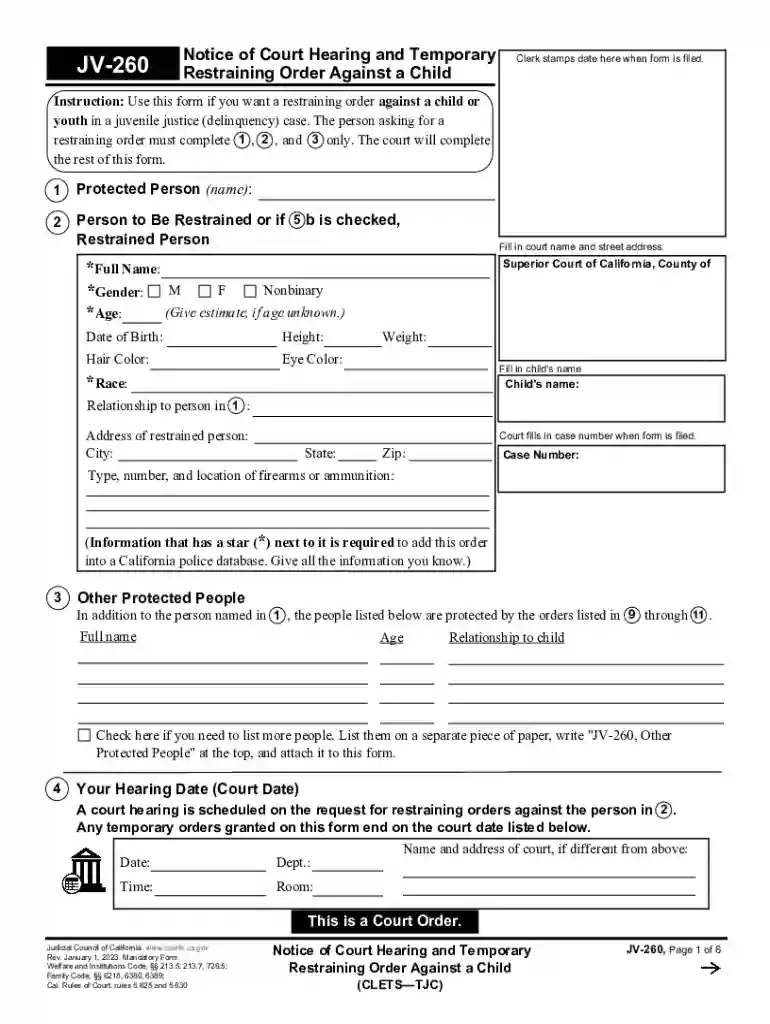
The JV-260 Notice of Court Hearing and Temporary Restraining Order Against a Child Judicial Council form is a legal document used in the juvenile justice system. This form is pivotal in requesting a court hearing and establishing a temporary restraining order (TRO) against a child or youth. It ensures that specific actions, such as contact or possession of prohibited items, are restricted pending a court decision. The primary purpose of this form is to provide legal protection in situations where a minor's behavior poses a threat to others or themselves.
This form is an official court document recognized by the judiciary to enforce temporary restraining orders. It is used to legally mandate restrictions and ensure compliance under the supervision of law enforcement. The use of the JV-260 form helps maintain public safety and provide necessary protections while upholding the rights of involved parties until a full court hearing is conducted.
The JV-260 form can be obtained directly from court offices or judicial websites where such forms are typically available for download. It is essential for applicants to ensure they are accessing the most current version of the form. Legal assistance or guidance from court-appointed officials can also be sought to ensure proper form acquisition.
While the JV-260 form is standardized, each state may have unique procedures or additional requirements for processing these forms. It is critical to consult state-specific legal guidelines or seek legal counsel to ensure compliance with local legal standards when submitting this form.
In instances where a child's conduct at school poses a risk to peers, a JV-260 form can be filed to restrict the child from contact with affected parties temporarily.
The form is also applicable in domestic situations where a minor's behavior may be threatening to family members, prompting precautionary court-ordered restrictions until further review.
The JV-260 form is essential for securing immediate legal intervention in situations posing potential danger. It provides a structured legal avenue to address immediate safety concerns, ensuring due process is followed while protecting involved parties until a comprehensive court assessment is made.
This content is designed to offer comprehensive insights and guidance on the JV-260 form, ensuring that users understand both its structure and application within the legal framework of juvenile justice.
We've got more versions of the JV-260 Notice of Court Hearing and Temporary Restraining Order Against a Child Judicial Council form form. Select the right JV-260 Notice of Court Hearing and Temporary Restraining Order Against a Child Judicial Council form version from the list and start editing it straight away!
At DocHub, your data security is our priority. We follow HIPAA, SOC2, GDPR, and other standards, so you can work on your documents with confidence.




Temporary Restraining Order Against a Child (form JV-260), and must state on its face the date of expiration of the order. Temporary Restraining Order Against
The suggested citation for this document is as follows: ITRC (Interstate Technology Regulatory Council). 2014. Petroleum Vapor Intrusion: Fun- damentals ofRead more
Form DV-115 Request to Continue Court Hearing and Reissue Temporary Restraining Order. Actions. Title: California Family Law for Low


