






Definition and Purpose of the Motion for Temporary Custody
A motion for temporary custody is filed in the context of disputes involving the custody of minors. In the Prince William Juvenile and Domestic Relations District Court, this motion serves as a formal request for a temporary custody arrangement that is binding until a final decision is made or a permanent order is issued. This process is often used when immediate decisions about the child's living situation are crucial, as it ensures the children's stability and welfare are prioritized.
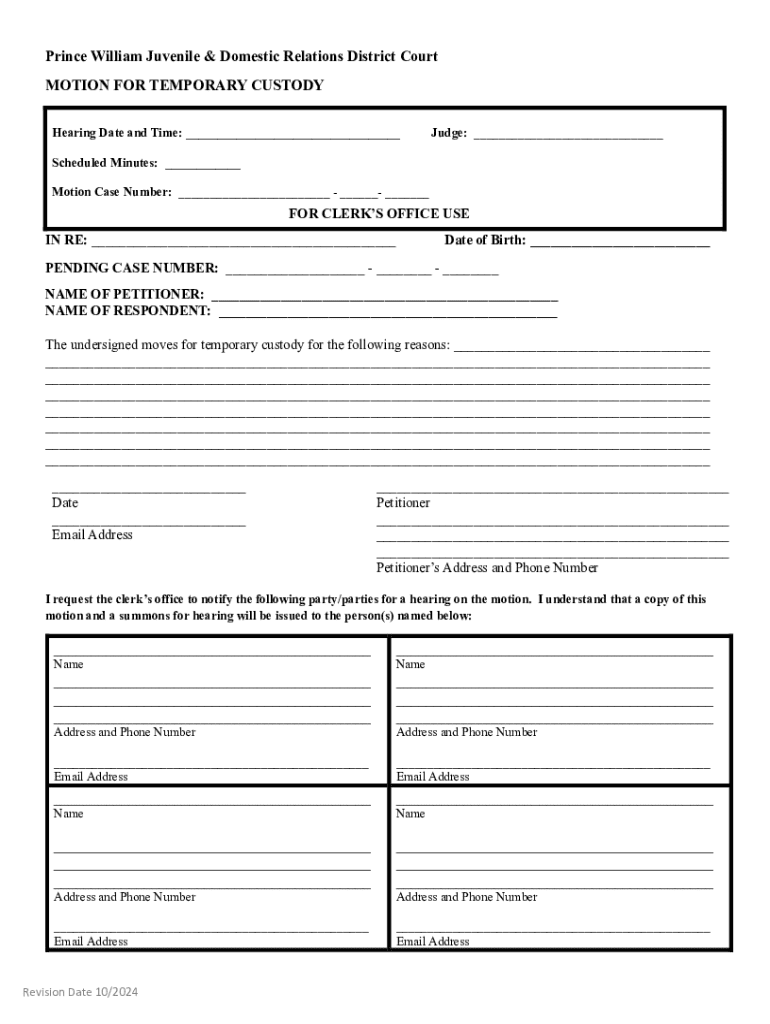
The motion includes detailed information pertinent to the case, such as the hearing date, the judge presiding over the case, and the unique case number assigned. Moreover, it delineates the parties involved—the petitioner (usually the individual initiating the action) and the respondent. Both parties present their reasons, supported by evidence, as to why the temporary custody arrangement is necessary and in the best interest of the children involved.
Practical Scenarios for Filing
- Emergency Situations: Immediate family conflict or issues of child safety might necessitate a rapid arrangement.
- Parental Instability: Instances where one parent may temporarily be unable to provide proper care due to health issues, incarceration, or substance abuse.
- Interim Measures in Divorce: Utilized during divorce proceedings where custody is yet to be finalized and interim arrangements are needed.
How to Use the Motion Form in Court
Using the motion form in the Prince William Juvenile and Domestic Relations District Court involves several steps to ensure the petitioner's request is appropriately filed and considered.
Step-by-Step Instructions
- Complete the Form: Ensure all required fields are filled out, including identifying details like names and addresses of the petitioner and respondent, as well as the reasons for requesting temporary custody.
- Attach Additional Documentation: Prepare and attach relevant support documents, such as affidavits, that address the child's living situation and needs.
- File the Form: Submit the completed motion and supporting documents to the court clerk. Note down deadlines to ensure the form is filed within the designated time frame.
- Serve the Other Party: Arrange for the respondent to be legally served with a copy of the motion, ensuring they have notice of the proceedings.
- Attend the Hearing: Prepare to present your case during the scheduled hearing, providing evidence and arguments as to why the requested temporary custody arrangement supports the child's best interests.
Obtaining the Motion Form
Accessing the motion form for temporary custody in the Prince William Juvenile and Domestic Relations District Court is a straightforward process.
Methods of Access
- Online Access: The court's official website generally provides downloadable versions of the form, enabling easy access and completion.
- In-Person Retrieval: Visit the court's clerical office to request a physical copy of the form. This may be preferable for those who require immediate assistance or have additional questions.
Key Elements of the Motion Form
In the Prince William Juvenile and Domestic Relations District Court, the motion form for temporary custody includes several critical components.
Core Sections
- Petitioner and Respondent Information: Details regarding both parties, ensuring clarity on who is involved in the custody request.
- Case Number and Judge: Each motion is assigned a unique case number that ensures all documents and proceedings are organized and trackable.
- Custody Request Details: Clearly articulate the reasons for temporary custody, supporting this with evidence and examples where applicable.
Additional Elements
- Notification Instructions: These inform all involved parties of the hearing date and the necessity of their attendance, promoting transparent legal processes.
- Legal References: Include any specific statutes or precedents that support the necessity for a temporary custodial arrangement.
Important Legal Considerations
Navigating the legal landscape involving temporary custody requires understanding key legal considerations.
Legal Use and Implications
- Best Interest of the Child: The overriding principle that guides custody decisions, focusing on the child's safety, emotional needs, and stability.
- Statutory Requirements: Compliance with state laws and guidelines specific to Virginia and applicable to the Prince William Juvenile and Domestic Relations District Court.
Steps After Filing the Motion
After filing the motion, several critical steps follow to ensure progression through the legal system.
Next Steps
- Confirmation of Filing: Obtain a receipt or official acknowledgment from the court to confirm the submission.
- Service of Process: Ensure the respondent receives the motion in accordance with legal procedures.
- Preparation for Hearing: Gather evidence, documents, and prepare witness testimony to support your case during the hearing.
- Hearing Attendance: Both parties should attend the hearing prepared to discuss the motion before the judge.
State-Specific Rules and Requirements
Understanding the specific regulations and requirements of the Prince William Juvenile and Domestic Relations District Court is essential for ensuring compliance and optimizing chances for a favorable outcome.
Virginia-Specific Guidelines
- Filing Deadlines: Ensure adherence to specific deadlines within Virginia state law to prevent dismissal or delays in processing.
- Court-Defined Criteria: Familiarity with the evaluation criteria employed by judges in Virginia when considering temporary custody requests.
Examples and Real-World Scenarios
Real-world scenarios often reveal the practical application and impact of filing a motion for temporary custody.
Illustrative Cases
- Parental Relocation: A parent needing to temporarily relocate for work and requiring a change in the custody arrangement.
- Crisis Intervention: In cases of domestic instability where immediate child safety concerns arise, prompting a request for a revised custody order.