






Definition & Meaning
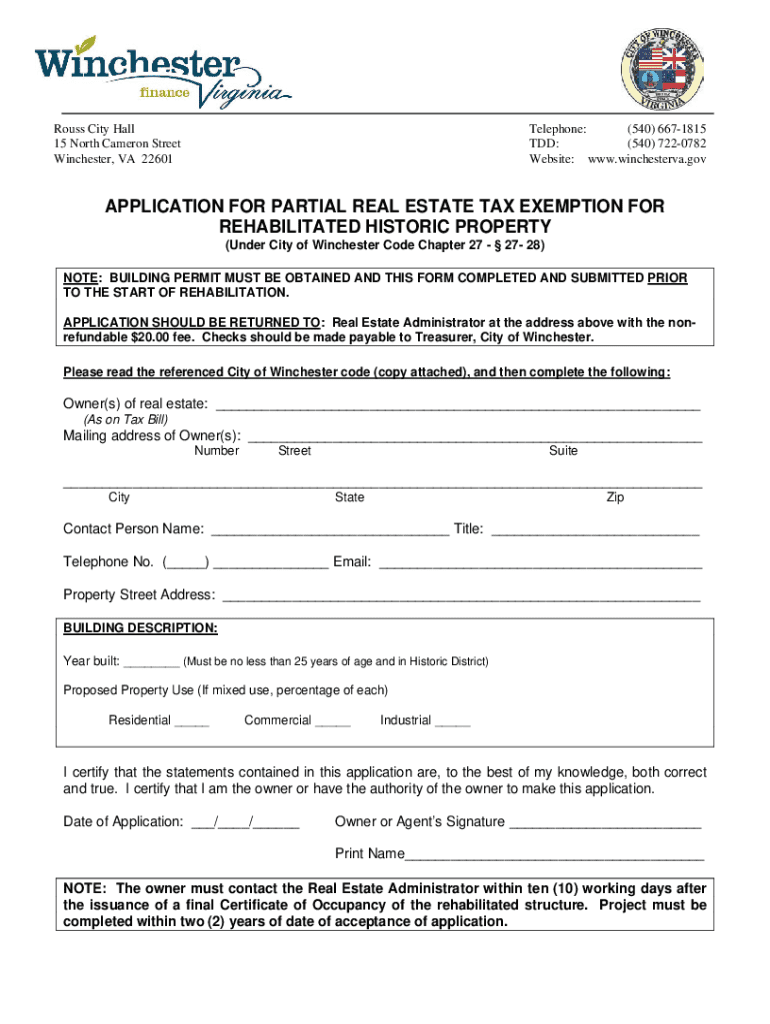
The "Application for Partial Real Estate Tax Exemption for Rehabilitated Historic Property" is a formal document used by property owners in Winchester, VA, to seek tax relief on properties that have undergone substantial rehabilitation. This form is specifically designed to aid in the preservation and improvement of historic properties by offering a partial tax exemption as an incentive. Such exemptions are particularly beneficial for enhancing and maintaining properties that have historical significance, contributing to cultural heritage while also promoting urban revival.
How to Use the Application for Partial Real Estate Tax Exemption for Rehabilitated Historic Property
Using this application involves several detailed steps to ensure compliance with local regulations and successful submission. Property owners must first assess their eligibility by consulting Winchester's guidelines for rehabilitated historic properties. The form must be filled out accurately, detailing substantial renovations or restorations that meet the defined criteria. Applicants should also compile all necessary supporting documentation before submission.
Key Considerations
- Historic Designation: Verify that the property is legally classified as historic according to the city’s records.
- Renovation Minimums: Ensure that the renovations meet or exceed the financial or structural thresholds required for the exemption.
- Completion Timeline: The renovations should have been completed within a stipulated time frame to qualify.
Eligibility Criteria
This application is specifically structured for property owners in Winchester, VA, who have completed significant renovations on historic properties. The criteria ensure that only those who meet specific requirements can apply for exemption, supporting both residential and commercial properties that have been rehabilitated.


Core Eligibility Factors
- Property Age: Properties should be at least 25 years old.
- Extent of Renovation: The renovations must be substantial and meet the minimum expenditure threshold set by the city.
- Historic Significance: Properties must hold a designation that marks them as historic.
Steps to Complete the Application
Completing the application involves a series of methodical steps that require attention to detail. Owners are advised to follow these steps to ensure proper documentation and form completion.
Step-by-Step Instructions
- Review Guidelines: Start by reviewing the City of Winchester's guidelines for historical property rehabilitation.
- Gather Documentation: Collect before-and-after photographs, renovation contracts, and receipts to support your application.
- Complete the Form: Fill out the application, ensuring all sections are completed with precise and accurate information.
- Submit Application: Once completed, submit the form along with all required documentation to the appropriate city department.
Required Documents
Substantial documentation is required to complement the application form. These documents provide evidence of renovation, property status, and financial investment.
Document Checklist
- Proof of Historical Designation: Certification or documentation designating the property as historic.
- Renovation Receipts: Detailed transaction records indicating costs associated with the renovations.
- Photographic Evidence: Images showing property conditions before and after renovations.
- Technical Reports: Any engineering or architectural assessments conducted during renovation.
Application Process & Approval Time
Once the application is submitted, it undergoes a thorough review process to ensure all criteria and guidelines are met. The approval process duration is generally determined by the city's assessor office workload and may vary.
Timeline and Approval
- Initial Review: Applications are initially reviewed for completeness and compliance with basic requirements.
- Detailed Assessment: A detailed examination of submitted documents and any required site inspections are conducted.
- Approval Notification: Successful applicants are notified of their exemption status and the term of the exemption, which typically lasts for ten years.
Legal Use of the Application
The application serves as a legal tool enabling property owners to claim tax relief under the conditions permitted by the local jurisdiction. Misuse or inaccurate reporting on the application could lead to legal consequences.
Compliance and Penalties
- Accuracy and Honesty: All information submitted must be truthful and accurate to the best of the applicant’s knowledge.
- Consequences of Misrepresentation: Providing false information may result in penalties, including fines or revocation of the tax exemption.
Important Terms Related to the Application
Understanding the terminology associated with the application helps ensure accurate completion and comprehension of the requirements and benefits.
Key Terms
- Rehabilitation: Refers to repairs or enhancements made to restore or improve property condition without compromising its historical integrity.
- Exemption Period: The duration for which the tax exemption applies, generally lasting ten years.
- Historic District: A designated area recognized for its cultural significance and comprising properties of historical value.
By adhering to these guidelines, property owners can effectively navigate the application process for a partial real estate tax exemption on rehabilitated historic properties, contributing to both personal financial benefits and the preservation of cultural heritage.