




01. Edit your form online
Type text, add images, blackout confidential details, add comments, highlights and more.

Type text, add images, blackout confidential details, add comments, highlights and more.

Draw your signature, type it, upload its image, or use your mobile device as a signature pad.

Send it via email, link, or fax. You can also download it, export it or print it out.
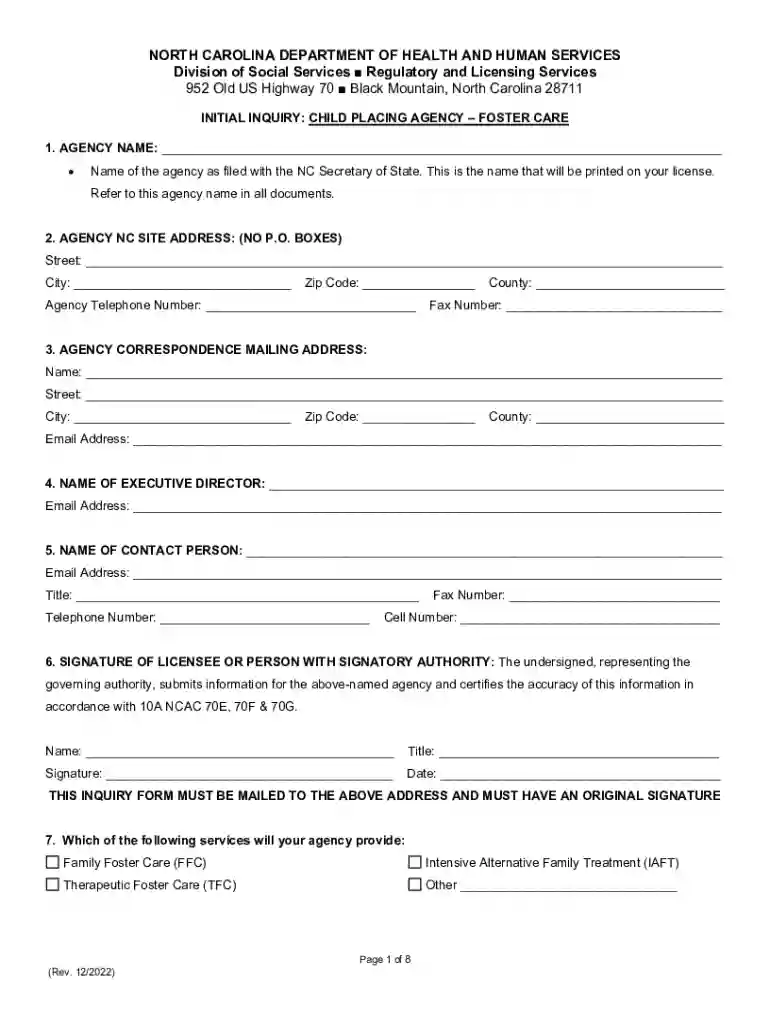
The inquiry form for a child placing agency in the context of foster care primarily functions as a comprehensive application that agencies must complete to become licensed as child placing agencies in foster care. This form serves as a critical document that collects detailed information about the agency, ensuring it meets all necessary state regulations and standards. This process is essential for agencies wanting to provide foster care services legally. The document includes sections on agency details such as ownership, management structure, and services provided, among other aspects.
Completing the inquiry form for a child placing agency involves a series of steps to ensure all necessary information is captured accurately. This section breaks down the process into manageable components to facilitate a smooth application procedure.
Understanding the key components of the inquiry form is crucial for agencies to comply fully with licensing requirements. Each element demands specific information that reflects the agency's capability and readiness to operate as a child placing entity.
Ownership and Management: Identifies the individuals or organization that owns and manages the agency, ensuring accountability and transparency.
Executive Director’s Background: Verifies the qualifications and experience of the individual who will be overseeing the agency's daily operations, ensuring they meet the necessary competencies.
Proof of Accreditation: Confirms that the agency is accredited by recognized bodies, indicating that it adheres to established standards of practice.
Background Checks and Security Clearances: Ensures that all personnel involved are cleared to work with children, promoting a safe environment for foster care.
The form is primarily used by entities seeking to become licensed child placing agencies under state foster care systems. These could include:
Non-profit Organizations: Many non-profits operate child placement services and need formal licensing to ensure eligibility for certain types of funding or to meet grant requirements.
Private Agencies: For-profit agencies that provide foster care services use the form to comply with legal and operational standards set by regulatory bodies.
State Departments: Governmental bodies might also utilize this form when working through funding partners or to ensure agencies align with state child welfare goals.


Completing and submitting the inquiry form is a legal requirement for agencies intending to operate within the child placing domain. The form supports several legal functions:
Licensure Verification: Ensures that the agency is legally recognized to operate, which helps safeguard the welfare of children placed under their care.
Regulatory Compliance: Keeps the agency aligned with state and local laws, avoiding legal repercussions and maintaining eligibility for state funding.
Regular Updates: Any changes in management or services require a prompt update to the documentation, ensuring the agency remains compliant.
Annual Renewals: Periodic renewal of the license may necessitate resubmission of the updated form, ensuring ongoing compliance with evolving standards.
State-specific rules can affect how an inquiry form is processed and what additional information may be required. Each state may have unique regulations and requirements.
North Carolina Example: Agencies in North Carolina must submit a needs assessment and budget proposal specific to state mandates. Proof of accreditation from a state-approved body may be necessary.
Variations in Requirements: While the core elements remain consistent, some states might require additional documentation such as local transport arrangements or detailed disaster recovery plans.
Understanding state-by-state differences in the inquiry form process can be crucial for agencies operating in multiple states or looking to expand their services.
Regulatory Variations: States have individual regulations that dictate the scope and nature of services an agency can provide. For instance, some states might require extra documentation for specialized services such as therapeutic foster care.
Licensing and Accreditation Bodies: Different states can have varying accreditation organizations or agencies responsible for overseeing child placing agencies.
California: Emphasizes regulations around data privacy and the use of digital data systems for secure records management.
Texas: May require additional training and certification for caregivers beyond the basic requirements.
Various methods are available for submitting the inquiry form, depending on the resources and preferences of the agency.
Mail: Agencies can choose to mail physical copies of the application, retaining organized copies for record-keeping and future reference.
In-Person: Direct submission to state offices can sometimes expedite processing but may require additional verification on site.
Understanding and navigating these options can significantly impact processing times and overall application success.
We've got more versions of the inquiry form: child placing agency-foster care form. Select the right inquiry form: child placing agency-foster care version from the list and start editing it straight away!
| Versions | Form popularity | Fillable & printable |
|---|---|---|
| 2022 | 4.9 Satisfied (37 Votes) |
At DocHub, your data security is our priority. We follow HIPAA, SOC2, GDPR, and other standards, so you can work on your documents with confidence.




The primary purpose of this manual is to clarify eWiSACWIS placement documentation requirements for child welfare staff, supervisors and managers.
Child Placing Agency for Foster Care Inquiry Form Mail the inquiry form, accreditation letter, 952 Old US Highway 70 Black Mountain, NC 28711 North Carolina


