What Is a Total Compensation Statement and Its Components 2026

Get Form
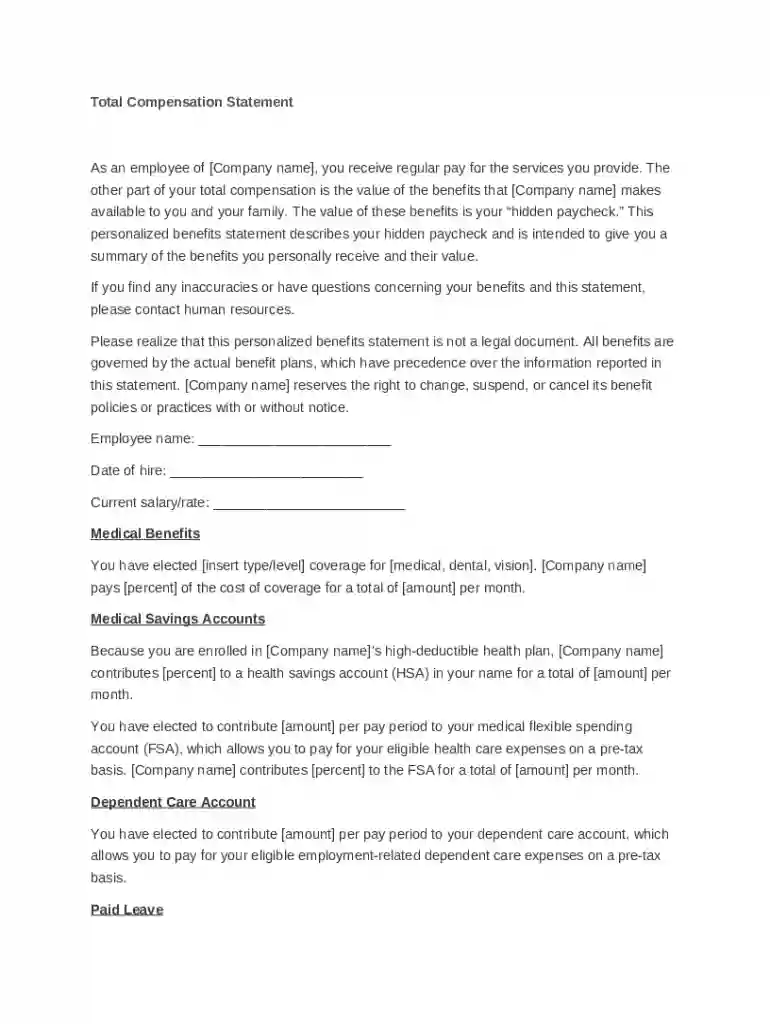
What Is a Total Compensation Statement and Its Components Preview on Page 1

Here's how it works

01. Edit your form online
Type text, add images, blackout confidential details, add comments, highlights and more.

02. Sign it in a few clicks
Draw your signature, type it, upload its image, or use your mobile device as a signature pad.

03. Share your form with others
Send it via email, link, or fax. You can also download it, export it or print it out.

Definition & Meaning

A Total Compensation Statement is a detailed document that outlines all the financial and non-financial benefits an employee receives from their employer. This includes basic salary, bonuses, health insurance, retirement contributions, and other fringe benefits. The statement provides a comprehensive view of the employee's "hidden paycheck" by highlighting the full value of their compensation package, beyond just the base salary.

Key Elements of a Total Compensation Statement

Base Salary

  • Represents the fixed annual or hourly wage.
  • Often highlighted as the primary component of compensation.

Bonuses and Incentives

  • Performance-based rewards beyond the base salary.
  • Includes annual bonuses, sales incentives, and merit awards.

Health and Insurance Benefits

  • Coverage for medical, dental, and vision insurance.
  • Includes employer-contributed premiums for life and disability insurance.

Retirement Plans

  • Contributions toward retirement savings like 401(k) or pensions.
  • May include employer matching contributions.

Paid Time Off (PTO)

  • Accrued vacation days, sick leave, and personal days.
  • Some companies combine into a single PTO category.

Other Perks and Benefits

  • Includes tuition reimbursement, commuter benefits, and wellness programs.
  • May also feature employee discounts or access to facilities.

How to Use a Total Compensation Statement

Understanding a Total Compensation Statement is crucial for employees to appreciate the full value of their employment package. Employees can use this statement to:

  • Negotiate with current or prospective employers.
  • Budget personal finances more effectively.
  • Compare total compensation with industry averages.

Steps to Complete and Review a Total Compensation Statement

  1. Verify Personal Information: Ensure all personal and employment details are accurate.
  2. Check Financial Numbers: Cross-reference salary, bonuses, and deductions to confirm accuracy.
  3. Review Benefits Summary: Confirm that all insurance and retirement benefits are current and comprehensive.
  4. Assess Additional Perks: Identify all other listings to understand their monetary value.
  5. Consult with HR: Address any discrepancies or questions with the human resources department.

Who Typically Uses a Total Compensation Statement?

Total Compensation Statements are predominantly used by:

  • Employees: To gain a holistic view of their compensation package.
  • Employers: To showcase the complete value of the compensation package during recruitment.
  • HR Departments: To ensure transparency and compliance with compensation policies.

Legal Use of a Total Compensation Statement

A Total Compensation Statement is not a legally binding document but serves as a valuable tool to:

  • Educate employees about their earnings and benefits.
  • Promote transparency in compensation practices.
  • Serve as a reference point for potential disputes or misunderstandings regarding compensation.

Important Terms Related to Total Compensation Statements

  • Gross Salary: Total earnings before deductions.
  • Net Salary: Earnings after all deductions and taxes.
  • Fringe Benefits: Additional perks provided to employees.
  • Matching Contributions: Employer contributions that match employee savings in retirement plans.

State-Specific Rules for Total Compensation Statements

Different states may have specific requirements or regulations regarding the disclosure of compensation details. However, the Total Compensation Statement remains a uniform document designed to fit diverse state contexts. Employees should be aware of any state-specific rules that might affect their compensation details.

be ready to get more

Complete this form in 5 minutes or less

Get form

Got questions?

We have answers to the most popular questions from our customers. If you can't find an answer to your question, please contact us.
Contact us
Here are the key sections that your template should include. Basic information. Employees name and job title. Direct compensation. Base salary or hourly wages. Indirect compensation. Paid time off (PTO) Retirement benefits. Perks and other benefits. Other monetary benefits. Employer-paid taxes and contributions.
Components of Total Compensation ComponentDescription Base Salary The fixed amount you receive regularly for your work Bonuses and Incentives Performance-based bonuses, profit-sharing, or sales commissions Employee Benefits Health insurance, retirement plans, paid time off, life and disability insurance2 more rows Sep 10, 2024
Total compensation refers to the entire package of pay and benefits an employee receives in exchange for their work. This goes far beyond base salary it includes bonuses, benefits, equity, and other financial perks that a company may offer.
Salary typically refers to base salarythe fixed amount paid regularly for job duties. However, total compensation includes five components: base salary, bonuses, benefits, equity, and perks, which together form a comprehensive compensation package.

Security and compliance

At DocHub, your data security is our priority. We follow HIPAA, SOC2, GDPR, and other standards, so you can work on your documents with confidence.
Learn more
ccpa2
pci-dss
gdpr-compliance
hipaa
soc-compliance