




01. Edit your form online
Type text, add images, blackout confidential details, add comments, highlights and more.

Type text, add images, blackout confidential details, add comments, highlights and more.

Draw your signature, type it, upload its image, or use your mobile device as a signature pad.

Send it via email, link, or fax. You can also download it, export it or print it out.
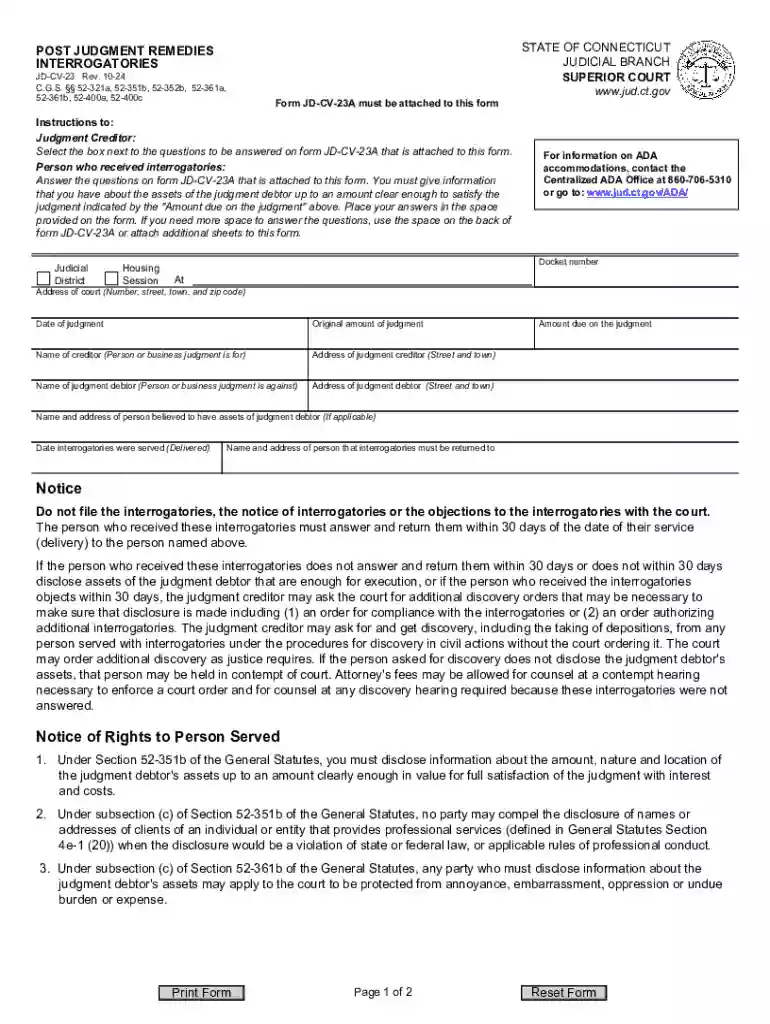
The Jd-cv-23 form is a legal document utilized in the Connecticut Superior Court system. It is designed for post-judgment interrogatories, which are formal questions submitted to a party in a lawsuit after a judgment has been rendered. The form assists judgment creditors in gathering information regarding the assets of a judgment debtor, which can be used to enforce the judgment. The form provides specific legal references and outlines the rights and obligations of individuals being served with interrogatories. Additionally, it identifies exempt personal property that the debtor is entitled to retain, ensuring compliance with court regulations and protecting individual rights.
The primary users of the Jd-cv-23 form are judgment creditors and their legal representatives within Connecticut. These are parties who have obtained a court judgment in their favor and are seeking to enforce it through asset disclosure of the debtor. The form is also used by individuals or entities who have been served as judgment debtors, requiring them to disclose pertinent financial information. Legal practitioners, including attorneys and paralegals, often assist in completing and processing the form to ensure accuracy and compliance with state-specific legal procedures.


Obtain the Form: Access the Jd-cv-23 from the Connecticut Judicial Branch's official website or request it at the local courthouse.
Fill in Personal Information: Enter the full name, address, and contact details of both the judgment creditor and debtor.
Answer Interrogatories: Provide detailed responses to each of the questions in the interrogatories section. This typically includes asset disclosure, income details, and information regarding any property exemptions.
Attach Required Documents: Attach supporting documents, such as financial statements or asset records, if instructed by the form.
Review for Accuracy: Verify all information provided to ensure it is complete and accurate before submission.
Submit the Form: File the completed form with the appropriate Connecticut Superior Court and provide a copy to all relevant parties involved in the case.
Judgment Creditor: An individual or entity that has won a court judgment awarding them a monetary claim against a debtor.
Judgment Debtor: A party who has a monetary judgment entered against them in a court proceeding.
Interrogatories: Written questions that one party in a legal case sends to another party, which must be answered under oath.
Exempt Personal Property: Items owned by the debtor that are legally protected from being used to satisfy a court judgment, as per Connecticut law.
The Jd-cv-23 form is specifically used within the Connecticut legal system to facilitate post-judgment procedures. Its primary objective is to aid creditors in collecting debts through a court-mandated process. The form ensures that asset disclosure is conducted legally and ethically, following the statutes governing creditor-debtor relationships in Connecticut. When completing or responding to the Jd-cv-23, parties must adhere to prescribed legal protocols to maintain the integrity of the judicial process.
The Jd-cv-23 is governed by Connecticut state laws, which may differ from those in other jurisdictions. Specific rules apply to how interrogatories are served, the timeframe for responses, and the enforcement of compliance. Connecticut laws also define what constitutes exempt personal property and the procedures for contesting responses. It is crucial for users of the Jd-cv-23 to be aware of these state-specific regulations to ensure valid and efficient use of the form.
Debt Collection: A creditor uses the Jd-cv-23 to identify assets held by a debtor after winning a lawsuit over unpaid debts.
Asset Verification: A legal team representing a small business conducts asset verification using the form to ensure that funds owed are recoverable.
Disputed Judgment: A judgment debtor utilizes the exemptions section of the Jd-cv-23 to retain necessary items that are legally protected from seizure.
By following structured steps and understanding the relevant legal context, parties can effectively navigate the completion and submission of the Jd-cv-23, facilitating a smooth post-judgment process.
We've got more versions of the Jd-cv-23 form. Select the right Jd-cv-23 version from the list and start editing it straight away!
At DocHub, your data security is our priority. We follow HIPAA, SOC2, GDPR, and other standards, so you can work on your documents with confidence.






Jul 31, 2019 This report was prepared under contract to the Department of Defense Strategic. Environmental Research and Development Program (SERDP).Read more
Anne Joseph OConnell is a lawyer and social scientist (with graduate training in economics and political science) whose.Read more
Some forms that you may need to collect on a Civil Judgment include: Post Judgment Remedies - Interrogatories (JD-CV-23) (PDF) Wage Execution Proceedings,


