






Definition and Meaning
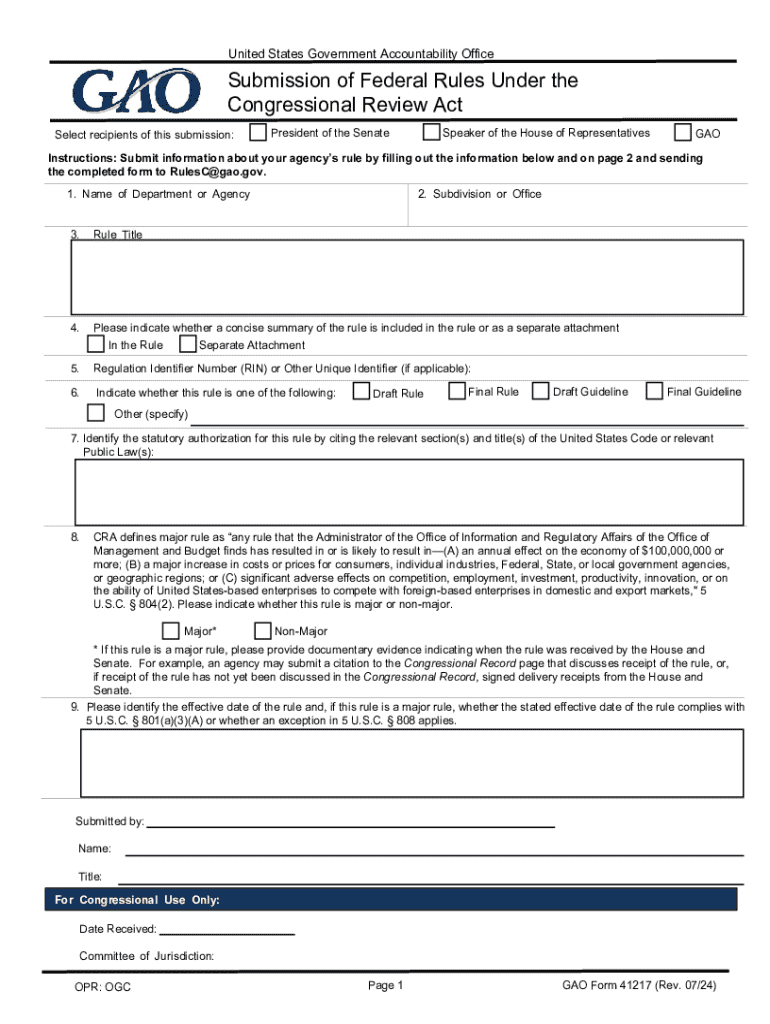
The "Submission of Federal Rules Under the" process refers to the required submission of federal regulations under the Congressional Review Act (CRA). This act mandates that federal agencies submit their rules to Congress and the Government Accountability Office (GAO) before they can take effect. This process allows Congress the opportunity to review and potentially disapprove new regulations.
- Congressional Review Act (CRA): A legislative mechanism aimed at overseeing federal regulations.
- GAO Role: Responsible for receiving summaries of rules before they are enacted.
- Agency Compliance: Agencies must comply with statutory requirements before submissions.
Steps to Complete the Submission of Federal Rules Under the CRA
Completing the submission requires adherence to detailed steps to ensure compliance with the CRA:
-
Prepare Rule Documentation:
- Include the rule title and description.
- Provide regulatory identifiers and relevant sections impacted.
-
Evaluate Rule Classification:
- Determine if the rule is a major or non-major regulation.
- Major rules typically have broader economic impacts.
-
Compile Required Information:
- Identify the agency and contact person.
- Provide an analysis of the rule’s cost-benefit.
-
Ensure Compliance:
- Provide evidence of compliance with statutory requirements.
- Include any required public comments.
-
Submit to GAO and Congress:
- Regulations must reach both entities for review.
- Non-compliance can delay the rule’s implementation.
Important Terms Related to the Submission Process
Understanding key terminology is essential for navigating the submission process:
- Major Rule: A rule that may have a significant economic impact, require a 60-day hold before enforcement.
- Non-Major Rule: Generally has less economic impact and a quicker enactment timeline.
- Public Comment: An opportunity for the public to provide feedback on proposed rules.
Legal Use of the Submission Process
The legal framework surrounding the submission of federal rules ensures accountability:
- Congressional Oversight: Submissions allow Congress to exercise their oversight by reviewing rules which could delay or disapprove their implementation.
- Judicial Review: While rare, courts may assess the legality of a submitted rule if challenged.
Key Elements of the Submission Form
Comprehensively completed forms must include several critical components:
- Title and Summary: Provides an overview of the rule.
- Regulatory Identification Number: Unique number associated with the rule.
- Impact Statement: Analysis of how the rule will affect stakeholders.
Examples of Using the Submission Process
Practical examples highlight how agencies have navigated the submission requirements:
- Environmental Regulations: Submissions for new emission standards typically undergo rigorous review due to potential economic impacts.
- Health and Safety Standards: Changes in health guidelines require transparency and public input.
Compliance Deadlines and Important Dates
Timely submissions are critical:
- 60-Day Delays: Major rules often have a built-in delay for additional review.
- Submission Deadlines: Rules should be submitted promptly to avoid lapses in enforcement.
Penalties for Non-Compliance
Failure to comply with submission requirements can result in significant consequences:
- Revoked Enforcement: Rules may be invalidated if not properly submitted.
- Legal Action: Agencies might face litigation for implementing unapproved rules.
Form Submission Methods
Federal agencies have multiple options for submitting rules:
- Online Submission: Using secure government portals like regulations.gov.
- Mail or In-Person: Printed submissions may be necessary for comprehensive documents or backup.
Who Issues the Form
The process is administered by various bodies:
- Federal Agencies: Responsible for initial rule drafting and submission.
- GAO: Plays a critical role in documenting and reviewing submitted rules.
Digital vs. Paper Version
The choice between digital and paper submissions often depends on the complexity of the document:
- Digital Submission: Preferred for convenience and speed.
- Paper Copies: Might be required for extensive reports or backup records.
Business Entity Types Affected
Various business entities may be impacted by federal rule submissions:
- Corporations: Often affected by regulatory changes in trade or environment.
- Small Businesses: Must stay informed about regulations impacting their operations.
Software Compatibility
Compatible software can facilitate efficient document preparation:
- Document Handling Tools: Platforms like DocHub allow streamlined sharing and editing of submission forms.
- Integration with Cloud Services: Ensures ease of access and collaboration across teams.
By understanding these aspects, agencies can ensure their compliance with the Congressional Review Act and facilitate smoother implementation of necessary regulations.