01. Edit your form online
Type text, add images, blackout confidential details, add comments, highlights and more.

Type text, add images, blackout confidential details, add comments, highlights and more.

Draw your signature, type it, upload its image, or use your mobile device as a signature pad.

Send it via email, link, or fax. You can also download it, export it or print it out.
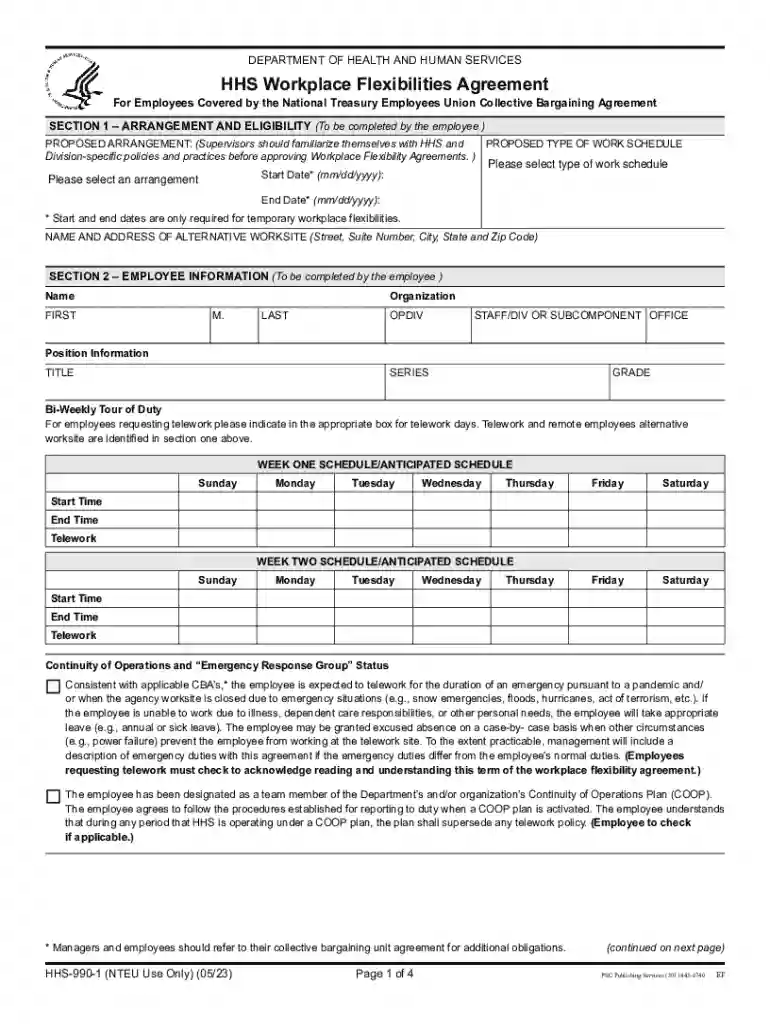
Form HHS-990-1, known as the HHS Workplace Flexibilities Agreement, is an official document designed to facilitate flexible work arrangements for employees covered by the National Treasury Employees Union Collective Bargaining Agreement. This form serves as a framework to outline and formalize telework arrangements, ensuring both the employer and the employee understand their responsibilities and commitments. The agreement includes sections detailing the eligibility criteria for telework, the terms under which the telework will be conducted, and specific conditions such as work schedule adjustments and equipment usage.
The primary objective of Form HHS-990-1 is to support the implementation of flexible work arrangements, particularly teleworking, within the Health and Human Services (HHS) department. It provides a standardized approach to managing remote work, ensuring that all parties adhere to pre-established guidelines. This form not only encourages voluntary participation in remote work opportunities but also specifies the terms for termination of such agreements if necessary.
Completing Form HHS-990-1 involves several detailed steps to ensure all relevant information is accurately captured:
Fill Out Employee Information: Begin by entering the personal details of the employee, including full name, department, and contact information. Accuracy in this section is critical for proper identification and processing.
Supervisor Review and Approval: The next step involves the supervisor's evaluation of the employee's eligibility and readiness for telework, considering factors like job responsibilities and past performance.
Define Telework Terms: Clearly specify the terms of the teleworking arrangement, including the number of days per week, work hours, and availability during work hours. This section should reflect mutual agreement between the employee and supervisor.
Outline Equipment and Compliance: List the equipment and software required for telework, and ensure compliance with HHS policies regarding the security and maintenance of work devices and data confidentiality.
Signatures and Final Approval: Both the employee and supervisor must sign the form to validate the agreement, confirming that all participants understand and agree to the terms outlined.
The form consists of several important components that support the telework arrangement:
Eligibility for using Form HHS-990-1 is determined by several factors, focusing on role suitability and employee performance. Criteria include:
Understanding these criteria helps align the use of Form HHS-990-1 with organizational goals and ensures only suitable candidates engage in telework.


Using Form HHS-990-1 effectively involves understanding its structure and purpose. The form is intended to:
Employees and supervisors should familiarize themselves with the form's sections to take full advantage of workplace flexibilities.
Form HHS-990-1 is legally binding once signed by both parties. It adheres to relevant federal telework policies, ensuring that all agreements aligned with this form stand up to legal scrutiny. The form stipulates conditions under which the telework agreement can be modified or terminated, including breach of compliance, changes in job role, or organizational restructuring. Employees are obligated to comply with all HHS telework policies as outlined in the agreement, and non-compliance may result in the revocation of teleworking privileges.
Several scenarios highlight the practical application of Form HHS-990-1:
Example 1: An employee working in data analysis has the option to telework three days per week. The form outlines the required security protocols and data handling policies.
Example 2: A project coordinator uses the form to set up a flexible schedule that accommodates off-site client meetings and remote project management.
These examples underscore the form's versatility in accommodating various job functions and employee needs.
Form HHS-990-1 can be submitted through different channels to facilitate ease of processing:
Selecting the most appropriate submission method depends on the user's preference and the specific requirements of their department.
We've got more versions of the Form HHS-990-1 HHS Workplace Flexibilities Agreement form. Select the right Form HHS-990-1 HHS Workplace Flexibilities Agreement version from the list and start editing it straight away!
| Versions | Form popularity | Fillable & printable |
|---|---|---|
| 2023 | 4.1 Satisfied (23 Votes) |
At DocHub, your data security is our priority. We follow HIPAA, SOC2, GDPR, and other standards, so you can work on your documents with confidence.