




01. Edit your form online
Type text, add images, blackout confidential details, add comments, highlights and more.

Type text, add images, blackout confidential details, add comments, highlights and more.

Draw your signature, type it, upload its image, or use your mobile device as a signature pad.

Send it via email, link, or fax. You can also download it, export it or print it out.
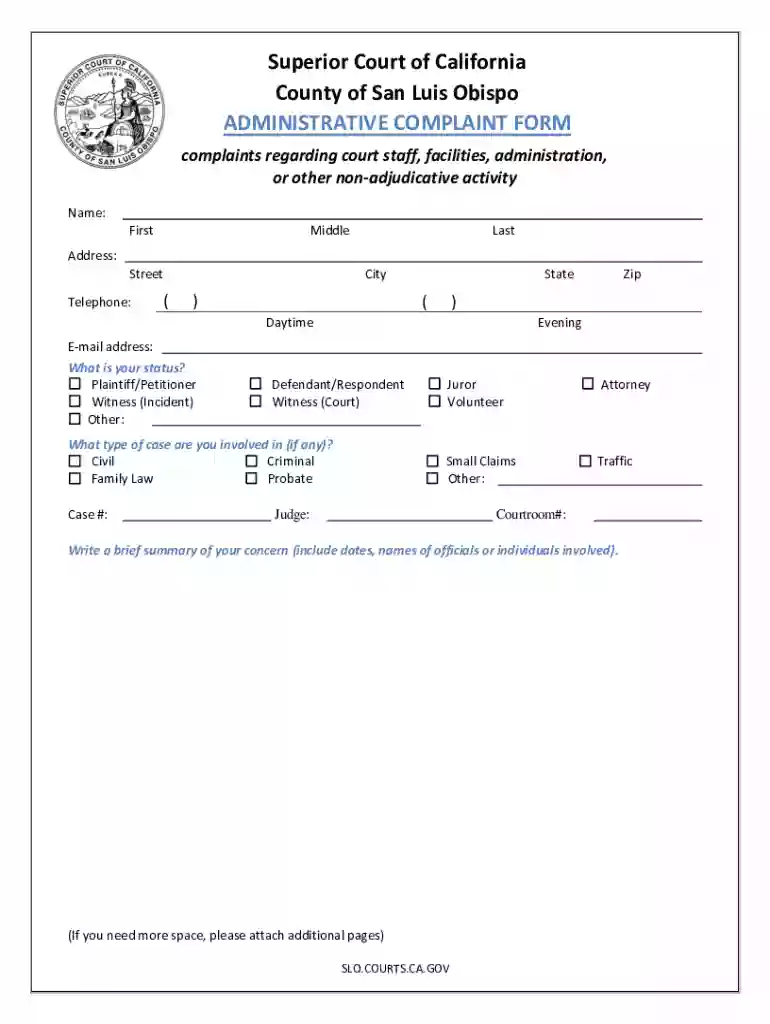
The Administrative Complaint Form is a formal document used to address issues concerning non-adjudicative activities within the Superior Court of California, County of San Luis Obispo. This form serves as an official channel for individuals to file complaints related to court administration, staff, or facilities. It is designed to systematically capture the complainant's personal information, the nature of their complaint, the context, and any desired resolutions. The purpose of the form is to ensure that grievances are handled in an organized manner, promoting accountability and transparency within the judicial administrative framework.
Filing a complaint using the Administrative Complaint Form requires careful attention to detail to ensure the submission is complete and accurate. Follow these steps:
Identify the Issue: Clearly determine the specific issue you wish to address concerning court staff, administration, or facilities.
Gather Information: Collect all relevant details about the incident, including dates, locations, and the individuals involved.
Complete the Form: Fill out each section of the form, providing your personal information and a summary of the complaint. Be sure to specify your status and the type of case involved if applicable.
Specify Desired Outcome: Indicate the action or resolution you seek from the court.
Select Response Method: Choose how you wish to receive a response from the court, ensuring all communication lines are open.
Completing the Administrative Complaint Form involves several key steps to ensure all necessary information is provided:
Personal Information: Fill in your full name, contact details, and any other identifying information required by the form.
Status and Case Type: Clearly state your status (e.g., plaintiff, defendant, observer) and the type of case (if relevant).
Complaint Details: Provide a detailed description of the issue, including any background information that may support your complaint.
Desired Actions: Express what actions you want the court to undertake in response to your complaint.
Receive a Response: Indicate if you prefer a mailed or electronic response, and provide the appropriate addresses.
The form contains several crucial segments that require accurate information:
Complainant Information: Includes personal and contact information.
Description of Complaint: A narrative section detailing the grievance and relevant supporting facts.
Actions Sought: Outlines the expected resolution or response.
Acknowledgment: Space for the complainant's signature to confirm the authenticity of the submitted information.
The Administrative Complaint Form is primarily used by individuals involved with the judicial system in a non-adjudicative capacity who experience dissatisfaction with court administration. This includes:
Court Users: Such as plaintiffs, defendants, or their representatives seeking redress for administrative issues.
General Public: Members using court facilities or interacting with court staff.
Legal Professionals: Attorneys or legal advocates filing on behalf of an affected party.


Filing an administrative complaint should adhere to specific legal standards. The form is designed to be used within a defined legal context, ensuring procedural fairness is followed in complaint resolution. Complaints must be based on factual occurrences and genuine grievances, frivolous or malicious filings can result in legal implications. The form's role is to foster a mechanism through which court operations remain accountable and responsive to public concerns.
While the Administrative Complaint Form discussed here is specific to the Superior Court of California, County of San Luis Obispo, users should be aware that each state, and often each county, may have individual regulations governing administrative complaints.
The form supports multiple submission methods to accommodate user preferences and logistical constraints:
Online Submission: This method allows users to fill out and submit the form electronically via the court's official website, ensuring quicker processing times.
Mailing Option: For those preferring to send physical documents, submissions can be mailed directly to the designated court address.
In-Person Submission: Individuals may deliver their completed forms to the court administrative office for direct submission and potential immediate feedback.
These varied submission channels aim to enhance accessibility and convenience for all users.
We've got more versions of the Administrative Complaint Form form. Select the right Administrative Complaint Form version from the list and start editing it straight away!
| Versions | Form popularity | Fillable & printable |
|---|---|---|
| 2022 | 4.2 Satisfied (52 Votes) |
At DocHub, your data security is our priority. We follow HIPAA, SOC2, GDPR, and other standards, so you can work on your documents with confidence.





Please use your MyVC e-mail address (username@mail.valenciacollege.edu). VID Required. Phone Required. Complaint Information.Read more
All complaints regarding court operations must be submitted in writing via email or mail to: admin@slo.courts.ca.gov
fax to (410) 468-2260 **You can find a copy of the complaint form here. Your complaint should include the following information: The name, address, email


