







Definition & Meaning
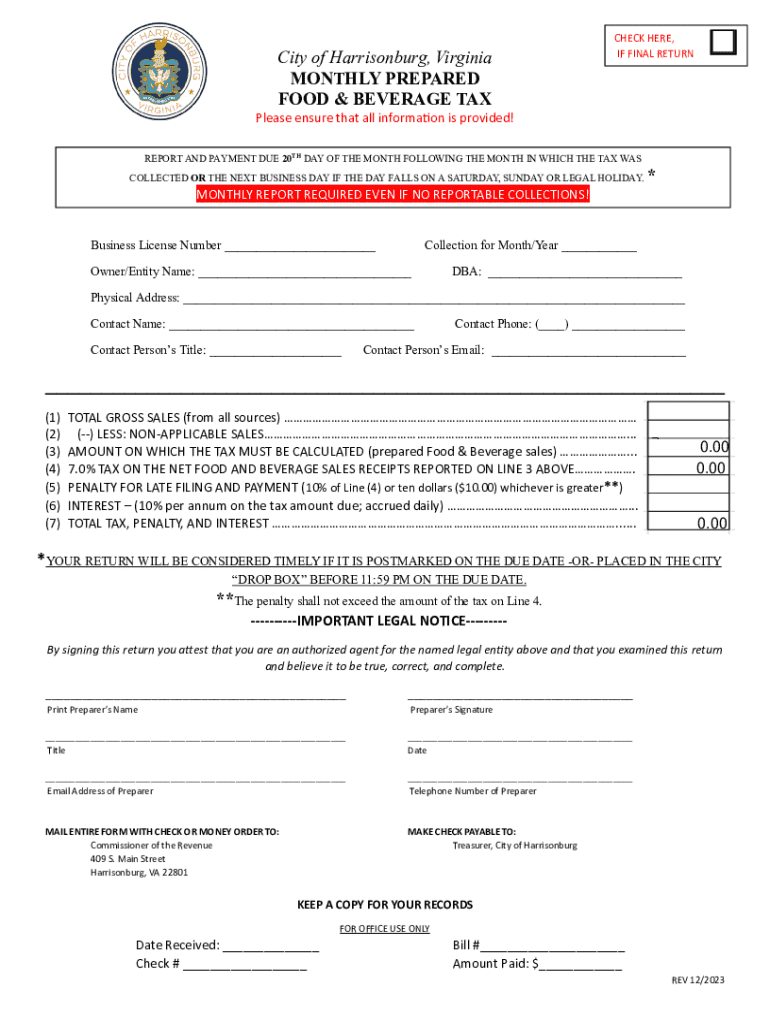
The Harrisonburg Monthly Prepared Food and Beverage Tax Return is a document used by businesses in Harrisonburg, Virginia to report and pay taxes on prepared food and beverage sales. This form captures detailed information about the gross sales of food and beverages, the amount subject to taxation, and the calculated taxes due to the city. It is an essential compliance document for businesses engaged in the sale of taxable prepared foods and beverages.
Steps to Complete the Harrisonburg Monthly Prepared Food and Beverage Tax Return
-
Gather Required Information: Collect data on the total gross sales for the reporting period, separating taxable and non-taxable sales as needed.
-
Calculate Taxable Sales: Deduct any exempt sales to determine the amount of sales subject to the food and beverage tax.
-
Determine Tax Due: Apply the appropriate tax rate to the taxable sales to calculate the total tax owed.
-
Complete the Form: Fill out the form with all required sections, including business details, sales figures, and tax calculations.
-
Review and Sign: Verify all information for accuracy, then sign the form to certify the accuracy of the reported data.
-
Submit the Return: Send the completed form and payment to the appropriate city department by the designated deadline.
Filing Deadlines / Important Dates
-
Monthly Filing: The deadline for submitting the Harrisonburg Monthly Prepared Food and Beverage Tax Return is typically the 20th day of the month following the reporting period. This timely submission ensures compliance with local tax regulations.
-
Extension Requests: Extensions for filing might be available under certain circumstances, but should be requested prior to the deadline to avoid penalties.
Required Documents
- Sales Records: Detailed records of sales transactions, including receipts and ledger entries documenting gross and taxable sales.
- Exemption Documentation: Proof for any sales claimed as exempt from the food and beverage tax, such as certificates or supporting invoices.
Penalties for Non-Compliance
-
Late Filing Fees: Businesses failing to file by the due date may incur penalties, typically a percentage of the tax due, which increases with time.
-
Interest on Unpaid Taxes: In addition to penalties, interest may accrue on any unpaid tax amounts, emphasizing the importance of timely compliance.
Legal Use of the Harrisonburg Monthly Prepared Food and Beverage Tax Return
The form serves as a legal document showing compliance with the Municipal Code of Harrisonburg, which mandates the reporting and payment of taxes on prepared food and beverage sales. Businesses must accurately complete and file this form to avoid legal repercussions.
Key Elements of the Harrisonburg Monthly Prepared Food and Beverage Tax Return
-
Business Information: Includes the legal name, address, and contact information of the business or taxpayer.
-
Gross and Taxable Sales: The total and taxable amounts of sales over the month, segmented for clarity.
-
Tax Calculations: Detailed computations demonstrating how the tax amount was calculated.
-
Preparer’s Details: Information about the individual preparing the form, which might be different from the business owner if outsourced.
Software Compatibility (TurboTax, QuickBooks, etc.)
Businesses may utilize various accounting and tax preparation software to aid in the completion of this form. Popular tools such as QuickBooks or TurboTax offer features for tracking sales and tax liabilities. These systems can streamline data gathering and calculation processes, ensuring more efficient and accurate form preparation.
Business Entity Types
Different types of businesses, such as LLCs, corporations, and partnerships, might have varying requirements or nuances in reporting, depending on their structure and operations. It's crucial for these entities to recognize their obligations and ensure they are correctly cataloging their financial activities regarding food and beverage sales.
Form Submission Methods (Online / Mail / In-Person)
-
Mail: Traditional submission by mailing the completed form and payment to the local tax office.
-
In-Person: Forms may be delivered directly to the tax office for immediate processing.
-
Online: Some jurisdictions offer online filing options, which provide a convenient and time-efficient method for submission.
Selecting the correct method of submission helps ensure compliance and timeliness in tax obligations.




