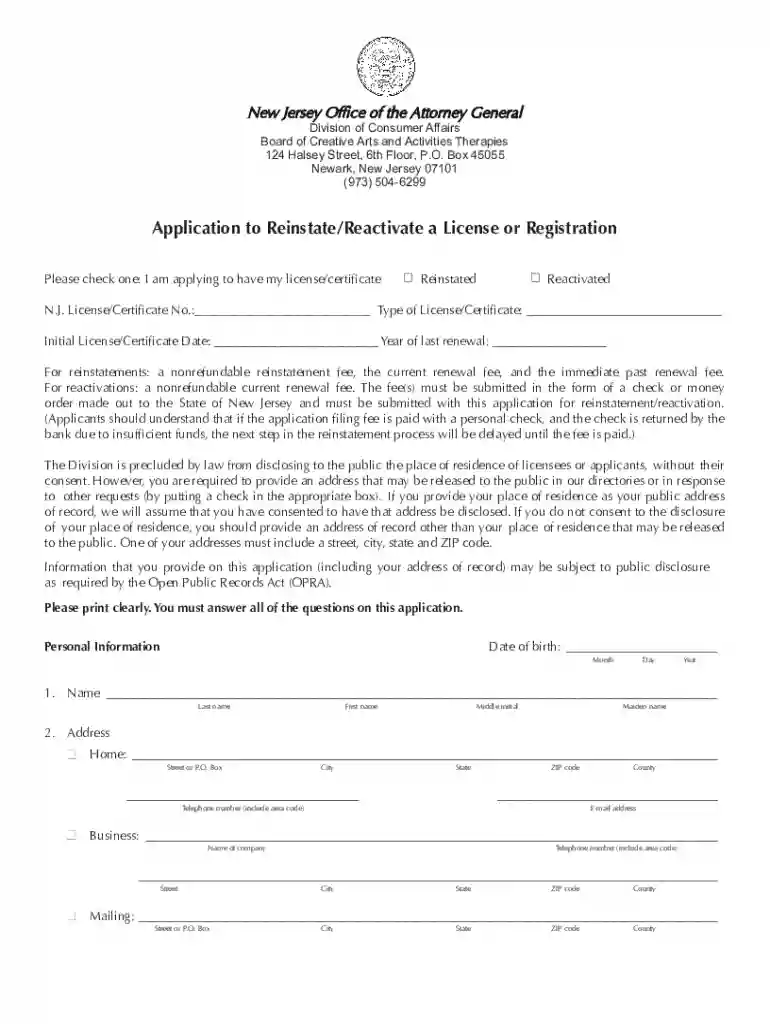
New Jersey Office of the Attorney General Licensure 2026

Get Form
New Jersey Office of the Attorney General Licensure Preview on Page 1

Here's how it works

01. Edit your form online
Type text, add images, blackout confidential details, add comments, highlights and more.

02. Sign it in a few clicks
Draw your signature, type it, upload its image, or use your mobile device as a signature pad.

03. Share your form with others
Send it via email, link, or fax. You can also download it, export it or print it out.

Definition and Meaning

The "New Jersey Office of the Attorney General Licensure" pertain to the various professional licenses governed by the New Jersey Attorney General's office. This form is crucial for individuals seeking to validate their credentials within the state, ensuring compliance with legal and professional standards. The licensure process involves verifying qualifications, assessing proficiency, and certifying individuals as eligible to practice in their respective fields. The guidance provided by the office covers a wide range of professions, ensuring that all practitioners meet the necessary ethical and professional standards.

How to Obtain the New Jersey Office of the Attorney General Licensure

To obtain licensure through the New Jersey Office of the Attorney General, applicants must follow a detailed process. This includes:

  1. Reviewing Eligibility Requirements: Confirm that you meet all prerequisites, such as educational qualifications and work experience, for your specific profession.
  2. Submitting Required Documents: Prepare necessary documents, including educational transcripts, proof of employment, and any relevant certifications.
  3. Completing the Application Form: Fill out the licensure application accurately, ensuring all sections are completed.
  4. Application Fee Payment: Submit the applicable fee as specified by the office. Ensure that the payment method is accepted.
  5. Criminal History Background Check: Undergo a background check, which is mandatory for all applicants. The forms and procedures for the background check must be adhered to strictly.

Required Documents

Applicants must provide several critical documents to complete the licensure process:

  • Educational Transcripts: Proof of academic qualifications from accredited institutions.
  • Employment Verification: Documents demonstrating relevant work experience, including letters from past employers.
  • Identification Proof: A government-issued ID to verify identity.
  • Certification Copies: Copies of any professional certifications pertinent to the field.
  • Legal Disclosures: Information relevant to any past legal issues or ongoing cases.

Each document must be genuine and verifiable, as falsification can lead to application rejection and potential legal consequences.

Application Process and Approval Time

The process for application involves meticulous steps that include preparation, submission, and waiting periods:

  1. Preparation: Gather all necessary documents and complete the application form with accurate information.
  2. Submission: Submit the application through the designated method—either online, via mail, or in person.
  3. Review and Verification: Your application and documents are reviewed by the office. Any discrepancies or missing information may lead to delays.
  4. Background Check Completion: Ensure the background check process has been initiated and completed.
  5. Final Approval: Once all reviews are complete and all criteria are met, an approval notice will be issued. The timeframe for approval varies depending on the volume of applications and the specific licensure being sought.

Form Submission Methods

Applicants can submit their applications using various methods:

  • Online Submission: The most efficient method, allowing users to upload documents and complete forms digitally.
  • Mail Submission: Send the completed application and documents via certified mail to ensure receipt.
  • In-Person Submission: Some applications may be submitted in person at designated offices, providing an opportunity to resolve queries immediately.

Each method has its pros and cons, and the choice may depend on accessibility and personal preference.

Penalties for Non-Compliance

Failing to comply with licensing regulations can result in significant penalties:

  • Fines and Fees: Non-compliance can lead to financial penalties, including fines for late submission or incomplete applications.
  • License Revocation or Suspension: Failure to maintain or renew licenses appropriately can result in suspension or revocation.
  • Legal Action: In severe cases, individuals may face legal action for practicing without a valid license.

These penalties emphasize the importance of adhering to all regulatory guidelines and submission deadlines.

Important Terms Related to New Jersey Office of the Attorney General Licensure

Several terms are essential for understanding the licensure process:

  • Licensure: The granting of a license, often following verification of qualifications and credentials.
  • Background Check: A review of personal and professional history to ensure compliance with legal standards.
  • Certification: Acknowledgement of proficiency and eligibility in a specific professional field.
  • Compliance: Adherence to legal and regulatory standards as stipulated by the licensure authority.
  • Verification: The process of confirming details and credentials provided in the licensure application.

Recognizing these terms is critical for navigating the licensure process effectively.

State-Specific Rules for the New Jersey Office of the Attorney General Licensure

New Jersey imposes specific rules and nuances distinct from other states. It is crucial to understand these differences to ensure compliance:

  • State Regulations: New Jersey has unique licensing requirements that may differ from other states concerning professional qualifications.
  • Mandatory Certification: Certain professions may require additional state-specific certifications or endorsements.
  • Continuing Education: New Jersey mandates ongoing education for license renewal in specific professions, ensuring updated knowledge and skills.

Understanding these state-specific requirements helps in maintaining a valid practicing status within New Jersey.

be ready to get more

Complete this form in 5 minutes or less

Get form

Got questions?

We have answers to the most popular questions from our customers. If you can't find an answer to your question, please contact us.
Contact us
0:25 3:18 This could be a warning a notice of a lawsuit. Or even a subpoena. If Its crucial to take suchMoreThis could be a warning a notice of a lawsuit. Or even a subpoena. If Its crucial to take such communication seriously. Why Would The Attorney General Contact Me? - CountyOffice.org YouTube County Office Law YouTube County Office Law
How to Check if License is Suspended Online NJ NJMVC Website. Call the New Jersey Motor Vehicle Commission (NJMVC) Visit an NJMVC Office. Check with Local Law Enforcement.
Attorney General Matt Platkin (@NewJerseyOAG) / X. Official account for the Office of the NJ Attorney General. *Direct messages not monitored* For Constituent Services: (609) 984-5828.
The Attorney General oversees the Department of Law Public Safety with the support of his executive leadership team. The team advises the Attorney General on legal, policy, and administrative matters and assists with the day-to-day supervision of the Departments divisions and initiatives. Attorney Generals Executive Leadership Team - NJ.gov NJ.gov oag oag scag1 NJ.gov oag oag scag1
The Attorney General represents the United States in legal matters generally and gives advice and opinions to the President and to the heads of the executive departments of the Government when so requested. Office of the Attorney General - Department of Justice Department of Justice Department of Justice

Security and compliance

At DocHub, your data security is our priority. We follow HIPAA, SOC2, GDPR, and other standards, so you can work on your documents with confidence.

Learn more
ccpa2
pci-dss
gdpr-compliance
hipaa
soc-compliance

People also ask

Basic Requirements Be at least 17 years old. Hold a probationary license for at least six months, or a license from another state. Provide residency and identity documentation. Fill out a drivers license application and take required written and road skills tests. Pay required fees.
The Supreme Court of New Jersey is the government authority that licenses attorneys in the state, through a special administrative branch known as the New Jersey Board of Bar Examiners.
Alina Habba Alina Habba is the Acting U.S. Attorney and Special Attorney to the United States Attorney General for the District of New Jersey. District of New Jersey | Meet the Acting U.S. Attorney and Department of Justice (.gov) usao-nj meet-us-attorney Department of Justice (.gov) usao-nj meet-us-attorney

Related links