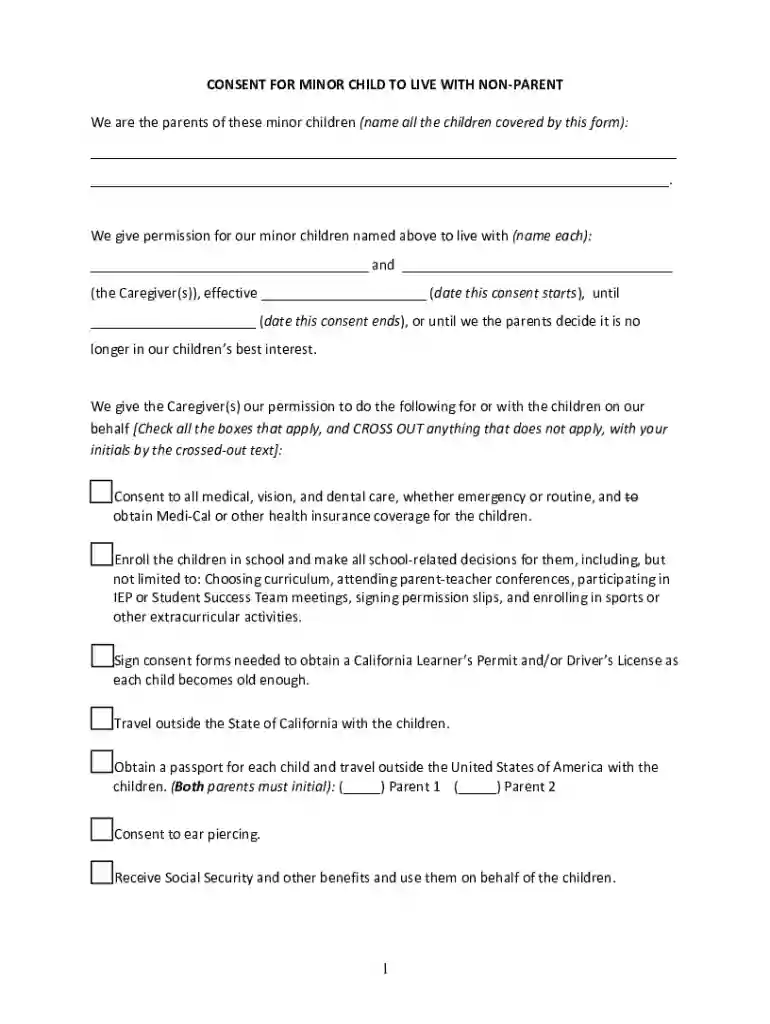
Consent for Minor Child to Live With Non-parent 2026

Get Form
Consent for Minor Child to Live With Non-parent Preview on Page 1

Here's how it works

01. Edit your form online
Type text, add images, blackout confidential details, add comments, highlights and more.

02. Sign it in a few clicks
Draw your signature, type it, upload its image, or use your mobile device as a signature pad.

03. Share your form with others
Send it via email, link, or fax. You can also download it, export it or print it out.

Definition and Meaning

The "Consent for Minor Child to Live With Non-parent" form is a legal document that permits a non-parental figure to assume temporary guardianship of a minor child. This arrangement can be crucial for parents who need to grant another individual the authority to make decisions on behalf of their child. The form commonly details the nature of the guardianship, the duration of the consent, and the specific rights entrusted to the non-parent caregiver. This can include decision-making in areas such as medical care, education, and travel.

How to Use the Consent for Minor Child to Live With Non-parent

Utilizing this form effectively involves clear communication and consent from all parties involved. First, parents or legal guardians must identify the non-parent recipient to whom they are giving consent to live with the minor child. The form should be filled out with precise information regarding:

  • Names of the child, parents, and non-parent caregiver.
  • Duration for which the consent is valid.
  • Permissions being granted, such as medical or educational decisions.

The form often requires signatures from the consenting parents and should be notarized to ensure its legal standing.

Steps to Complete the Consent for Minor Child to Live With Non-parent

  1. Gather Required Information: Collect details about the minor child, parents, and non-parent caregiver.
  2. Fill Out the Form: Enter all pertinent information, including names, addresses, and dates.
  3. Specify Permissions: Clearly articulate the permissions being granted and any limitations.
  4. Agree on Duration: Define how long the consent will be in effect.
  5. Sign and Notarize: Obtain signatures from the parents and have the form notarized to enhance its legal enforceability.

Key Elements of the Consent for Minor Child to Live With Non-parent

Key elements that should be included in the form are:

  • Identification Details: Full names and contact information for the child, parents, and non-parent caregiver.
  • Guardianship Period: Clearly stated start and end dates of the consent.
  • Granted Rights: Specific rights granted to the non-parent regarding decision-making.
  • Signature Section: Space for all necessary signatures, ensuring all parties agree to the terms.
  • Notarization Section: Space for a notary public to sign and seal the document, verifying its authenticity.

Legal Use of the Consent for Minor Child to Live With Non-parent

The form has legal implications that allow the non-parent to act in the child’s best interests in the absence of the parents. This consent is legally binding and can be used in various situations such as:

  • Emergency Medical Treatment: Non-parents can authorize urgent medical procedures.
  • Educational Enrollments: Enables school registration and participation in educational activities.
  • Travel Arrangements: Allows the non-parent to travel with the child, both domestically and internationally, according to the specified terms.

Who Typically Uses the Consent for Minor Child to Live With Non-parent

This form is typically used by:

  • Parents or Legal Guardians: Who need to temporarily transfer guardianship rights due to circumstances like travel or medical emergencies.
  • Non-parent Caregivers: Such as family members, friends, or designated guardians, who are responsible for the child in the absence of the parents.
  • Legal Professionals: Assisting in the preparation and notarization of the form to ensure it is properly executed.
decoration image ratings of Dochub

State-specific Rules for the Consent for Minor Child to Live With Non-parent

Regulations regarding this form can vary by state. Specific state laws may dictate:

  • Required Documentation: Additional forms or disclosures that must be included.
  • Notarization Requirements: Variance in notarization protocols or additional witnesses.
  • Duration Limitations: State-imposed limits on how long the guardianship can last.

It is important to review local laws to ensure compliance with all applicable regulations.

Important Terms Related to Consent for Minor Child to Live With Non-parent

Understanding critical terms can aid in completing the form accurately. Some of these terms include:

  • Guardianship: Legal responsibility granted to someone other than the child's biological parents.
  • Non-parental Custodian: The designated individual responsible for the child as per the consent form.
  • Duration of Consent: The time frame during which the non-parent can exercise parental rights and duties.
  • Notarization: Official validation of the form through a certified notary public to ensure the form’s legality and authenticity.
be ready to get more

Complete this form in 5 minutes or less

Get form

Got questions?

We have answers to the most popular questions from our customers. If you can't find an answer to your question, please contact us.
Contact us
California law explicitly allows children 14 and older to express a preference in court under California Family Code 3042. However, like in Colorado, their preference does not dictate the outcome.
Verbal Consent This is the clearest and safest form of consent. Examples of giving verbal consent include: Yes That sounds great
Cooperate with Co-Parent: Work together with the other parent to ensure the transition is smooth. Discuss schedules, rules, and how to maintain a consistent parenting approach. Focus on Stability: Ensure that your child feels secure in their choice. Help them adjust to the new living situation by being supportive.
To create a consent form, you need to list the consenting parties and specify the activities or data covered by the consent. It should also state the parties rights and responsibilities and include dates, contact information, and other necessary details.
Heres how to write a parental consent letter: Compose a short letter of permission. Find a suitable letter template online or create a letter from scratch using your preferred word processing tool. Fill in the necessary details. Convert the file to a PDF. Send the consent letter via email.

Security and compliance

At DocHub, your data security is our priority. We follow HIPAA, SOC2, GDPR, and other standards, so you can work on your documents with confidence.

Learn more
ccpa2
pci-dss
gdpr-compliance
hipaa
soc-compliance

People also ask

A valid form should include the childs name, date of birth, passport number, travel details, the accompanying adults information, and both parents contact and signature. Notarisation is strongly recommended.
Customize the downloaded template or new letter with your childs information, including their full name, date of birth, or any relevant identification details. Provide specific details about the consent, such as the event or activity your child is participating in and any related dates or duration.

Related links