





Definition & Meaning
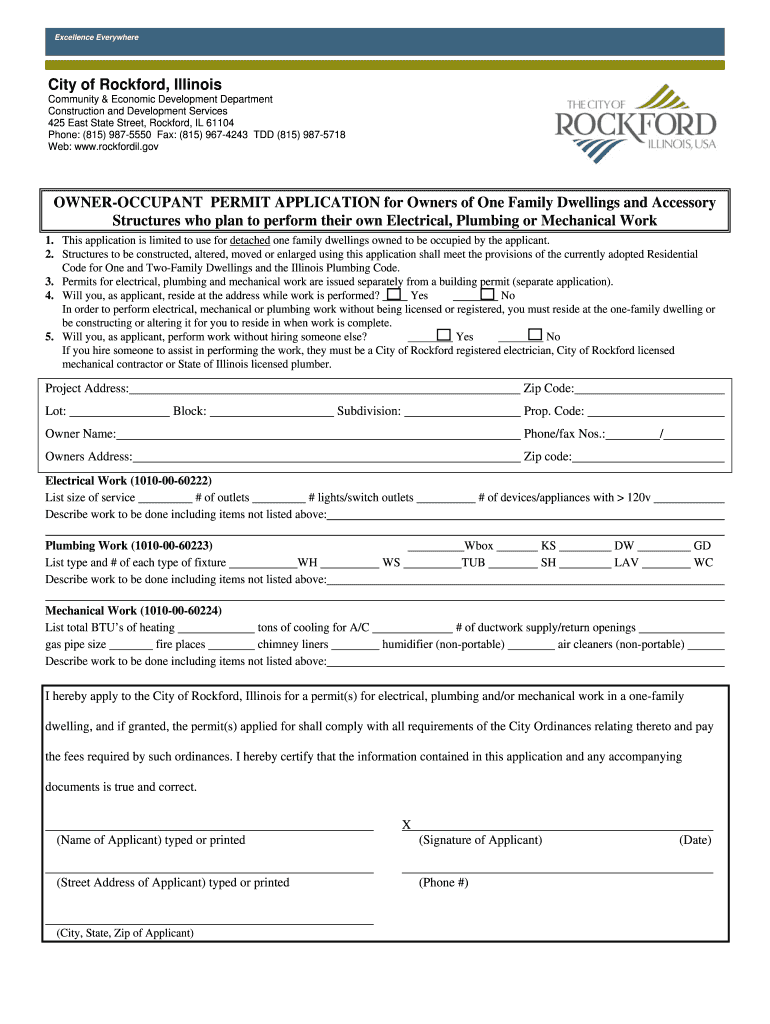
The Owner-Occupant Permit Application for Owners of One Family Dwellings and Accessory is a legal document used by homeowners who wish to perform electrical, plumbing, or mechanical work on their properties in Rockford, Illinois. This form is specifically designed for owner-occupants, meaning homeowners who reside in the dwelling and possess the necessary skills to conduct the improvements themselves. Understanding this application is essential for homeowners seeking to legally undertake remodeling or repair work on their dwellings and attached structures.
How to Obtain the Owner-Occupant Permit Application
To acquire the Owner-Occupant Permit Application, homeowners can visit the local municipal office in Rockford, Illinois, where they can obtain a physical copy. Alternatively, the application may also be available for download on the official website of the city’s building department. This ensures accessibility for all homeowners, providing a convenient way to initiate the application process for their home improvement projects.
Eligibility Criteria
In order to use the Owner-Occupant Permit Application, homeowners must meet specific eligibility requirements. These include:
- Owner-Occupancy: The applicant must currently reside in the one-family dwelling.
- Skill Requirement: The homeowner should possess the necessary skills to perform the allowed work, as defined in city regulations.
- Property Type: The application is only applicable for one-family dwellings and any accessory structures associated with the property.
By meeting these criteria, the homeowner ensures that their application is processed smoothly, adhering to local mandates.


Steps to Complete the Owner-Occupant Permit Application
- Gather Information: Collect details about the property, scope of work, and personal qualifications necessary for completing the permit application accurately.
- Fill in Personal and Property Details: Enter applicant information and property description. Ensure the accuracy of all provided data.
- Describe Planned Work: Clearly outline the electrical, plumbing, or mechanical work to be performed.
- Verify Eligibility: Confirm alignment with eligibility criteria for homeowners and properties.
- Submit the Application: Deliver the completed application to the local building department, either in-person or via mail, depending on available submission methods.
By following these steps, applicants can ensure their submissions are complete and increase the likelihood of obtaining necessary permits.
Required Documents
When submitting the Owner-Occupant Permit Application, specific documentation is typically required, such as:
- Proof of Ownership: Documentation verifying the applicant's ownership of the property.
- Identification: A government-issued ID to confirm the identity and residency status of the applicant.
- Skill Verification: If applicable, proof of competency in performing the work, like certifications or licenses.
Having these documents prepared beforehand aids in streamlining the application process.
Key Elements of the Application
The Owner-Occupant Permit Application encompasses several critical elements:
- Applicant Information: Name, address, and contact details of the homeowner.
- Property Details: Exact location, type, and description of the dwelling.
- Work Description: Detailed summary of the intended electrical, plumbing, or mechanical work.
- Compliance Agreement: An agreement asserting that the homeowner will comply with all local code requirements during the project's execution.
Each element plays a vital role in ensuring the application is thorough and meets all city requirements.
Legal Use of the Owner-Occupant Permit Application
The application serves a critical legal function, helping to ensure that all work undertaken by a homeowner is compliant with local building codes and regulations. This helps to:
- Ensure Safety: By requiring adherence to building codes, the application helps maintain safety standards within the property.
- Protect Property Value: Properly permitted and completed projects can help maintain or even increase the property’s value.
- Clarify Liability: By having a clear and legally binding permit, the homeowner acknowledges and accepts responsibility for the work conducted.
Understanding these legal implications helps homeowners appreciate the importance of securing an owner-occupant permit.
State-Specific Rules
For the city of Rockford in Illinois, state-specific guidelines dictate the processing and approval of the Owner-Occupant Permit Application. These include:
- Local Code Compliance: Conformance to Illinois local construction and safety regulations.
- Inspection Requirements: Mandatory inspections at various stages of the project to ensure continued compliance.
- Special Exemptions: Any stated exemptions specific to Illinois property laws regarding owner-occupant work.
These state-specific rules ensure the process remains relevant to local regulations and standards.
Important Terms Related to the Application
Familiarity with key terms is essential for applicants:
- Owner-Occupant: A homeowner who lives on the property they seek to improve.
- Accessory Structure: Additional buildings on the property, such as garages or sheds, associated with the main dwelling.
- Compliance: Adhering strictly to local building and safety codes.
These terms are frequently used within the application and relevant guidelines, clarifying the process for prospective applicants.