01. Edit your form online
Type text, add images, blackout confidential details, add comments, highlights and more.

Type text, add images, blackout confidential details, add comments, highlights and more.

Draw your signature, type it, upload its image, or use your mobile device as a signature pad.

Send it via email, link, or fax. You can also download it, export it or print it out.
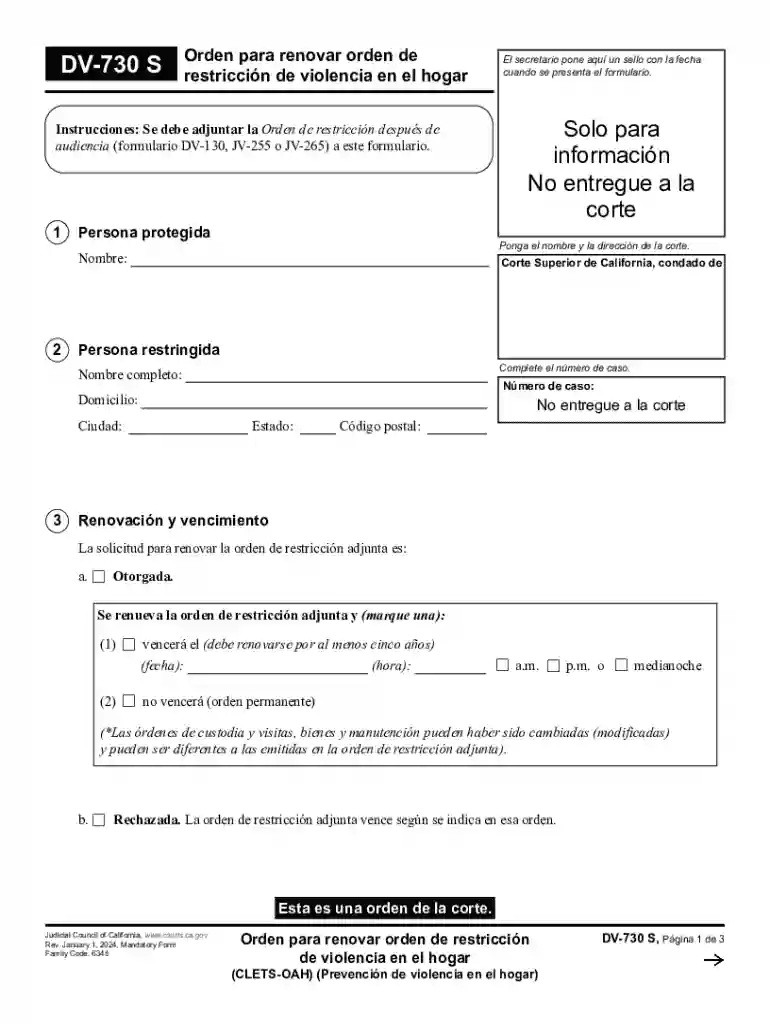
The DV-730 S Judicial Council form serves as a legal document specifically used to renew existing domestic violence restraining orders in California. It is part of a structured process designed to extend the protection provided by the original restraining order. This form becomes necessary when individuals seek continued legal protection against threats or actions of domestic violence beyond the original order's expiration date. By completing the DV-730 S, parties ensure that the order remains active, preventing any lapse that might endanger the protected individuals.
The primary purpose of the DV-730 S form is to facilitate the renewal process for domestic violence restraining orders in California. This ensures ongoing safety and legal protection for individuals susceptible to domestic abuse. The form maintains continuity in legal protection by mandating the renewal before the current order expires. It lays out detailed steps that must be followed to legally extend the protections offered by the initial order.
Gather Necessary Documents:
Filling Out the Form:
Legal Compliance and Delivery Requirements:
Submission:
Protected & Restrained Individuals Section:
Case Number & Hearing Information:
Instructions for Attachment:
Each of these elements requires attention to detail and must be completed according to specific guidelines provided by the California courts. Missing or incorrect information can delay the renewal process and potentially put individuals at risk.
The DV-730 S form's legal standing is based on California state law, specifically dealing with the renewal of domestic violence restraining orders. Legal statutes govern how and when these forms can be used, with penalties applied for misuse or intentional misinformation. Compliance with federal law is integral, and the form itself serves as an embodiment of the victim's right to continued protection.
Statutory Guidelines:
Enforcement and Compliance:
Using the DV-730 S form legally binds both parties to the stipulations outlined within the renewed order, extending protections under the same terms unless otherwise specified by the court.
The DV-730 S forms are accessible through multiple channels:
Direct Court Access:
Online Resources:
Legal Assistance:
Always verify that you are using the latest version of the DV-730 S form to comply with any updates in legislation or procedural requirements. Keep all gathered forms and supporting documents secure to ensure the protection of sensitive information.
The primary users of the DV-730 S form are individuals currently under the protection of a domestic violence restraining order. These individuals, primarily victims of domestic abuse, use the form to ensure their continued legal safety. Secondary users include legal practitioners who assist with the filing and submission process.


While the form is designed for domestic violence victims, it also extends to other individuals who may be indirectly affected, such as minors under the protection of the order. Advocates and support organizations dedicated to preventing domestic violence might also use this form to guide affected individuals through the renewal process.
The usage and submission of the DV-730 S form are governed by California state laws, which outline specific procedures that must be followed for the form to be valid:
Filing Procedures:
Service of Process:
While the general rules apply across the state, certain counties may have additional requirements. It is advisable to contact the local court to ensure all procedural specifics are accurately followed, which may include deadlines and additional form requirements.
Failure to comply with the protocols associated with the DV-730 S form can have significant legal consequences:
Lapse in Protection:
Legal Penalties:
Always ensure that forms are submitted in a timely manner, with all requirements met as stipulated by state law. Legal counsel is advisable to navigate complex situations or for individuals unfamiliar with the judicial process.
We've got more versions of the DV-730 S Judicial Council forms form. Select the right DV-730 S Judicial Council forms version from the list and start editing it straight away!
At DocHub, your data security is our priority. We follow HIPAA, SOC2, GDPR, and other standards, so you can work on your documents with confidence.