






Definition & Meaning
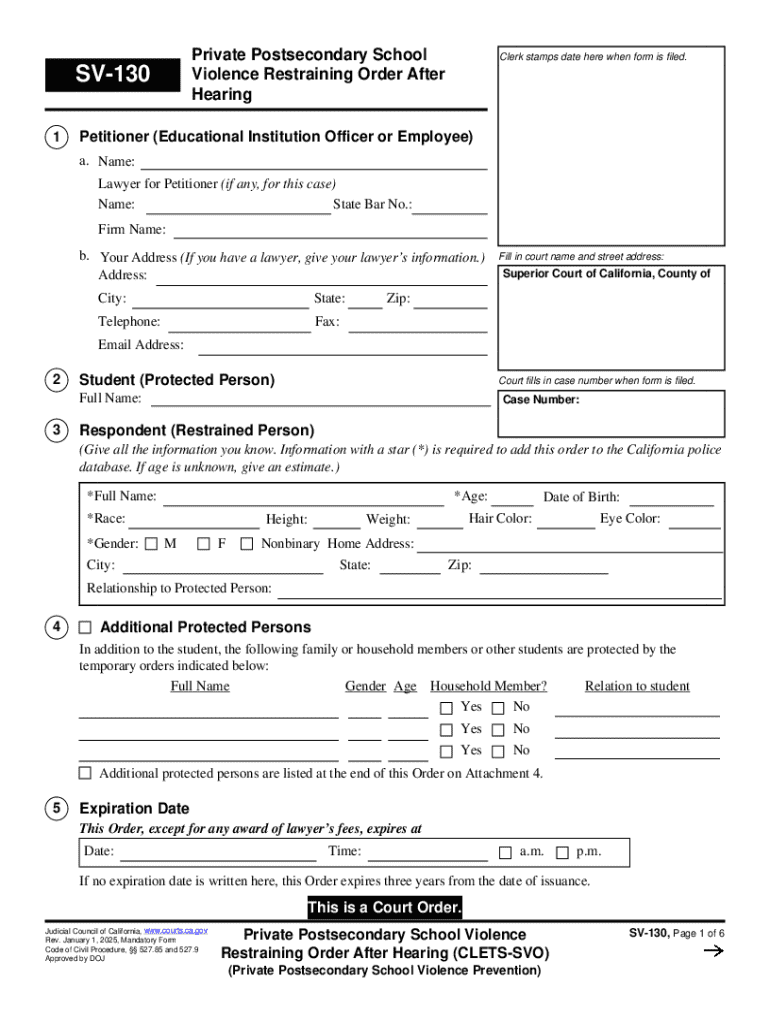
A Private Postsecondary School Violence Restraining Order After Hearing refers to a legal injunction that can be issued by a court in California with the intent to protect individuals affiliated with private postsecondary institutions from acts of violence or threats. This type of restraining order is specifically designed for situations involving schools, recognizing the unique dynamics and potential for repeated confrontation in educational settings. It legally restricts the respondent — the alleged aggressor — from engaging in certain actions that might endanger the protected individuals, be it students, faculty, or staff.
How to Use the Private Postsecondary School Violence Restraining Order After Hearing
The Private Postsecondary School Violence Restraining Order After Hearing is used to maintain safety within educational environments by legally constraining a respondent's actions post-hearing. Following a court hearing, if a judge determines that violence has occurred or there is a credible threat of future harm, this order may be granted. It is typically utilized by educational institutions or individuals in school environments who perceive a risk of violence, and it dictates specific behaviors the respondent must avoid, such as making contact or coming within a certain distance of the protected parties.
How to Obtain the Private Postsecondary School Violence Restraining Order After Hearing
To obtain this restraining order in California, the petitioner — often an individual or institution affiliated with a private postsecondary school — must first complete the necessary legal forms. These forms are typically filed with a superior court. Following the filing, a court hearing will be scheduled where both parties can present their cases. The petitioner must demonstrate the necessity of the order to ensure safety from violence or threats. If the court is convinced, it will issue the order, delineating specific prohibitions against the respondent.
Steps to Complete the Private Postsecondary School Violence Restraining Order After Hearing
-
Filing the Petition: Begin by filling out the appropriate legal forms, which detail the need for the restraining order.
-
Court Hearing: Attend the hearing where evidence of the need for protection is presented. Both the petitioner and respondent can offer testimony or evidence.
-
Judge's Decision: The judge evaluates all evidence and testimonies to determine the necessity of the order.
-
Issuance of the Order: If the court grants the petition, an order will be issued specifying the restrictions imposed upon the respondent.
-
Service of Process: Ensure the respondent is formally notified of the order and its terms through a process server or law enforcement.
Important Terms Related to the Private Postsecondary School Violence Restraining Order After Hearing
- Petitioner: The individual or entity requesting the restraining order.
- Respondent: The person against whom the order is sought.
- Protected Persons: Individuals named in the order who are to be protected from the respondent.
- Personal Conduct Orders: Specific behaviors the respondent must abstain from, such as harassment or threats.
- Stay-Away Orders: Establishes a physical distance the respondent must maintain from protected persons.
Legal Use of the Private Postsecondary School Violence Restraining Order After Hearing
The legal premise of the Private Postsecondary School Violence Restraining Order After Hearing is to prevent further violence or threats within the schooling environment by setting legally enforceable boundaries. It allows educational institutions to act proactively in safeguarding their community. Violations of the order can lead to legal penalties, including arrest, fine, or other court-imposed consequences, thus serving as a potent deterrent against aggressive behaviors.
Key Elements of the Private Postsecondary School Violence Restraining Order After Hearing
- Identification of Parties: Clear identification of the petitioner, respondent, and protected individuals.
- Specific Orders: Detailed behavior prohibitions, such as no contact, no threats, or maintaining a certain distance.
- Firearm Restrictions: Provisions regarding the possession or use of firearms by the respondent.
- Legal Enforcement: Specifies enforcement mechanisms and penalties for breaches of the order by law enforcement.
State-Specific Rules for the Private Postsecondary School Violence Restraining Order After Hearing
In California, this restraining order is governed by state-specific laws that reflect both the need for public safety and legal due process. California law provides specific procedural guidelines for filing, notification, and enforcement, ensuring both petitioners and respondents understand their rights and responsibilities. State law mandates that the order be entered into the California Restraining and Protective Order System for oversight and enforcement across jurisdictions.
Examples of Using the Private Postsecondary School Violence Restraining Order After Hearing
Consider a situation where a student receives repeated threats from a former classmate within a private university setting. The university may seek this order to ensure the student's safety, prohibiting the aggressor from entering specific campus areas or contacting the victim directly. Alternatively, a faculty member threatened by a former student might use this restraining order to stipulate required distances the student must maintain, safeguarding classroom and campus environments.