




01. Edit your form online
Type text, add images, blackout confidential details, add comments, highlights and more.

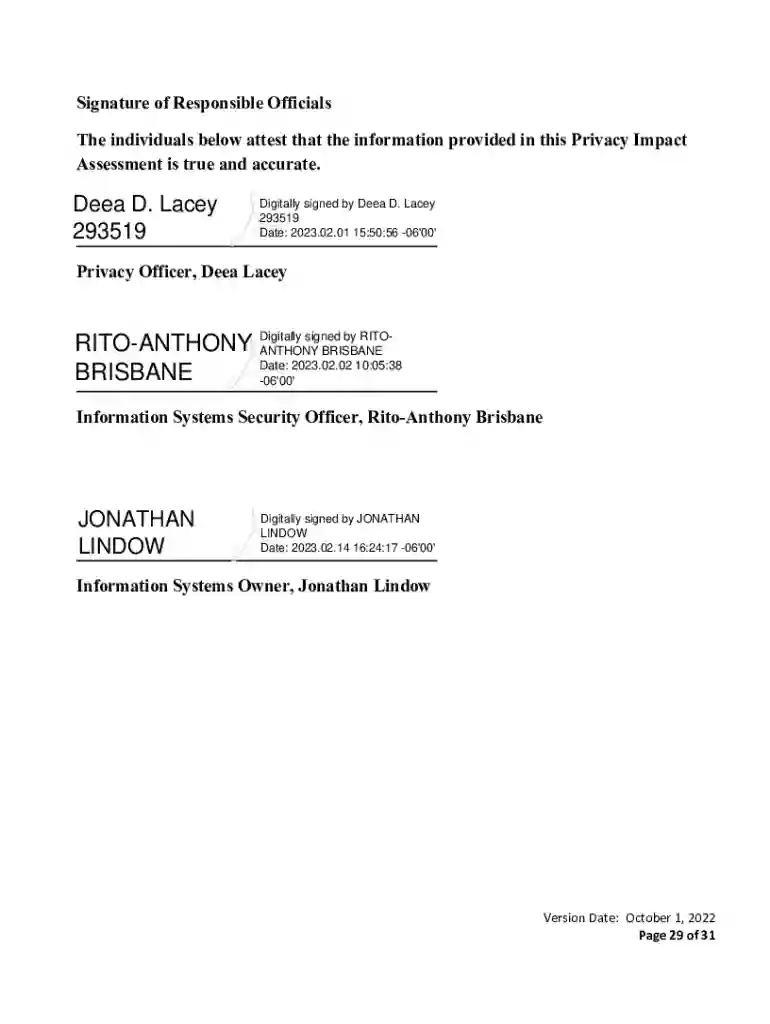
Type text, add images, blackout confidential details, add comments, highlights and more.

Draw your signature, type it, upload its image, or use your mobile device as a signature pad.

Send it via email, link, or fax. You can also download it, export it or print it out.
The Invoice Payment Processing System (IPPS) Privacy Impact Assessment (PIA) refers to a document that assesses the privacy risks involved in managing and processing invoices through the IPPS, a system utilized by the Financial Services Center of the Department of Veterans Affairs. This system is designed to modernize the way invoices are handled, ensuring efficiency and compliance with privacy regulations. The PIA evaluates how personal data is collected, stored, shared, and protected, to uphold transparency and secure sensitive vendor information associated with the Department of Veterans Affairs. This assessment is crucial for maintaining user trust and adhering to national privacy standards in the United States.
Completing the IPPS PIA involves several meticulous steps to ensure thoroughness and compliance with regulatory standards:
Identify Information Types: Determine the types of personally identifiable information (PII) the IPPS collects and processes. This could include vendor names, addresses, financial details, and any other sensitive information.
Understand Stakeholders: Identify all stakeholders involved, ensuring that each party understands their role in handling the data. This includes internal departments within the VA and any external partners who process invoices.
Evaluate Data Flow: Map out how data flows within the system. This step highlights transmission points that may pose privacy risks and requires detailed documentation.
Analyze Risk: Assess potential risks and impacts associated with collecting and using PII. This analysis should consider unauthorized access risks, data breaches, and improper data handling.
Implement Mitigation Measures: Develop strategies and actions to mitigate identified risks, such as encryption methods and access controls.
Review Compliance: Check against relevant laws and regulations, such as the Privacy Act, to ensure that all processes comply with pre-existing legal frameworks.
The legal use of the IPPS PIA is tightly bound with compliance to various federal privacy regulations, ensuring that data collected via the IPPS aligns with the legal requirements such as the Privacy Act and the Federal Information Security Management Act (FISMA). The document outlines permissible data collection, usage, and sharing practices. Its aim is to protect personally identifiable information while facilitating efficient invoice processing for the Department of Veterans Affairs. Legal authorities referenced throughout the PIA are integral in maintaining lawful processing and safeguarding all involved parties’ rights.
The IPPS PIA consists of several key components that ensure comprehensive oversight and accountability in invoice processing:
Purpose and Scope: Clearly delineating the goal of the IPPS and outlining its operational boundaries.
Data Collection Procedures: Explaining how and why data is collected, including the sources from which information is gathered.
Data Sharing and Access: Documenting which entities have access to data and under what circumstances data sharing occurs, ensuring limited and justified sharing practices.
Risk Assessment: Conducting a thorough analysis of potential risks involved in data handling and proposing mitigation strategies.
Security Measures: Description of the security protocols in place to protect data integrity and confidentiality.
Consider a scenario where a vendor submits an invoice to the Department of Veterans Affairs for services rendered. The IPPS processes this invoice by securely handling vendor data, ensuring timely payment while protecting the vendor’s sensitive information. The PIA assesses this sequence to identify and mitigate privacy risks, ensuring each step upholds regulatory compliance. Another example involves evaluating the impact of integrating new system updates within the IPPS, where the PIA would measure potential data privacy implications and outline necessary adjustments to maintain security standards.
The IPPS PIA form typically supports multiple submission methods to accommodate various user needs. Most commonly, submissions can be made:
Online: Through a secure portal provided by the Department of Veterans Affairs, ensuring quick and efficient transmission of the completed form.
Mail: For those who prefer traditional methods, allowing for physical documentation delivery.
In-Person: At designated VA offices, providing the opportunity to clarify any queries directly with officials.
Each method involves specific guidelines to ensure the secure handling and processing of PIAs.
Failure to comply with the requirements outlined in the IPPS PIA can result in several repercussions. These may include:
Businesses that engage in contractual agreements with government entities, particularly the Department of Veterans Affairs, benefit most from the IPPS. These include:
These businesses protect their sensitive data and improve operational efficiency by adhering to the comprehensive privacy assessment offered by the PIA.
We've got more versions of the Invoice Payment Processing System (IPPS) PIA form. Select the right Invoice Payment Processing System (IPPS) PIA version from the list and start editing it straight away!
At DocHub, your data security is our priority. We follow HIPAA, SOC2, GDPR, and other standards, so you can work on your documents with confidence.




IPPS Invoice Processing Platform System IPR IPR Intellectual Property Rights IRD Independent Research and Development. PIA Proprietary Information Agreement
Jul 28, 2026 The Bureau of the Fiscal Service conducts a Privacy Impact Assessment (PIA) on information systems collecting personally identifiable


