
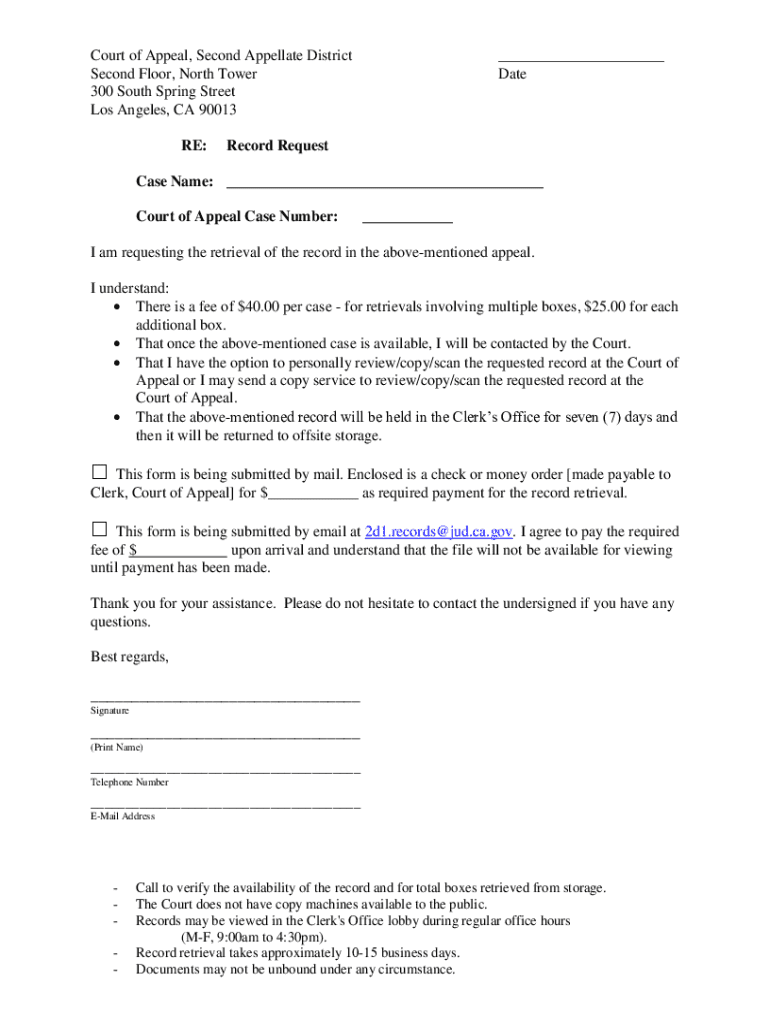







Definition and Purpose of the Record Request Form
The Record Request Form is a document used primarily for retrieving specific records from official sources, such as courts or government entities. Its main function is to serve as a formal request for access to particular documents or files, often for legal, personal, or academic purposes. This form ensures that requests are processed efficiently and accurately, maintaining a standardized approach to document retrieval.
A crucial aspect of the Record Request Form is its ability to outline essential details such as the type of record being requested, the requester's information, and the purpose for the record's use. The form also often includes a section for payment details, reflecting any applicable fees associated with processing the request. This structured approach aids in managing and tracking these requests efficiently.
How to Use the Record Request Form
Understanding the process of utilizing the Record Request Form is critical for successful submission. Begin by clearly identifying the specific record you wish to access. This ensures that the form provides precise information, reducing the possibility of delays or errors during processing.
-
Identify the Record: Begin by determining the exact document or set of records you need. Clearly state the title or category of the record on the form.
-
Complete Personal Information: Fill out your full name, address, contact number, and email address. Accurate contact details are necessary for any follow-up communication.
-
Specify the Purpose: Clearly outline the reason for your request. This could be for legal proceedings, academic research, or personal reasons.
-
Payment Information: Include details of how you will cover any applicable fees. This could involve credit card information or details for an electronic transfer.
-
Review and Submit: Carefully review your completed form for accuracy. Any errors could delay processing. Submit the form as per the instructions provided, which could vary based on the issuing authority.
Steps to Complete the Record Request Form
Completing the Record Request Form requires attention to detail and a clear understanding of the information needed. Follow these steps to ensure a smooth process:
-
Read the Instructions: Thoroughly read all instructions provided with the form. Each section will have specific requirements that must be followed.
-
Gather Required Documents: Prepare any necessary documents that might support or verify your request, such as identification or case numbers.
-
Fill Out Each Section: Address each section of the form, starting with personal information and ending with any special instructions or additional information fields.
-
Include Required Attachments: If applicable, include any required attachments, such as proof of identity. Ensure that these attachments are clear and legible.
-
Check for Completeness: Confirm that each section is complete and that information is accurate. Double-check all entries for typos or missing data.
-
Submit According to Guidelines: Depending on the instructions, submit the form through the designated method, which may include mailing it, dropping it off in person, or submitting it online.
Legal Use of the Record Request Form
The legal use of the Record Request Form is predominantly governed by the jurisdiction under which it is issued. This form typically serves in contexts where records are needed for various legal procedures or official matters, such as court cases, legal disputes, or government filings.
-
Court Proceedings: Often, attorneys or parties involved in a litigation process will use the form to request court records or evidence needed for building a legal case.
-
Government Requests: Government agencies may require these forms to be submitted when requesting documents stored in archives or databases, ensuring there is a formal record of who requested what information and why.
-
Confidentiality and Compliance: When handling sensitive records, the form may include sections outlining legal obligations related to confidentiality and compliance with data protection laws.
Important Terms Related to the Record Request Form
Understanding the terminology associated with the Record Request Form is crucial for accurate completion and submission:
-
Appellant: In some forms related to court records, the appellant is the person who filed an appeal against a decision or judgment.
-
Authentication: Verification that the requester has the right or permission to access specific records.
-
Disclosure: Permission or legal requirement to share certain information contained within the records that are requested.
-
Retention Period: The length of time the requested records will be held and the conditions under which they can be released or accessed.
-
Petition: A formal written request, sometimes required alongside the main form, asking the court or issuing authority to release specific records.
Key Elements of the Record Request Form
Several critical components make up the Record Request Form, each serving a distinct function to ensure the form fulfills its purpose:
-
Personal Information Section: Where the requester provides their basic contact information for identification and further communication.
-
Details of the Request Section: Specifies the record type, period, and any other particulars, ensuring precise retrieval of documents.
-
Purpose of Request: Explains why the requester needs the records, whether for a legal case, personal use, or research.
-
Declaration and Signature: Includes a formal declaration where the requester certifies the accuracy of the information provided and agrees to terms, followed by a signature.
-
Payment Information: Section for specifying how any service fees will be handled, ensuring the request process is financially prepared.
Examples of Using the Record Request Form
The Record Request Form can be employed in various scenarios, illustrating its flexibility and importance:
-
Legal Proceedings: Attorneys may submit the form to access court documents necessary for a pending case, ensuring they have the required evidence to support their arguments.
-
Academic Research: Scholars conducting detailed historical research might request government archive records, using the form to specify the time period and nature of the documents needed.
-
Medical Records: An individual might use a version of the Record Request Form to obtain their personal medical records for a second opinion or transfer to another healthcare provider.
Form Submission Methods
The methods for submitting the Record Request Form usually depend on the issuing authority’s requirements and available technology:
-
Online Submission: Many institutions accept electronic submissions, allowing easier access and faster processing. Users complete the form on a website, often uploading supporting documents digitally.
-
Mail Submission: If online options are unavailable, forms may be mailed to the provided address. This method often requires careful attention to form completeness and the correct postage.
-
In-Person Submission: In some cases, presenting the form directly to an office might be required, which can expedite verification processes and enable personal assistance.
By maintaining a comprehensive understanding of these topics and procedures, individuals and organizations can effectively navigate the process associated with the Record Request Form.




