






Key Elements of the General Contractor Agreement Template
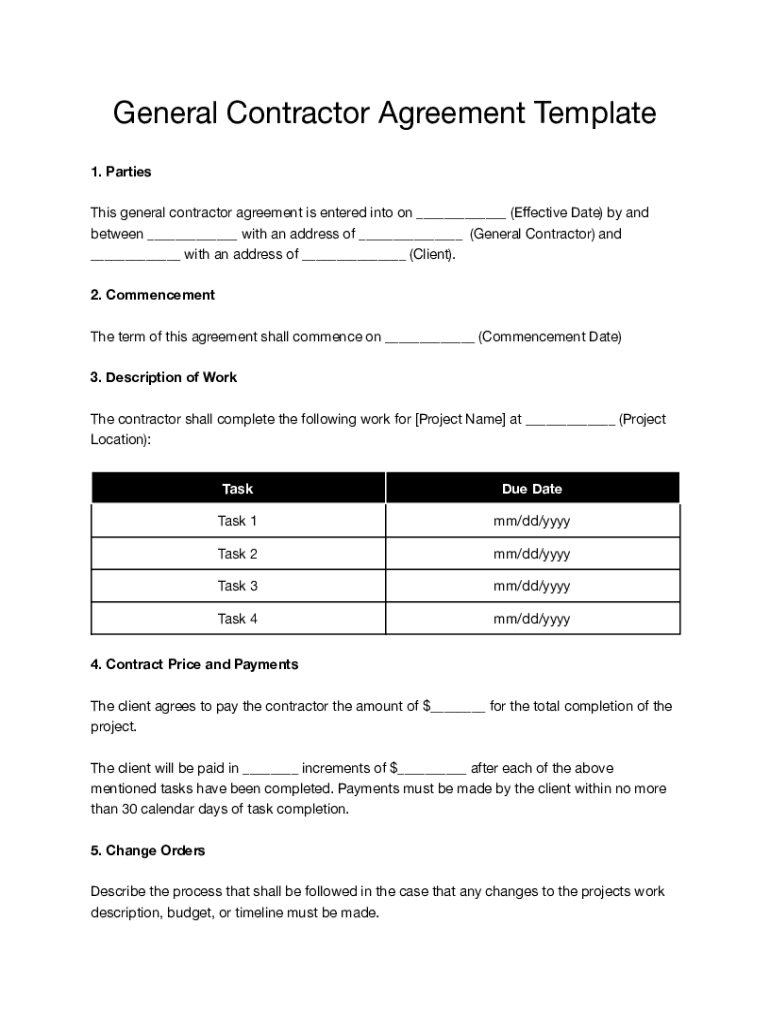
The General Contractor Agreement Template is essential for outlining the agreement terms between a contractor and a client for a specified project. It includes various critical sections that ensure clarity and protect the interests of both parties involved.
- Parties Involved: This section specifies the names, addresses, and roles of the parties in the agreement — the client and the general contractor.
- Project Commencement: Details on when the project is expected to start, along with anticipated timelines.
- Description of Work: An in-depth description of the services to be provided by the contractor, often including project specifications and quality standards.
- Payment Structure: Outlines the payment terms, including deposit amounts, milestone payments, final payment, and any late fees.
- Change Orders: Procedures for making changes to the scope of work, including how changes can affect pricing and schedule.
- Insurance Requirements: Specifies the types and amounts of insurance coverage the contractor must maintain.
- Permits and Licenses: Requirements for any necessary permits or licenses needed for the project.
- Confidentiality Clause: Conditions under which information related to the project should be kept confidential.
- Warranties: Information about any warranties provided by the contractor, including duration and coverage extent.
- Termination Conditions: Circumstances under which the agreement may be terminated by either party.
- Entire Agreement Clause: A statement that this document represents the complete understanding between the parties.
Steps to Complete the General Contractor Agreement Template
Completing the General Contractor Agreement Template involves a series of carefully executed steps to ensure the document accurately reflects the agreed-upon terms.
- Identify the Parties: Begin by filling in the names and contact information of the client and contractor.
- Specify the Project Details: Clearly define the project scope, including timelines and specifics about the work to be performed.
- Outline Payment Terms: Detail the payment arrangements, including amounts, schedules, and methods, ensuring all parties agree.
- Address Change Orders: Include provisions for handling any changes in the contract, describing the process and implications on the original terms.
- Insurance Verification: List the required insurance policies, ensuring the contractor demonstrates proof of coverage.
- Include Legal Provisions: Fill sections on confidentiality, warranties, and termination clauses carefully to prevent future disputes.
- Final Review and Signatures: Once the template content is completed, review the document thoroughly. Parties can then sign and date it, finalizing the agreement.
Important Terms Related to the General Contractor Agreement Template
Understanding the specific terms within the General Contractor Agreement Template is crucial for both legal and operational clarity.
- Scope of Work: Defines the full range of activities the contractor is expected to perform.
- Retainage: A portion of payment withheld until the project is completed satisfactorily.
- Indemnity: A contractual obligation of one party to compensate for losses incurred by the other.
- Force Majeure: A clause that allows for contract termination or modification due to unforeseen events like natural disasters.
- Lien Waiver: A document from the contractor forgoing the right to hold a lien against the property.
Legal Use of the General Contractor Agreement Template
The General Contractor Agreement Template must be used in compliance with applicable legal requirements to ensure enforceability.
- Compliance with State Laws: Different states have unique legal requirements for contracts, influencing elements like licensing and warranties.
- Binding Arbitration vs. Litigation: Deciding through mutual consent whether disputes will be resolved via arbitration or in court.
- Non-discrimination Provisions: Ensuring the agreement abides by state and federal laws prohibiting discrimination in employment or service provision.
Who Typically Uses the General Contractor Agreement Template
Various parties might find the general contractor agreement template beneficial, reflecting the broad applicability of such agreements.
- Independent Contractors: Often employed for single projects, such as home renovations or new constructions.
- Construction Firms: Use these templates as part of business transactions with clients.
- Property Owners/Clients: Individuals or companies employing contractors for projects ranging from small renovations to large-scale constructions.
- Subcontractors: Components of the agreement might be adapted to fit subcontractor arrangements if additional expertise or labor is needed through a secondary layer of contracting.


State-Specific Rules for the General Contractor Agreement Template
Regulations may vary considerably by state, affecting the use and enforcement of general contractor agreements.
- Licensing Requirements: Some states demand contractors hold specific licenses for certain types of work, which might need to be included explicitly in the agreement.
- Consumer Protection Laws: States like California have specific statutes protecting consumer rights in construction contracts.
- Liability Insurance Standards: Different jurisdictions may set minimum insurance coverage a contractor must maintain.
Versions or Alternatives to the General Contractor Agreement Template
Several variations or related forms might serve similar purposes or provide additional features within construction contracts.
- Subcontractor Agreements: Variants that specifically address the legal context of subcontractor arrangements.
- Lump Sum Contracts: A version focused on delivering a project for an agreed-upon sum, differing from cost-plus models.
- Design and Build Contracts: Integrate design responsibilities with construction tasks, suitable for projects where a single entity handles both design and construction.
Why Use a General Contractor Agreement Template
Utilizing a General Contractor Agreement Template offers numerous practical benefits:
- Clarity in Expectations: Helps all parties understand their responsibilities, which reduces misunderstandings.
- Legal Protection: Offers structured protection for both client and contractor interests should disputes arise.
- Efficiency in Preparation: Speeds up contract preparation through pre-formatted and legally vetted clauses.
- Professional Appearance: Provides a polished document reflective of professional standards in the construction industry.
How to Use the General Contractor Agreement Template
Using the General Contractor Agreement Template effectively requires a systematic approach.
- Customization for Each Project: Tailor the template to match the specific requirements and nuances of individual projects.
- Consultation with Legal Professionals: Ensure compliance with local laws through a review by qualified legal specialists.
- Review and Approval Process: Obtain input and confirmation from all stakeholders involved before finalizing the agreement.