
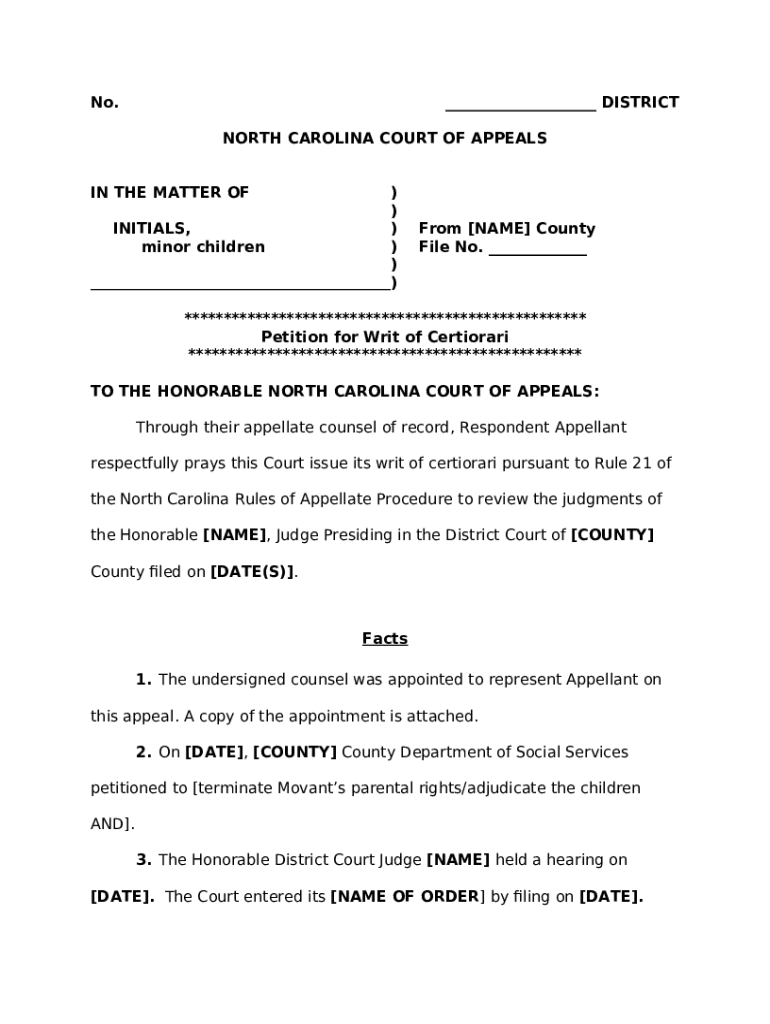







Definition & Meaning
A Petition for Writ of Certiorari is a legal document filed to seek judicial review of a decision by a lower court. It acts as a formal request for a higher court to assess the legal justifications of a prior ruling. This petition is commonly used to challenge the judgments of appellate courts, including the U.S. Supreme Court and various state supreme courts. Specifically, it aims to pinpoint errors in lower court decisions, including procedural mistakes or misinterpretations of law, that may have affected the verdict.
Real-world Implications
- Often used in cases involving significant legal principles or constitutional issues.
- Appeals are discretionary, meaning higher courts can choose whether to accept or deny the petition.
- Limited to specific cases where no further direct appeal is available or where judicial precedents need examination.
Key Elements of the Petition for Writ of Certiorari
Each petition contains critical components that judges evaluate when deciding to accept or deny a review:
- Case Summary: The factual and procedural background that led to the current legal situation.
- Questions Presented: Clearly formulated legal questions the petitioner wants the higher court to address.
- Reasons for Granting the Petition: Arguments explaining why the higher court should consider the case, focusing on errors in the lower court's legal interpretation.
- Appendix: Includes relevant record excerpts and exhibits from lower court proceedings.
Steps to Complete the Petition for Writ of Certiorari
The process to complete this document requires careful attention to detail:
- Draft the Petition: Ensure all components, including the case summary and legal questions, are clearly articulated.
- Gather Supporting Documents: Include pertinent case records and legal precedents.
- Review for Compliance: Verify adherence to court-specific rules governing the format, length, and submission of the petition.
- Submit the Petition: File the completed petition with the appropriate higher court within specified deadlines.
Practical Tips
- Enlist an attorney experienced in appellate law to ensure the petition is compelling and legally sound.
- Check court jurisdiction to confirm the petition is filed with the correct court.
Filing Deadlines / Important Dates
Timeframes are critical when filing a Petition for Writ of Certiorari:
- U.S. Supreme Court: Typically 90 days from the date of the lower court's final judgment.
- State Courts: Deadlines vary; consult specific court rules to avoid missing critical filing windows.
Consequences of Missing Deadlines
- Failing to meet filing deadlines generally results in dismissal of the petition.
- Extensions may be granted under exceptional circumstances, but require substantiated requests.
Legal Use of the Petition for Writ of Certiorari
The document serves a precise legal function:
- Primarily employed in appellate litigation to challenge misapplications of law.
- Instrumental in setting precedents for future legal interpretations.
- Often used in cases that warrant national significance, potentially affecting large populations.
State-Specific Rules for the Petition
While many aspects of filing are universal, state-specific protocols exist:
- Paperwork Requirements: States may dictate distinct forms or additional documentation.
- Submission Procedures: Filing methods and court contact points can vary significantly.
- Court Fees: Costs associated with filing can differ by state and case specifics.
Example: North Carolina
In North Carolina, petitions to the Court of Appeals for termination of parental rights must illustrate trial counsel’s errors, demanding a comprehensive understanding of local appellate procedures.
Who Typically Uses the Petition for Writ of Certiorari
The petition is primarily utilized by:
- Attorneys and Legal Practitioners: Represent clients seeking appellate review.
- Individuals: Parties from lower court cases aiming to challenge decisions.
- Corporations and Entities: Often involved in significant appellate litigation affecting business operations.


Important Terms Related to the Petition
Understanding critical terminology aids in the comprehension and drafting of the petition:
- Certiorari: A Latin term meaning "to be informed of," reflecting the petition’s purpose.
- Appellate Review: A higher court's examination of a lower court's decision.
- Judicial Precedent: Previous court decisions that influence future case rulings.
Contextual Definitions
- Errors of Law: Disagreements over the legal interpretations made by a lower court.
- Procedural Mistakes: Errors in the way a lower court conducted the proceedings.
By providing this detailed breakdown, users of a Petition for Writ of Certiorari can navigate its complexities more effectively, ensuring higher chances of success in their appellate pursuits.




