Definition & Meaning
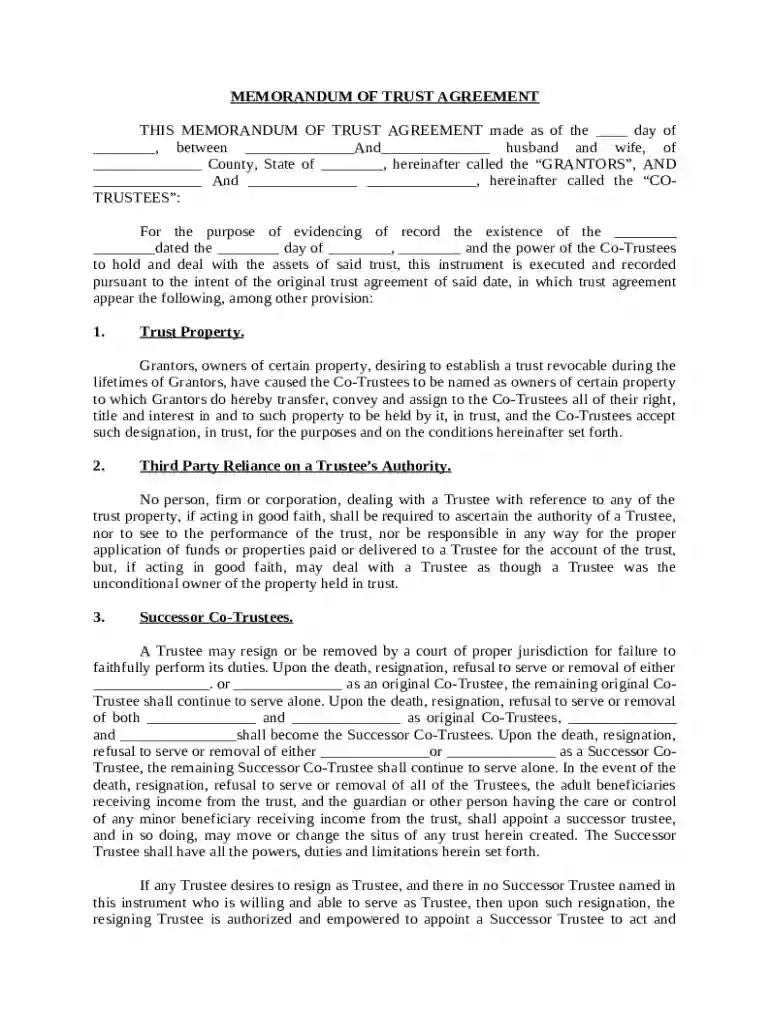
A Memorandum of Trust Agreement is a legal document that serves to outline the establishment of a trust, specifying the roles and responsibilities of the Grantor(s) and Trustee(s). Typically, it involves detailing the name of the trust, the identities of its Co-Trustees, and the nature of the trust property. The document is vital for formalizing the trust's existence and its governance terms. It is particularly important for managing financial and property transfers while maintaining confidentiality regarding the specific assets involved.
Key Components
- Grantor: The individual or entity creating the trust, often transferring assets into it.
- Trustee: The appointed person or institution managing the trust according to its terms.
- Trust Property: The assets under the trust’s control, which the Trustees manage and distribute as directed.
Purpose and Use
Memorandums of Trust Agreement help in transferring property under managed terms, allowing the Grantor to specify how assets should be handled without listing them publicly. This is often used in estate planning to maintain privacy and ensure wishes are respected in the event of incapacitation or death.
How to Use the Memorandum of Trust Agreement
Practical Scenarios
- Estate Planning: Individuals seeking to arrange the efficient transfer of their property posthumously often use this document.
- Property Management: Those wanting to manage real estate or financial assets through a trusted legal framework.
Process Overview
- Identify Parties: Determine who will serve as Grantor(s) and Trustee(s).
- Define Terms: Clarify rights, responsibilities, and terms for managing the trust assets.
- Execution: Both parties must sign the document to legally enforce the trust arrangement.
Real-World Example
An elderly couple might establish a revocable trust to ensure their children receive their property seamlessly upon their death, naming one child as the Co-Trustee to manage it.
Steps to Complete the Memorandum of Trust Agreement
- Gather Required Information: Collect personal details about the Grantors, Trustees, and the trust name.
- Draft Document: Create a draft outlining the trust's purpose, the property involved, and the roles of each party.
- Set Terms and Conditions: Clearly define the powers and duties of the Trustees, including any conditions under which they may be replaced.
- Include Legal Provisions: Ensure compliance with relevant legal requirements, including applicable state laws.
- Sign and Notarize: Obtain signatures from all involved parties and have the document notarized for legal validity.
Legal Use of the Memorandum of Trust Agreement
Compliance and Legal Guidelines
- State Law Compatibility: Ensure the document aligns with the state’s specific trust laws and legal terminology.
- Third-Party Reliance: Outlines terms for third parties to rely on the trust without needing to know the specifics of the assets.
Legal Assistance
Engaging an attorney familiar with trust law is often beneficial to ensure compliance and address complex legal scenarios.
Case Study
Consider a high-net-worth individual who uses a Memorandum of Trust Agreement to manage diverse assets, ensuring that the legal framework accommodates substantial financial interests while maintaining confidentiality.
Important Terms Related to Memorandum of Trust Agreement
Common Terms
- Revocable Trust: Allows changes or terminations by the Grantor.
- Irrevocable Trust: Cannot be modified once established without the beneficiaries' consent.
Definitions
- Successor Trustee: Person designated to take over trustee duties if the original Trustee can no longer serve.
- Fiduciary Duty: Legal obligation of the Trustee to act in the best interest of the beneficiaries.
State-Specific Rules for the Memorandum of Trust Agreement
Variations by State
- Recognition of Terms: Some states require more detailed beneficiary designations or specific language to validate the trust.
- Additional Documentation: Certain states might demand further support documents, like affidavits, to back the agreement.
Example State Specifics
California necessitates a slightly different approach, often requiring the inclusion of community property considerations for married Grantors, which might not be necessary in individual property law states like New York.
Examples of Using the Memorandum of Trust Agreement
Real-World Applications
- Family Business Transition: Parents establish a trust to incrementally transfer control of a business to their children.
- Educational Funds: Creating a trust to manage and disburse funds for grandchildren’s education, ensuring financial preparation over the years.
Hypothetical Scenario
An entrepreneur sets up a trust to manage their company's shares during succession planning, appointing a trusted advisor as a Co-Trustee to oversee decisions while protecting family interests.
Key Elements of the Memorandum of Trust Agreement
Structural Components
- Trust Name: Official designation of the trust for administrative and legal use.
- Co-Trustees: Identifies parties responsible for executing the trust’s terms.
- Distribution Clause: Specifies how and when trust property should be distributed to beneficiaries.
Important Considerations
- Amendment Provisions: Flexibility for the Grantor to update terms if it’s a revocable trust.
- Dissolution Terms: Conditions under which the trust may be terminated or dissolved.
Example
Providing a clear specification of beneficiaries’ entitlements ensures there is no ambiguity in how distributions should occur, which could eliminate potential disputes among family members.