
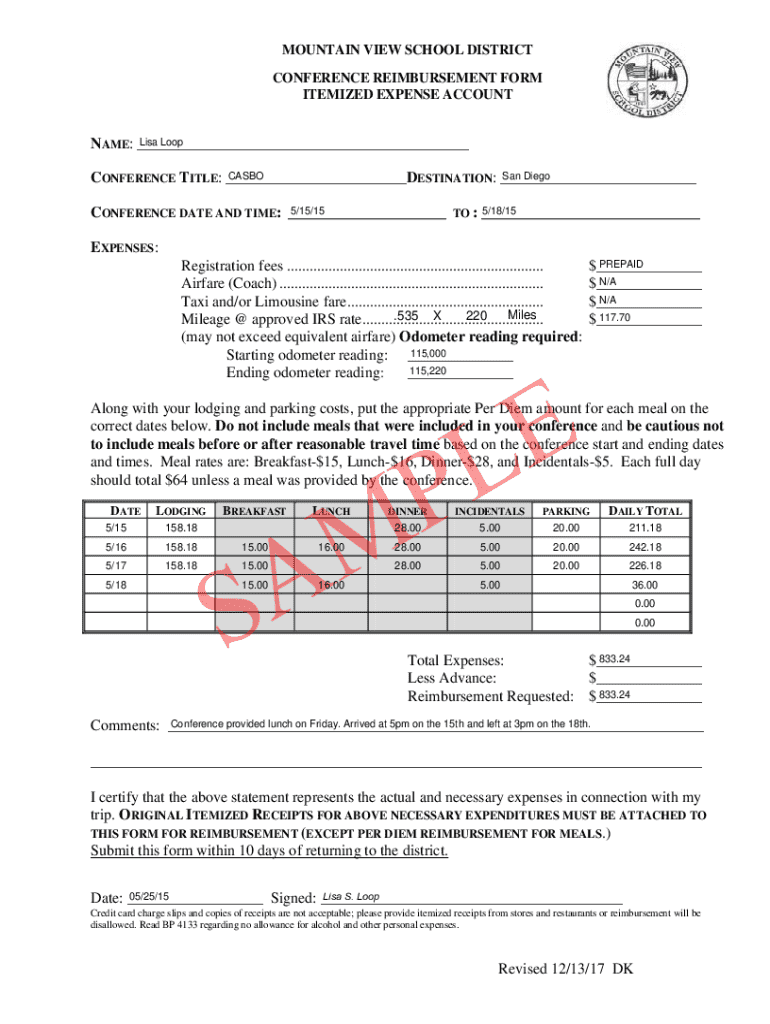







Definition and Purpose of the Conference Reimbursement Form
The Conference Reimbursement Form serves as a detailed document used for claiming expenses incurred during conferences. It captures all necessary details related to the costs a participant encounters, allowing an entity to verify and approve these expenses for reimbursement. Key expenses typically include registration fees, lodging, meals, travel, and other incidentals relevant to the conference visit. This form functions as an essential tool within both educational and professional settings where attending conferences contributes toward personal development or organizational goals.
Key Elements Captured in the Form
The form systematically lists and categorizes various expenses to ensure clarity and accuracy in reporting. Essential elements include:
- Personal Information: Includes the participant's name, department, and contact details.
- Conference Details: Specifies the event name, location, dates, and purpose.
- Itemized Expenses: Breaks down costs into categories such as registration, airfare, accommodation, and meals.
- Total Cost Calculation: Summarizes all expenses to provide a clear picture of total outlay.
Each section of the form is designed to ensure that all critical information is captured accurately, thereby facilitating a smooth reimbursement process.
Steps to Complete the Conference Reimbursement Form
Completing a Conference Reimbursement Form involves a detailed process to ensure all expenses are accurately documented and justified. This section outlines each step with precision:
-
Gather Necessary Receipts and Documents: Collect all receipts and documentation related to conference expenses, including confirmation emails and payment proofs.
-
Detail Conference Information: Fill out the participant’s details and conference specifics such as location, dates, and purpose, ensuring alignment with organizational policies.
-
Itemize Expenses: List individual expenses in their respective categories. Include necessary details such as transaction dates and vendor information for each cost.
-
Calculate Total Costs: Sum up all itemized expenses to provide an overall cost summary. Double-check all calculations for accuracy.
-
Attach Support Documents: Affix all original receipts and any pertinent documentation to support the claims made on the form.
-
Review and Sign: Ensure all sections are complete and accurate, then sign the form. Obtain any necessary approvals as required by your organization.
Completing the form meticulously helps expedite the approval and reimbursement processes, reducing back-and-forth communication to clarify discrepancies.
Required Documents for Submission
Accurate reimbursement requires comprehensive documentation. Here, the critical documents required for submission with the Conference Reimbursement Form are highlighted:
- Original Receipts: For registration fees, travel, lodging, meals, and any other reimbursable expenses.
- Itinerary and Agenda: Provides context for conference participation, aiding in justifying the necessity of each expense.
- Proof of Payment: Such as credit card statements or canceled checks for cross-verifying expenses.
- Employer Authorization: If applicable, documentation showing prior approval to attend the conference.
Special Considerations
- Digital vs. Physical Copies: Depending on organizational policies, both digital and hard copies of documents might be required. Confirm preferences beforehand.
Compiling these documents ahead of time helps streamline the reimbursement process and minimizes potential discrepancies.
Submission Methods: Online, Mail, or In-Person
Submitting the Conference Reimbursement Form can be done through several channels. Understanding these options ensures timely and efficient processing:
Online Submission
- Platform Compatibility: The form can be filled and submitted via platforms like DocHub, enabling ease and speed in document management.
- Digital Signature: Secure and legally-binding electronic signatures streamline the approval process.
- Document Upload: Attach supporting documents directly within the platform for a consolidated submission package.
Mail Submission
- Physical Copies: Mail the completed form and attached documents to the designated reimbursement office.
- Tracking: Use certified mail services to track document receipt, ensuring accountability.
In-Person Submission
- Direct Interaction: Offers an opportunity to address potential questions face-to-face when handing in documents.
- Receipt Confirmation: Obtain a receipt or confirmation slip upon submission for personal records.
By understanding and utilizing the appropriate submission method, participants can ensure their reimbursement requests are processed smoothly and efficiently.
Legal Considerations and Requirements
Ensuring compliance with legal requirements is critical when handling any form that relates to financial transactions. The Conference Reimbursement Form is no exception:
Compliance with Regulations
- IRS Guidelines: Ensure reimbursement aligns with IRS requirements, such as maintaining detailed records and reporting taxable benefits if applicable.
- Organizational Policies: Verify with your organization’s financial policies to confirm eligibility of each expense claimed.
Required Disclosures
- Accurate Reporting: Misreporting expenses can lead to penalties or denial of reimbursement. Transparency in claiming only eligible expenses is crucial.
- Fraud Prevention: Organizations may audit submitted forms to prevent fraudulent claims. Being thorough with documentation helps safeguard against such concerns.
Understanding these legal considerations not only ensures compliance but also reinforces trust and accountability within the reimbursement process.
State-Specific Rules for Conference Reimbursement
Though many conference reimbursement rules are universally applicable, certain state-specific regulations may apply based on location or policies in place.
- Variable Per Diem Rates: Some states have distinct per diem rates for meals and lodging, which must be adhered to.
- State Tax Considerations: Be mindful of any state-specific requirements regarding taxable reimbursements.
By being cognizant of these state-specific regulations, applicants can avoid potential complications or rejections in their claims, ensuring the correct processing of reimbursement requests.
Practical Scenarios and Examples
- Example 1: An academic professional from California may need to submit additional certification for educational conferences for compliance with certain institutions.
- Example 2: State-funded organizations in Texas might necessitate additional disclosures for reimbursing expenses under state budgets.
Regional knowledge ensures utmost compliance and reduces administrative overhead in processing claims.
Important Terms and Definitions
Grasping the terminology used in the Conference Reimbursement Form aids in accurate form completion and effective communication with the administrative body processing the claims.
- Per Diem: An allowance for lodging, meals, and incidental expenses incurred while traveling.
- Reimbursement: Compensation received for out-of-pocket expenses related to business activities.
- Itemized Expense: A specific expense listed with details regarding cost, date, and purpose.
- Receipt: A document that provides proof of payment made for services or products.
Understanding these terms eliminates ambiguity, ensuring clarity in processing reimbursement claims and fostering coherent communication between parties involved.




