




01. Edit your form online
Type text, add images, blackout confidential details, add comments, highlights and more.

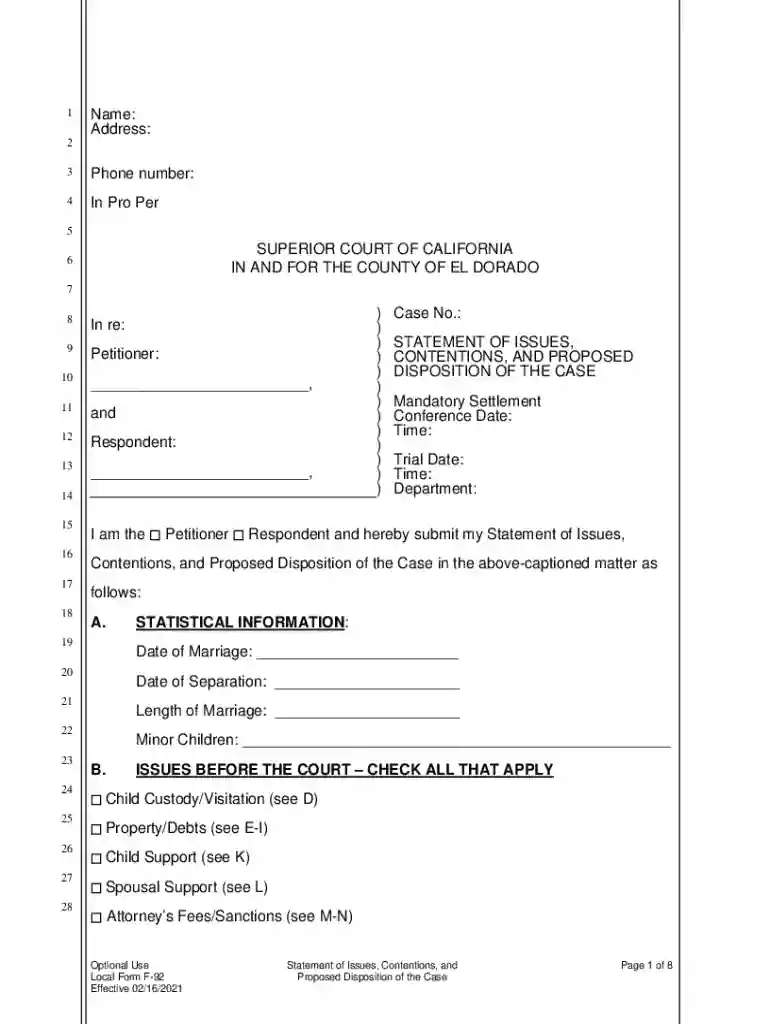
Type text, add images, blackout confidential details, add comments, highlights and more.

Draw your signature, type it, upload its image, or use your mobile device as a signature pad.

Send it via email, link, or fax. You can also download it, export it or print it out.
The "Statement of Issues, Contentions, and Proposed Disposition of the" is a legal document generally used in family law cases in the Superior Court of California. It outlines the key issues, disputing parties' contentions, and suggested resolutions regarding matters like child custody, visitation rights, property division, child and spousal support, and attorney fees. This document helps clarify each party's position on these issues before a court hearing, making it easier for the judge to understand the case dynamics and make informed decisions.
In crafting this statement, several critical components must be included for clarity and comprehensiveness:
Each of these elements serves as a building block to construct a complete view of the parties' viewpoints and expected outcomes.
Completing the Statement of Issues, Contentions, and Proposed Disposition of the involves several precise steps:
Following these steps ensures the statement is thorough, structured, and presents a convincing narrative to the court.
This document is pivotal in family law cases, facilitating informed judicial decision-making. By presenting all issues, contentions, and proposed dispositions coherently, it provides a structured narrative for the judge to follow. Legal practitioners utilize this statement to succinctly summarize the case, emphasize pressing issues, and propose equitable solutions. Its legal credibility lies in setting clear expectations for potential outcomes, thereby aiding in courtroom proceedings.
While the statement is used in California, variations might exist based on jurisdictional nuances. Regional courts might have different submission protocols, formatting standards, or content requirements. Practitioners must tailor the document in accordance with specific state directives. It's crucial to consult local court rules or legal professionals knowledgeable about state-specific procedures to ensure compliance.
This form is predominantly used by individuals involved in family law disputes, such as divorce or custody cases. Legal representatives for the parties involved usually draft these documents. However, pro se litigants—individuals representing themselves—might also compile this statement if they opt not to engage an attorney, given their understanding of legal processes.


Given the complexity and detail needed, using platforms like DocHub can significantly streamline the form preparation process. DocHub supports a variety of document formats and offers a suite of editing tools that enable easy annotation, text insertion, and real-time collaboration. These digital features ensure accuracy, enhance efficiency, and eliminate manual errors, which are crucial when drafting legal documents.
Consider the example of a couple disputing child custody arrangements. Each party would use this statement to articulate their preferred custody schedule, back their preferred arrangement with relevant evidence or testimonials, and propose a custodial plan that supports the child's best interests. Similarly, in a property division dispute, each party would outline what assets they believe are marital property and propose an equitable division plan based on legal grounds.
Failing to submit the "Statement of Issues, Contentions, and Proposed Disposition of the" may result in procedural setbacks. The court might delay proceedings, or the party at fault could lose the opportunity to present their arguments fully. Compliance is crucial to ensure that the case advances without unnecessary legal and procedural hurdles.
Timely submission is critical. Courts usually have specific deadlines for submitting this statement, and missing these can lead to complications in court proceedings. It's important to verify deadlines with the local court clerk's office or through legal counsel to ensure timely delivery. This ensures that all necessary preparations are completed efficiently and effectively.
Key terms to understand include "contentions," referring to party arguments; "issues," identifying disputed points; and "proposed disposition," relating to suggested outcomes. Familiarity with these terms is essential to effectively prepare and submit this document in a legal context. Understanding and correctly applying these terms can enhance the clarity and persuasiveness of the submission.
We've got more versions of the Statement of Issues, Contentions, and Proposed Disposition of the form. Select the right Statement of Issues, Contentions, and Proposed Disposition of the version from the list and start editing it straight away!
At DocHub, your data security is our priority. We follow HIPAA, SOC2, GDPR, and other standards, so you can work on your documents with confidence.




Family Law ; Statement of Issues, Contentions, and Proposed Disposition of the Case PDF Document, F-92, Eff. 02/16/2021 ; Child Custody Recommending CounselingRead more
The FAAs speaking order is the product of every appeal. It is reviewed by the Information Commission and (rarely) by writ courts.


