
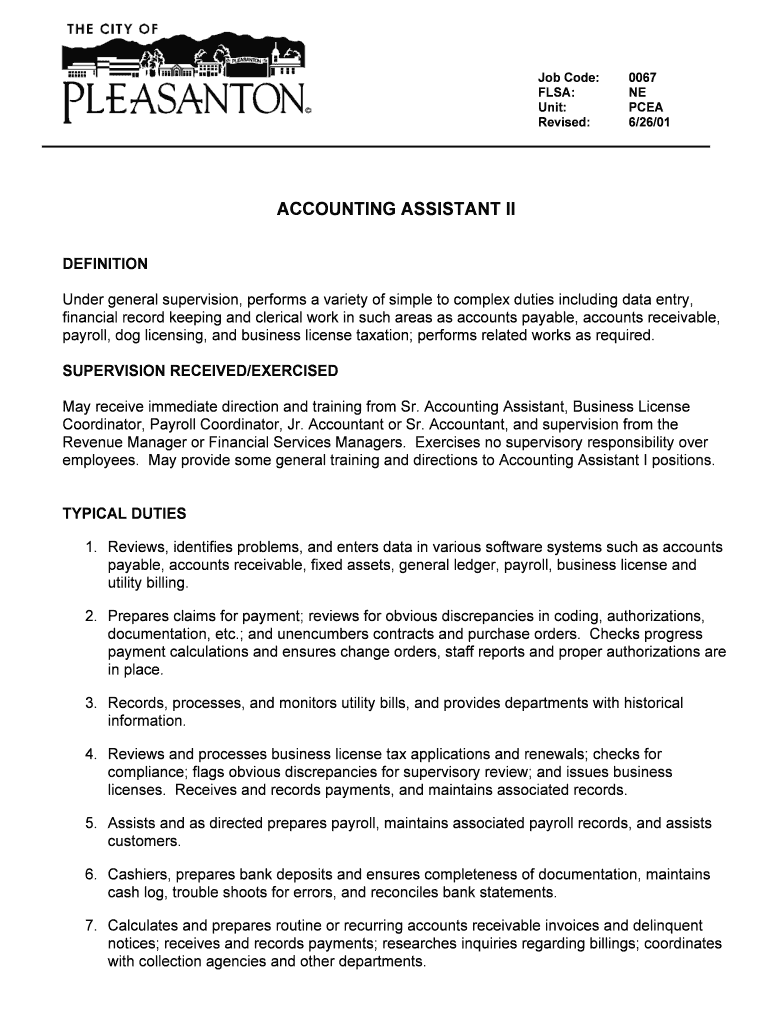







Definition & Role of Accounting Assistant II
An Accounting Assistant II typically holds a vital role within an organization’s finance department, providing essential support to accountants by managing day-to-day financial transactions and records. Responsibilities encompass data entry, processing payments, and maintaining accurate bookkeeping for accounts payable and receivable. This position requires meticulous attention to detail and proficiency in financial software to ensure precise tracking of all monetary exchanges. Employees in this role often handle payroll tasks and coordinate with other departments to streamline financial operations.
Key Responsibilities
- Data Management: Enter, update, and maintain financial data in accounting systems.
- Payment Processing: Execute payments and manage company financial obligations.
- Record Keeping: Maintain organized records for financial transactions.
- Clerical Tasks: Conduct routine clerical duties related to finance, such as filing documentation and preparing reports.
- Coordination: Interact with suppliers and clients to address payment discrepancies.
Steps to Complete Tasks as an Accounting Assistant II
Performing the duties of an Accounting Assistant II involves following a structured process to ensure tasks are completed accurately. Here’s a detailed guide on executing these responsibilities effectively:
- Data Entry: Accurately input financial data into accounting software, ensuring information matches source documents like bills and receipts.
- Verification: Double-check entries against original documents for consistency and correctness.
- Payment Processing:
- Review purchase orders and invoices before payment.
- Schedule and execute payments, always verifying account balances.
- Record Maintenance: Update financial records regularly, ensuring current and past transactions are documented and accessible for audits.
- Reconciliation:
- Conduct monthly reconciliations of account statements.
- Identify and rectify inconsistencies in financial records.
- Clerical Support: Assist in preparing financial summaries and reports as required by senior accountants or management.
Importance of the Accounting Assistant II Role
The Accounting Assistant II serves a crucial function in the financial ecosystem by facilitating smooth financial transactions and maintaining diligent records. This role ensures:
- Accuracy in Financial Transactions: Helps prevent errors that could lead to financial discrepancies.
- Efficient Payment Processing: Maintains the organization’s reputation by ensuring timely payments to vendors and employees.
- Organized Record-Keeping: Supports audits and internal reviews by providing readily accessible and accurate financial records.
- Support to Senior Accountants: Eases the workload of senior staff by managing routine accounting tasks.
Understanding Important Terms Related to Accounting Responsibilities
- Accounts Payable (AP): Short-term liabilities or money owed by a company to vendors or suppliers for purchases on credit.
- Accounts Receivable (AR): Funds a company expects to receive from customers for goods or services delivered.
- Payroll: The process related to compensating employees including managing wages, deductions, and benefits.
- Reconciliation: The process of comparing internal financial records against external statements to ensure consistency.
- Ledger: A book or collection of financial accounts where transactions are recorded systematically.
Legal Considerations for Accounting Assistance Roles
Accounting Assistant II positions must comply with state and federal financial regulations to ensure ethical and legal practices:
- Adherence to GAAP: Ensure all financial reporting and record-keeping follow the Generally Accepted Accounting Principles.
- Confidentiality: Safeguard sensitive financial information to prevent unauthorized access or disclosure.
- Compliance with Tax Regulations: Assist in preparing necessary documentation for internal and tax audits.
Key Elements of the Position
Breaking down the core components of the Accounting Assistant II role provides clarity about expectations and duties:
- Technical Proficiency: Competence in using accounting software (e.g., QuickBooks, Excel).
- Attention to Detail: Ability to spot numerical errors and discrepancies in financial documents.
- Organizational Skills: Manage multiple tasks efficiently, structuring workload to meet deadlines.
- Communication: Engage effectively with team members, vendors, and clients.
Software Compatibility for Financial Management
To perform efficiently, understanding software compatibility is crucial. Commonly used accounting tools include:
- QuickBooks & TurboTax: Widely used for managing small business accounts, invoicing, and tax preparation.
- Microsoft Excel: Essential for creating spreadsheets and financial reports.
- Enterprise Resource Planning (ERP) Systems: Centralized software solutions for managing business activities across departments.
Eligibility and Qualifications for Becoming an Accounting Assistant II
To qualify for a role as an Accounting Assistant II, candidates typically need:
- Education: An associate degree in accounting or a related field.
- Experience: One to three years of experience in accounting or bookkeeping.
- Skills: Strong analytical abilities, familiarity with accounting principles, and expertise in relevant software.




