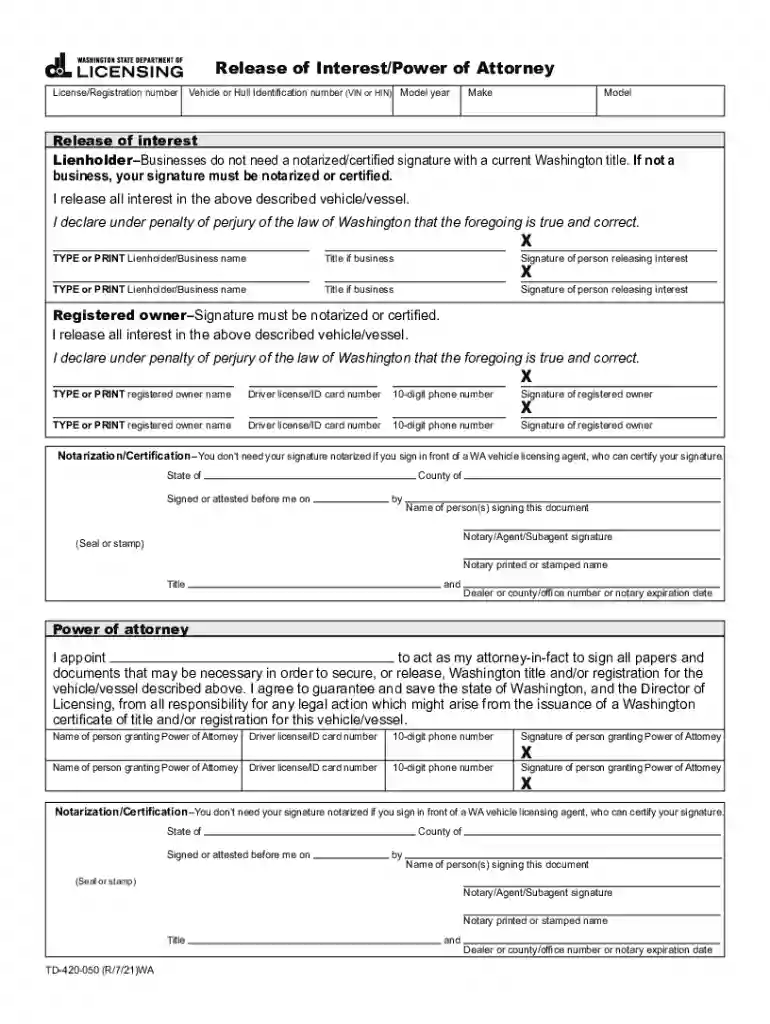
Release of Interest Power of Attorney Form to release interest in a vehicle or vessel and appoint a 2026

Get Form
Release of Interest Power of Attorney Form to release interest in a vehicle or vessel and appoint a  Preview on Page 1

Here's how it works

01. Edit your form online
Type text, add images, blackout confidential details, add comments, highlights and more.

02. Sign it in a few clicks
Draw your signature, type it, upload its image, or use your mobile device as a signature pad.

03. Share your form with others
Send it via email, link, or fax. You can also download it, export it or print it out.

Definition & Meaning

The Release of Interest Power of Attorney Form is a legal document used to relinquish ownership interest in a vehicle or vessel, granting another individual authority to manage matters related to the title and registration. This form is crucial in transferring responsibilities seamlessly to the appointed representative, known as the attorney-in-fact.

What Constitutes a Release

  • Release of Ownership: The form signifies that the original owner no longer holds any legal rights or claims over the vehicle or vessel.
  • Power of Attorney Assignment: It empowers a new individual to complete title transfers, handle registrations, and ensure compliance with state regulations.

Key Participants

  • Grantor: The original owner relinquishing interest.
  • Grantee: The appointed person taking over the responsibilities and legal obligations.

Steps to Complete the Release of Interest Power of Attorney Form

To correctly complete this form, follow these detailed steps to ensure all legal requirements are met:

  1. Identify Parties Involved:

    • Provide full legal names of both the grantor (releasing party) and grantee (appointed attorney-in-fact).
  2. Vehicle or Vessel Details:

    • Include specific information such as the Vehicle Identification Number (VIN) or Hull Identification Number (HIN), make, model, year, and registration number.
  3. Declaration of Intent:

    • Clearly state the intent to release ownership and grant power of attorney for managing related affairs.
  4. Notarization (if required):

    • Individuals typically need notarization, while businesses might be exempt. This verifies the authenticity of signatures.
  5. Signatures:

    • Ensure all involved parties provide signatures and dates.
  6. Submit Form:

    • Depending on state regulations, submission methods can include in-person at a Department of Motor Vehicles (DMV) office, via mail, or online where accepted.

Key Elements of the Form

Essential Sections

  • Owner Information:

    • Legal name, address, and contact details.
  • Vehicle or Vessel Description:

    • Detailed description to ensure precise identification.
  • Release and Designation:

    • A formal statement that articulates the release of interest and the delegation of power.

Legal Provisions

  • Notarization Clauses:

    • Some states necessitate notarization to affirm the legal standing of the document.
  • Signatures and Witnesses:

    • Spaces for signatures of both releasor and attorney-in-fact, along with optional witness signatures.

State-Specific Rules

Each U.S. state may impose unique regulations and requirements for executing a Release of Interest Power of Attorney Form:

Washington State Example

  • Notarization: Mandatory for individual owners; however, businesses may not require notarization.
  • Submission: Mail or in-person submission acceptable but verify with local DMV offices.

Possible Variations

  • Other States: Some may require additional documentation or have distinct witness requirements.

Legal Use of the Form

This form is employed in various legal contexts where relinquishing ownership and appointing representation is necessary:

  • Estate Settlement:

    • Facilitates transferring vehicle or vessel ownership during estate administration.
  • Business Transactions:

    • Useful in corporate mergers or dissolutions involving mobile assets.
  • Inter-family Transfers:

    • Common for transferring vehicles within families or to trusts.

Who Typically Uses the Form

decoration image ratings of Dochub

Individuals and Scenarios

  • Private Vehicle Owners: Releasing interest during sale or gifting.
  • Executors of Estates: For distributing assets according to a will.
  • Business Entities: Transferring assets as part of business operations.

Common Situations

  • Selling a Vehicle: Simplifies the transition by preemptively authorizing title and registration tasks.
  • Retirement Relocation: Handing over assets for management by a family member or trust.
  • Military Deployment: Granting a spouse or relative authority to manage vehicles in the owner’s absence.

Important Terms Related to the Form

Understanding specific legal terminology is key for users:

  • Attorney-in-Fact: The individual authorized to act on behalf of the original owner.
  • Release of Interest: The act of officially relinquishing ownership rights.

Legal Concepts

  • Binding Agreement: Once executed, this form becomes a legally enforceable agreement that reflects the intentions of the involved parties.

  • Fiduciary Responsibility: The attorney-in-fact must act in the best interest of the grantor.

Examples of Using the Form

Real-World Scenarios

  • Family Heirlooms: A parent transferring a cherished vintage car to a child.
  • Small Business Fleet Management: Divesting or acquiring business vehicle holdings efficiently.
  • Immediate Executor Empowerment: Executing duties without delay in estate management.

Hypothetical Cases

  • Cross-State Transfers: A New York owner moves to California, releasing their vehicle to a relative who resides locally to handle re-registration.

Utilizing the Release of Interest Power of Attorney Form properly can streamline numerous administrative processes associated with vehicles and vessels, ensuring both compliance and efficiency in ownership transitions.

be ready to get more

Complete this form in 5 minutes or less

Get form

Got questions?

We have answers to the most popular questions from our customers. If you can't find an answer to your question, please contact us.
Contact us
The Affidavit of Loss Release of Interest is a crucial document in U.S. property transfer situations where original documentation has been lost or destroyed. It serves as a legal substitute for missing original title documents or releases of interest, particularly in vehicle transfers.
0:25 2:49 The agent can only perform the transactions described in the POA. Notoriization the document must beMoreThe agent can only perform the transactions described in the POA. Notoriization the document must be signed by the principal in the presence of a notary.
A revocation document or letter is the most common method to cancel a power of attorney. This is a legal document that should clearly state that the power of attorney is no longer valid.
A release of interest is a legal document that relinquishes a persons rights or claims to a particular asset or ownership. A power of attorney is a document that allows one person to act on behalf of another in legal or financial matters.
Submit a completed Affidavit of Loss/Release of Interest form and a completed Vehicle Title Application to a vehicle licensing office. All legal and registered owners shown on the title must sign the Release of Interest to transfer the title to the new owner.

Security and compliance

At DocHub, your data security is our priority. We follow HIPAA, SOC2, GDPR, and other standards, so you can work on your documents with confidence.
Learn more
ccpa2
pci-dss
gdpr-compliance
hipaa
soc-compliance
be ready to get more

Complete this form in 5 minutes or less

Get form

People also ask

How to make a power of attorney in 8 steps Decide which type of power of attorney to make. Choose your agent. Decide how much authority to give your agent. Fill out a power of attorney form. Execute your POA according to the laws in your state. Give a copy of your POA form to your agent and other interested parties.

Related links