




01. Edit your copyright form online
Type text, add images, blackout confidential details, add comments, highlights and more.

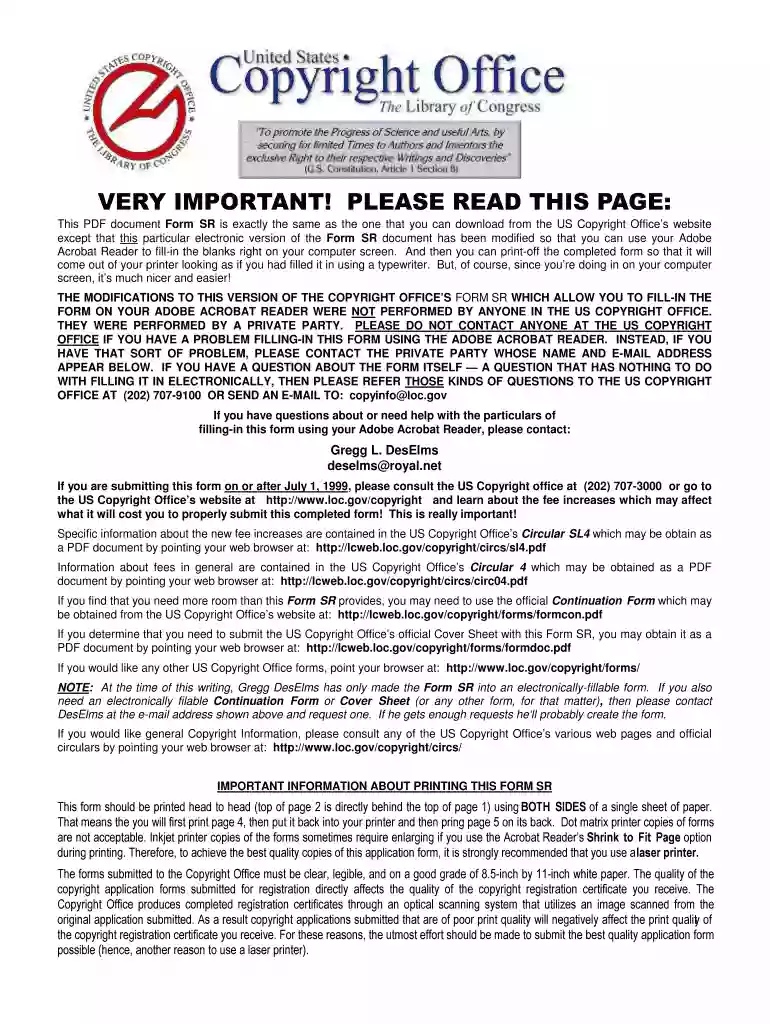
Type text, add images, blackout confidential details, add comments, highlights and more.

Draw your signature, type it, upload its image, or use your mobile device as a signature pad.

Send it via email, link, or fax. You can also download it, export it or print it out.
The "copyright form" refers to a document used for the registration of creative works under copyright law. This form ensures that the original work of an author or creator receives protection against unauthorized use. By completing this form, creators legally stake a claim to their intellectual property, establishing a public record of their ownership and rights. Typically, the form is associated with the registration of various works, including literary, musical, artistic, and architectural creations. Once submitted and processed, the copyright form serves as an official recognition by the copyright office, providing creators with the backing necessary to enforce their rights legally.
The process for obtaining the copyright form is straightforward and user-friendly. Typically, the form can be accessed through the official website of the United States Copyright Office (USCO). Here, you can download digital versions of various copyright forms, including options for sound recordings (Form SR) and literature (Form TX). For those who prefer a paper version, the copyright office offers a request service, where the form can be mailed directly to you. It's important to check for the latest fee schedule and any changes in submission requirements, as the copyright office periodically updates these details. Make sure you have all necessary documentation and information on hand before starting the application process.
Completing the copyright form involves several distinct steps to ensure a successful submission.
Gather Necessary Information: Before starting, have all required details about the work ready, including the title, author(s), and date of creation.
Complete Ownership Details: Identify the claimant’s name and address. Clarify the nature of the rights being claimed if there is any prior registration.
Describe the Work: Provide a comprehensive description of the work. Mention its category (e.g., literary, musical), and include publication details if applicable.
Sign and Date: The form must be signed by the author, claimant, or authorized agent to affirm the details provided are accurate.
Submit Application and Fee: Send the completed form with the proper fee amount to the copyright office. If filing electronically, upload any required digital deposits.
Monitor Processing Status: After submission, keep track of the application status via the copyright office's online portal to ensure all processing steps are completed.
Understanding the key components of the copyright form is crucial for a complete and accurate submission.
The copyright form carries with it legal significance, as it serves as an official and public declaration of a creator's rights to their work. Upon successful registration, creators are equipped with a legal foundation to enforce their rights, preventing unauthorized reproduction, distribution, or adaptation of their work. In the event of a dispute or infringement, the registration date on the form can be critical in demonstrating the creator's ownership. Additionally, registration enables the copyright holder to seek statutory damages and attorney fees in federal court, offering a powerful tool for legal remedies.
Familiarizing yourself with specific terminology is beneficial when dealing with copyright forms.
There are various methods available for submitting the copyright form, allowing flexibility based on individual preferences.
A diverse range of individuals and entities utilize copyright forms to protect their intellectual property. Authors, musicians, artists, and filmmakers commonly register their creations to prevent unauthorized use. Institutions such as publishers or recording companies are also frequent users, often managing registrations for their affiliated creators. Smaller companies or individual entrepreneurs who develop original content, such as software or marketing materials, also rely on copyright forms to safeguard their innovations. By ensuring legal recognition of their intellectual assets, these users can confidently distribute and monetize their creative works.


While copyright laws in the United States are largely governed by federal statutes, there may be state-specific nuances affecting the application or enforcement of rights. Variations in how local courts interpret copyright laws can influence legal strategies for protecting works. State-level business regulations may also impact copyright discussions, particularly for corporate entities registering copyrights. Creators should be aware of any state laws that might affect the licensing or sublicensing of their work, ensuring comprehensive protection. For precise guidance, consulting a legal expert with experience in local copyright matters is recommended.
At DocHub, your data security is our priority. We follow HIPAA, SOC2, GDPR, and other standards, so you can work on your documents with confidence.


Basic Registration Literary Form TX Visual Form VA Single Serials Form SE Performing Arts Form PA Sound Recording Form SR. Supplementary RenewalRead more
This is a directory of images which are copyright of their respective copyright holders. These images can be freely used on this wiki due to fair use rationaleRead more
An application for copyright registration can be filed by the author or owner of an exclusive right in a work, the owner of all exclusive rights, or an agent onRead more


