




01. Edit your form online
Type text, add images, blackout confidential details, add comments, highlights and more.

Type text, add images, blackout confidential details, add comments, highlights and more.

Draw your signature, type it, upload its image, or use your mobile device as a signature pad.

Send it via email, link, or fax. You can also download it, export it or print it out.
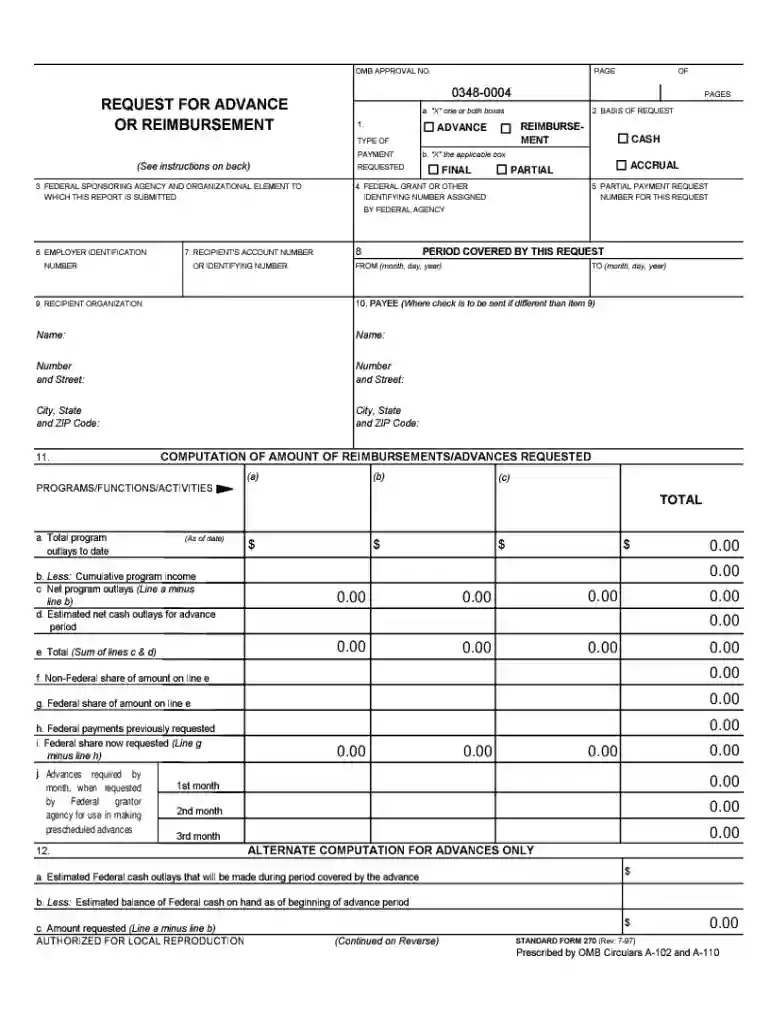
Form SF-270, Request for Advance or Reimbursement, is a standard form used by recipients of federal grants to request either advance payments or reimbursals for expenses incurred. This document is essential for maintaining transparent and accurate financial interactions between federal agencies and grant recipients, ensuring the proper use of awarded funds. The form specifically details financial requests, involving total program outlays and necessary cash flow estimates, which help manage awarded funds effectively and within regulatory compliance.
To utilize Form SF-270 effectively, recipients must understand its structure and purpose. The form includes sections for identifying the federal grant, the requesting organization, and specific financial details, such as estimated cash needs. Users should meticulously fill each section with precise information to facilitate efficient processing. Form submission frequency depends on the grant's requirements, but maintaining consistency and ensuring accuracy in each submission is critical for a smooth reimbursement or advance payment process.
Form SF-270 can be accessed through federal agency websites that manage grant programs or directly from the U.S. General Services Administration (GSA) website, where many standard forms are housed. Grant recipients may also receive the form from their designated grant officers. It's vital to use the most current version to ensure compliance with the latest regulations and requirements, as using outdated forms could result in submission rejections or processing delays.
Access the Form: Download the current version from the GSA website or obtain it via the managing federal agency.
Identify Grant Details: Fill in sections with the grant number, awarding agency, and recipient organization.
Financial Information: Enter requested amounts for advances or reimbursement and justify these needs with supporting calculations in the designated sections.
Certification: The authorized official from the recipient organization must certify the accuracy and legitimacy of the information provided.
Submission: Follow agency-specific guidelines for form submission, which might include online, mail, or in-person delivery methods.
Organizations that receive federal grants, such as educational institutions, non-profits, and research bodies, frequently use Form SF-270. These entities rely on federal funds for program execution and must regularly request funds for incurred expenses or anticipated outlays. The form ensures accountability in federal funding and supports organizations in maintaining compliance with financial management practices intended by grant awards.
Form SF-270's primary legal function is to maintain transparency and adherence to federal funding regulations. Completing the form honestly and accurately is obligatory to avoid legal penalties. Grant agreements typically stipulate the terms for using and reporting granted funds, and deviations or false claims can result in both financial penalties and reputational damage. Therefore, understanding legal requirements associated with form submission is paramount.
Many organizations utilize accounting and grant management software to manage their financial reporting and compliance efforts efficiently. Software such as QuickBooks and specialized grant management systems often offer templates or integration capabilities for completing Form SF-270. These solutions can streamline data entry and ensure accuracy through automated calculations and compliance checks, which is crucial for maintaining precise records.
Submission methods for Form SF-270 vary depending on the federal agency involved. Many agencies prefer online submissions due to their efficiency and ease of tracking. However, some may still accept mailed copies. Understanding specific agency requirements for submission, including any accompanying documentation, ensures that requests are processed without delay. Transitioning to digital submissions when possible can minimize processing times and provide immediate confirmation of receipt.
At DocHub, your data security is our priority. We follow HIPAA, SOC2, GDPR, and other standards, so you can work on your documents with confidence.



SF-270 Request for Advance or Reimbursement. Schema|Download PDF|Download DAT|Download. Reimbursement REIMBURSMENT. Federal Agency and Organizational Element
Cost reimbursement payments. Advance/scheduled payments. SF 270 - Request for Advance or Reimbursement often provide a form for the report.


