01. Edit your form online
Type text, add images, blackout confidential details, add comments, highlights and more.

Type text, add images, blackout confidential details, add comments, highlights and more.

Draw your signature, type it, upload its image, or use your mobile device as a signature pad.

Send it via email, link, or fax. You can also download it, export it or print it out.
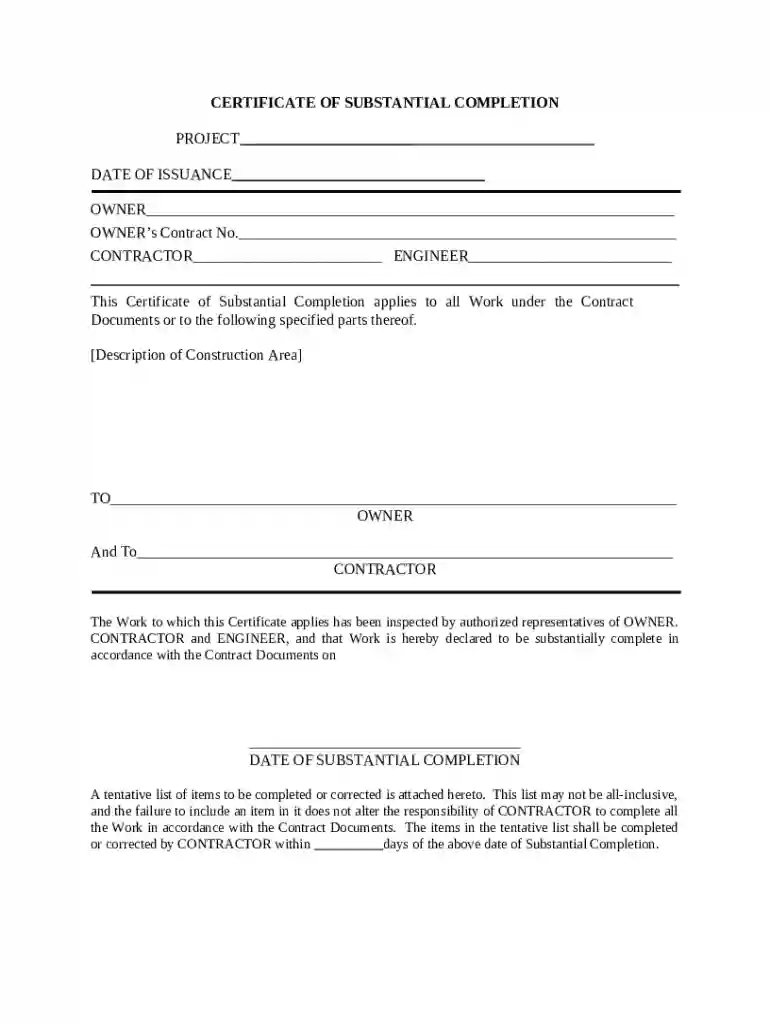
The Certificate of Substantial Completion is a pivotal document in the construction industry. It signifies that a construction project has reached a stage where it can be utilized for its intended purpose, despite minor incomplete tasks remaining. This certificate is typically signed by the owner, contractor, and engineer, marking a shift in responsibilities from the contractor to the owner for issues such as security, maintenance, and insurance. This moment also often triggers contractual conditions regarding project timelines and payments, ensuring that the terms of the contract continue to be honored.
Completing the Certificate of Substantial Completion involves several steps:
Inspection: The project is thoroughly inspected to ensure that it meets the requirements outlined in the contract. This inspection identifies any remaining work or deficiencies.
Documentation: Compile a list of incomplete items, often referred to as a punch list, which specifies work that needs finishing or correction.
Owner and Contractor Review: Both parties review and agree on the certificate's contents, ensuring mutual understanding of the remaining obligations.
Signatures: The document is signed by all relevant parties such as the owner, contractor, and often the project engineer or architect, ensuring all involved have acknowledged substantial completion.
Distribution: Copies of the signed certificate are distributed to relevant stakeholders to keep everyone informed of the official completion status.
Several important terms are associated with the Certificate of Substantial Completion:
Understanding these terms helps clarify responsibilities and expectations once substantial completion is achieved.
Legally, the Certificate of Substantial Completion holds significant weight. It often marks the beginning of specific legal timeframes, like limitations for claims or warranties. It also impacts liability issues, as responsibility typically transitions from the contractor to the owner. Additionally, substantial completion may affect insurance coverage and terms, making it a critical document in legal and insurance contexts.
Several key elements must be included in the Certificate of Substantial Completion:
Incorporating these elements ensures all parties have a clear and consistent understanding of project completion status.
Obtaining this certificate typically follows a structured process:
Request for Inspection: The contractor or project manager requests an inspection once they believe the project is substantially complete.
Conducting the Inspection: A formal inspection is conducted by relevant parties to assess the completion status.
Drafting the Certificate: If the project meets substantial completion criteria, a draft certificate is prepared with required details and punch list items.
Review and Approve: All parties review and make any necessary amendments before signing the certificate.
This procedure ensures thorough review and documentation before the project is officially certified as substantially complete.
The Certificate of Substantial Completion is primarily used by:
These users play a critical role in the construction lifecycle, facilitating transitions and ensuring a successful project closeout.


Real-world scenarios demonstrate the utility of the Certificate of Substantial Completion:
Large Corporate Offices: Certification marks the start of occupancy and transition to normal operational activities while minor tasks are completed.
Public Infrastructure Projects: Documentation ensures public access and use are safe while residual work is finalized.
School Construction: Allows new academic settings to commence as planned, with minor non-critical items pending resolution.
These examples highlight how the certificate facilitates operational continuity while ensuring contractual adherence.
At DocHub, your data security is our priority. We follow HIPAA, SOC2, GDPR, and other standards, so you can work on your documents with confidence.