






Definition & Meaning
The Pennsylvania Motor Vehicle (DMV) Power of Attorney (POA) is a vital legal document that empowers an appointed individual, known as the Agent, to manage specific motor vehicle-related tasks on behalf of the Principal, who is the vehicle owner. The POA grants the Agent the authority to handle various matters such as vehicle registration, licensing, ownership transfer, and titling. It is especially useful for individuals who cannot oversee these transactions personally due to distance, time constraints, or other personal reasons. Understanding the precise role and limitations of this document is crucial for both the Principal and the Agent, ensuring that vehicle-related activities are conducted legally and efficiently.
How to Use the Pennsylvania Motor Vehicle (DMV) Power of Attorney
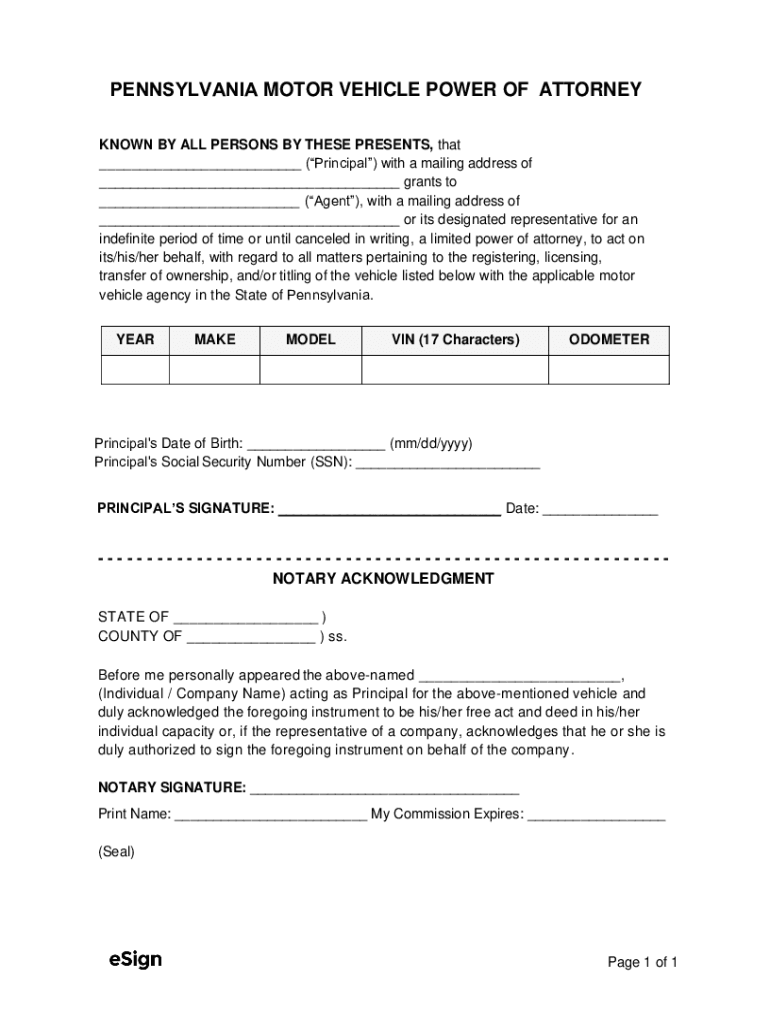
To effectively use the Pennsylvania Motor Vehicle (DMV) Power of Attorney, the Principal must first ensure that the document is correctly filled out with accurate details. The form includes sections for the vehicle's information, the Principal's personal data, and the Agent's details. Once the form is completed, it typically requires notarization to be legally binding. The Agent can then present this document at Pennsylvania DMV offices to execute tasks such as renewing registrations or transferring titles. It's critical to note that the authority given through this POA is limited to motor vehicle tasks, and the Agent must act in the best interests of the Principal, adhering strictly to the permissions granted.
Steps to Complete the Pennsylvania Motor Vehicle (DMV) Power of Attorney
- Gather Information: Collect essential information, including the Principal’s personal details, vehicle information, and the Agent’s contact details.
- Fill Out the Form: Accurately enter the gathered information into the respective sections of the form. Ensure no fields are left blank unless stated as optional.
- Review the Details: Double-check all entries for typos or errors to avoid complications during processing.
- Notarization: Arrange for notarization to authenticate the document. Both the Principal and the Agent may need to be present for this step.
- Submission: Once notarized, submit the form to the appropriate DMV office along with any other required documentation for processing.
Who Typically Uses the Pennsylvania Motor Vehicle (DMV) Power of Attorney
The Pennsylvania Motor Vehicle Power of Attorney is chiefly utilized by individuals who require someone else to handle specific motor vehicle tasks on their behalf. This includes military personnel stationed overseas, senior citizens, busy professionals, or those dealing with health issues that prevent them from physically attending to DMV tasks. Additionally, it can be useful for businesses that manage fleets of vehicles and need designated employees to handle title and registration matters without the personal appearance of the business owner.


Legal Use of the Pennsylvania Motor Vehicle (DMV) Power of Attorney
Legally, the Pennsylvania Motor Vehicle Power of Attorney serves as a documented authorization allowing the appointed Agent to act on the Principal’s behalf for specific vehicle-related tasks. It complies with state laws governing powers of attorney and must be executed correctly to be enforceable. The legal use of this POA is strictly confined to motor vehicle-related actions, and any attempt to use it beyond the specified scope could nullify the document or lead to legal consequences. Therefore, both Principal and Agent must fully understand the POA's constraints and responsibilities.
Key Elements of the Pennsylvania Motor Vehicle (DMV) Power of Attorney
- Vehicle Information: Details such as make, model, VIN, and year of the vehicle.
- Principal’s Information: Full name, address, and contact information of the owner.
- Agent’s Information: Name and contact details of the person appointed to act on behalf of the Principal.
- Scope of Authority: Specific actions the Agent is allowed to perform, such as registration renewal or title transfer.
- Notarization Requirement: Mandatory section for a notary public to validate the authenticity of the document.
State-Specific Rules for the Pennsylvania Motor Vehicle (DMV) Power of Attorney
Pennsylvania has particular rules governing the execution and use of a DMV Power of Attorney. The form must be notarized to be accepted by Pennsylvania DMV offices. Additionally, the scope of actions that the Agent can perform is limited to those explicitly stated in the document. The POA is only valid in Pennsylvania and cannot be used for vehicles registered in other states. Failure to comply with these state-specific regulations can result in the rejection of the document and delay in processing vehicle-related tasks.
Examples of Using the Pennsylvania Motor Vehicle (DMV) Power of Attorney
Consider a scenario where a Pennsylvania resident is relocating temporarily for work. To avoid falling behind on vehicle registrations or to sell a car, they can appoint a trusted colleague or family member as their Agent using the DMV Power of Attorney. In another example, a fleet management company might use multiple POAs to allow different employees to handle registration renewals or report vehicle acquisitions. Each of these scenarios illustrates the versatility and practical application of the POA in managing vehicle-related responsibilities while ensuring compliance with state regulations.