






Definition & Meaning
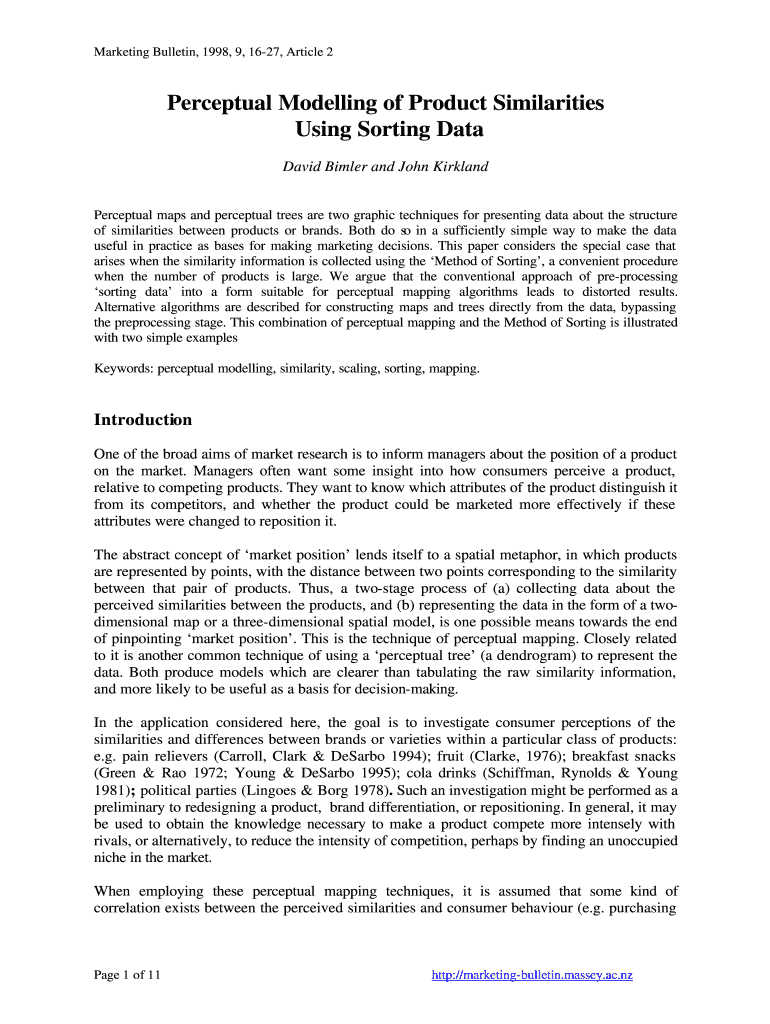
Perceptual Modelling of Product Similarities refers to the analytical process of understanding how consumers perceive similarities among different products. This method leverages sorting data to create perceptual maps and trees, offering a visual representation of product relationships based on consumer perception. The objective is to provide insights into how products are seen in the consumer’s eye, which can guide marketing and development strategies. Traditional approaches often involve preprocessing methods that can distort results, whereas perceptual modelling seeks direct construction of maps and trees for accuracy and relevance.
How to Use Perceptual Modelling of Product Similarities
To effectively utilize perceptual modelling, begin by collecting sorting data from consumers regarding the products of interest. This data can then be processed using specialized algorithms that construct perceptual maps and trees, highlighting the relative similarities among products. The resulting visual representations help in identifying clusters of similar products and discerning patterns in consumer preferences. These insights are crucial for businesses aiming to align their marketing efforts, product positioning, and strategy development with consumer perceptions.
Practical Applications
- Marketing Strategy: Use perceptual maps to identify gaps in the market or reposition products within an existing category.
- Product Development: Plan new products based on perceived similarities to existing successful items.
- Competitive Analysis: Understand where your products stand compared to competitors in consumer perception.
Steps to Complete the Perceptual Modelling of Product Similarities
- Data Collection: Gather sorting data from a sample of your target audience.
- Data Processing: Utilize advanced algorithms that do not require excessive preprocessing.
- Map Construction: Build perceptual maps and trees to visualize product similarities.
- Analysis: Examine the maps to identify clusters and trends.
- Implement Findings: Integrate insights into marketing and product strategies for better alignment with consumer expectations.
Why Use Perceptual Modelling of Product Similarities
The perceptual modelling approach offers several advantages:
- Accurate Insights: Provides a more precise understanding of consumer perceptions without distortions from preprocessing.
- Strategic Alignment: Helps align product offerings with consumer needs and market demands.
- Competitive Advantage: By understanding consumer perceptions better, businesses can gain an edge over competitors.
Who Typically Uses Perceptual Modelling of Product Similarities
This technique is often employed by:
- Marketing Professionals: To shape strategies based on consumer mindset.
- Product Developers: To guide the creation or improvement of products.
- Market Researchers: To assess consumer behavior and preferences.
- Brand Managers: To position products more effectively in the market.
Key Elements of the Perceptual Modelling of Product Similarities
Comprehensive perceptual modelling involves key elements such as:
- Sorting Data: Foundational to the analysis process, reflecting how consumers categorize products.
- Perceptual Maps: Visual tools depicting similarities between products.
- Perceptual Trees: Hierarchical representations that reveal deeper relational insights.
Examples of Using Perceptual Modelling of Product Similarities
There are several real-world cases where perceptual modelling has proven effective:
- Fruit and Vegetables: Understanding consumer preference groupings for more targeted marketing.
- Beer Industry: Identifying clusters of beers perceived as similar for tailored advertising campaigns.
Software Compatibility
When conducting perceptual modelling, several software solutions can facilitate the process:
- Data Analysis Tools: Such as SPSS or R for processing sorting data.
- Visualization Software: For creating perceptual maps and trees, like Tableau or Minitab.
- Document Management Platforms: DocHub and similar tools for supporting workflow by organizing and sharing findings.
Business Types That Benefit Most from Perceptual Modelling
Several businesses can benefit from perceptual modelling, including:
- Retail: For inventory and space management based on product similarity.
- Consumer Goods: To tailor product lines that align with consumer perceptions.
- E-commerce: For personalized recommendations based on perceived product similarities.