






Definition & Meaning
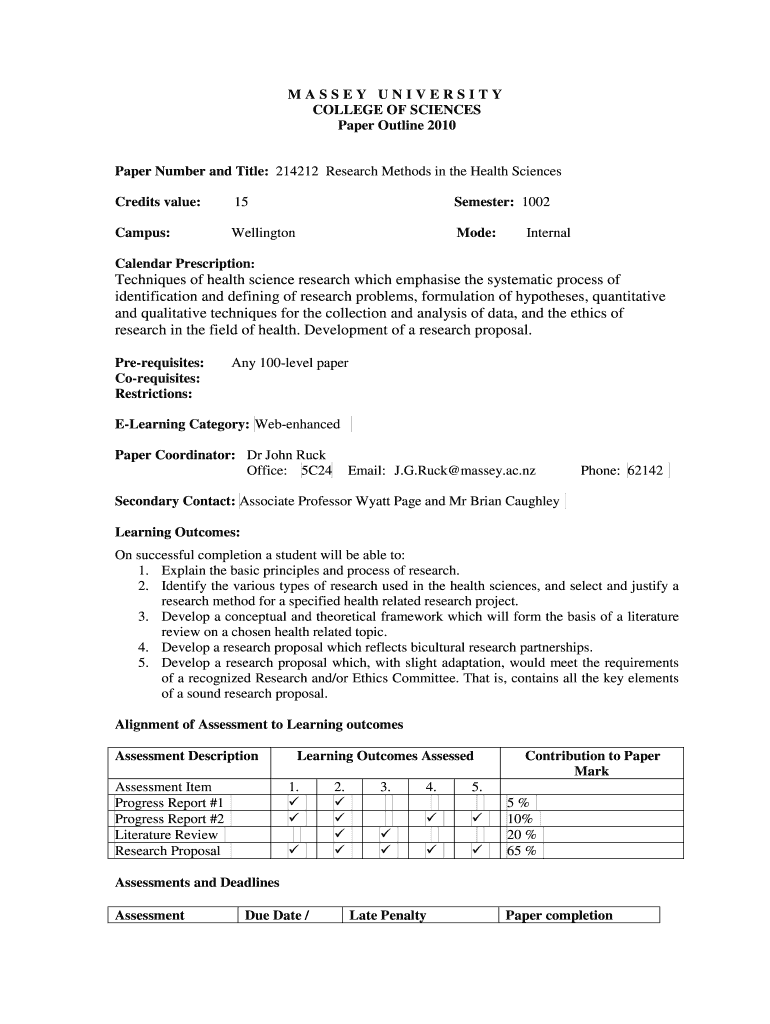
The "Techniques of Health Science Research" refers to a structured approach used in health sciences to systematically investigate, analyze, and solve research problems. These techniques are crucial for producing reliable, valid, and unbiased findings in health science research. At Massey University, they encompass a suite of methods including qualitative and quantitative analysis, epidemiological studies, and clinical trial designs. This systematic approach ensures rigorous research practices and contributes significantly to advancements in health sciences.
Key Components of Research Techniques
- Problem Identification: Recognizing and articulating a specific research issue or question within the realm of health sciences.
- Hypothesis Formulation: Developing a testable statement that predicts a relationship between variables.
- Data Collection: Gathering information through various methods such as surveys, experiments, or observations to support or refute hypotheses.
- Data Analysis: Utilizing statistical tools and software to interpret data, draw conclusions, and make informed decisions.
- Ethical Considerations: Adhering to ethical guidelines ensuring the protection of participants' rights and integrity of the research.
Key Elements of the Techniques
Understanding the critical elements of health science research techniques at Massey University involves a comprehensive look at the structured methodology designed to extract valuable insights.
Essential Methods
- Qualitative Research: Involves non-numerical data and focuses on understanding patterns of human behavior and perceptions. Techniques include interviews, focus groups, and case studies.
- Quantitative Research: Involves numerical data to establish patterns and test theories. Common methods include surveys, controlled trials, and epidemiological studies.
Application Process & Approval Time
- Develop Research Proposal: Students or researchers are required to draft a detailed proposal outlining their intended research, methodology, and expected outcomes.
- Ethical Approval: Necessary for research involving human subjects, ensuring compliance with ethical standards.
- Timeframes: Depending on the complexity of the research, approval times can vary but often range from a few weeks to several months.
Important Terms Related to the Techniques
Understanding terminology is fundamental to grasping the full scope of health science research techniques.
Common Terms and Their Definitions
- Epidemiology: The study of how often diseases occur in different groups of people and why.
- Clinical Trials: Research studies performed in people that are aimed at evaluating a medical, surgical, or behavioral intervention.
- Biostatistics: Application of statistics to a wide range of topics in biology, including public health.
- Informed Consent: Process of getting permission before conducting a health intervention on a person.
Who Typically Uses the Techniques
These research techniques are not limited to a specific group but are broadly used by a diverse range of individuals in the health science field.


Primary Users
- Researchers: Academics and professionals conducting studies in various health sectors.
- Healthcare Professionals: Practitioners seeking to apply evidence-based practices.
- Students: Enrolled in courses or programs that require the development of research skills.
Steps to Complete the Techniques
Completing a research process involves multiple structured steps which ensure comprehensive coverage and integrity.
Step-by-Step Process
- Identify Research Problem: Clearly define the issue or question to address within the field of health sciences.
- Conduct a Literature Review: Analyze existing research to establish a theoretical framework and understanding.
- Formulate Hypothesis: Develop a hypothesis based on the gathered information.
- Design Methodology: Plan a detailed approach for data collection and analysis.
- Collect and Analyze Data: Implement methodologies to gather reliable data and apply statistical tools for analysis.
- Interpret Results: Draw conclusions and relate findings to the original research question.
- Report Findings: Document the research outcomes in a comprehensive way, following academic and scientific standards.
Legal Use of the Techniques
Legal and ethical compliance is paramount in health science research. It ensures the protection of subjects and the validity of results.
Legal Frameworks
- Informed Consent Laws: Requires obtaining explicit permission from participants before their involvement.
- Research Ethics Committee Approval: Necessary for ensuring that the research complies with ethical guidelines.
Examples of Using the Techniques
Practical applications of these techniques often lead to significant advancements in the field.
Real-World Scenarios
- Epidemiological Study: Utilized to understand the spread of infectious diseases and inform public health policy.
- Clinical Trials: Conducted to evaluate the effectiveness and safety of new medical treatments or drugs before they are approved for general use.
Software Compatibility
In the modern research environment, using compatible software tools is essential for efficiency and accuracy in data analysis.
Popular Software and Tools
- SPSS: Widely used for statistical analysis in health research.
- NVivo: Frequently utilized for organizing and analyzing qualitative data.
- R Programming: Employed for data manipulation, calculation, and graphical display.
Digital vs. Paper Version
With technological advancements, there is a shift towards digital methods in health science research.
Comparative Overview
- Digital Version: Allows for seamless integration of research techniques with software tools for data collection and analysis; facilitates real-time collaboration.
- Paper Version: Traditional method still used in settings where digital means are not feasible but is typically slower and less efficient in large-scale studies.