






Definition and Meaning
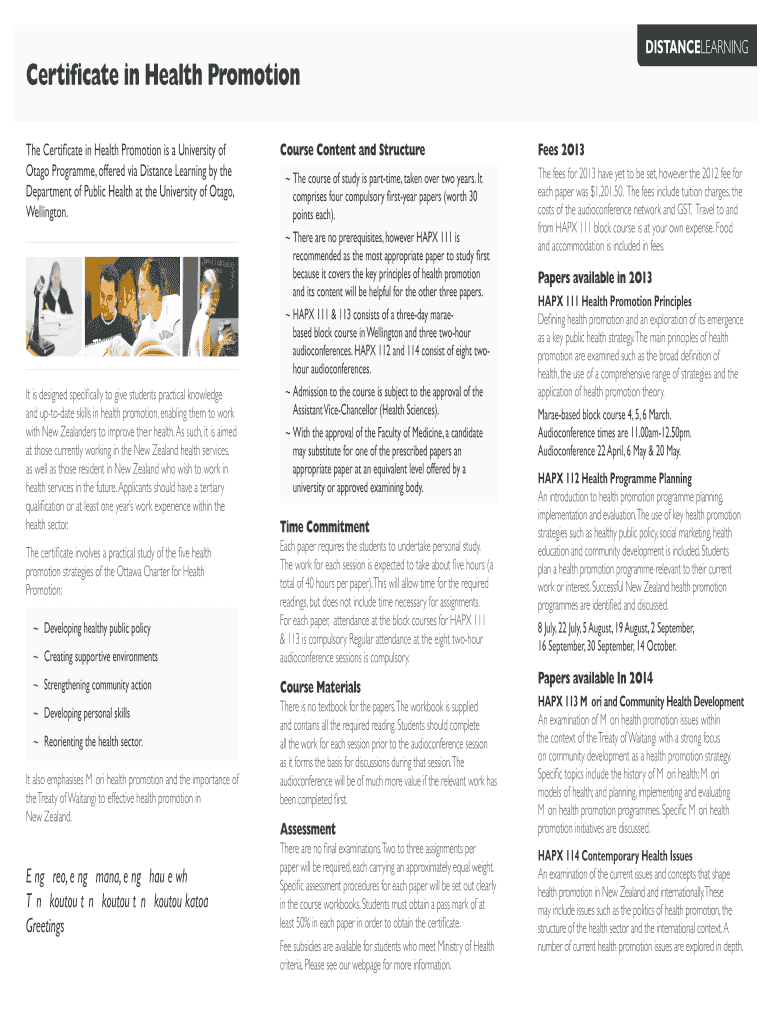
The Certificate in Health Promotion is a specialized educational credential that signifies the completion of a program designed to equip individuals with the knowledge and skills necessary for promoting health and well-being within communities. Offered by programs like the University of Otago's Department of Public Health, this certificate emphasizes practical strategies to enhance public health through education and community initiatives. The curriculum often covers diverse topics such as health education strategies, public policy influence, and community-based health promotion tactics. This certification stands as a testament to the holder's commitment to advancing public health and can lead to various career opportunities in health policy, education, and outreach programs.
How to Use the Certificate in Health Promotion
Holders of the Certificate in Health Promotion can leverage their credentials across various fields to initiate meaningful changes in public health practices. With this certificate, you can work in health education roles, designing programs that raise awareness about key health issues in specific communities. You might also apply the skills learned to develop public health campaigns aimed at reducing chronic diseases by promoting healthier lifestyles among populations. Additionally, the certificate can support your efforts in policy advocacy, enabling you to contribute to discussions that shape health-related legislation. Whether working for non-profits, government agencies, or private firms, the knowledge gained from this certification allows for significant contributions to health promotion and disease prevention efforts.
Steps to Complete the Certificate in Health Promotion
- Enroll in the Program: Begin by selecting an institution that offers the Certificate in Health Promotion, ensuring the program aligns with your career goals.
- Complete Coursework: Engage with the required courses, which may include topics like nutrition, mental health, and community health strategies.
- Participate in Interactive Learning: Many programs use tools such as audioconference networks; participate actively to enhance your understanding through real-time interaction.
- Submit Assignments: Rather than examinations, assessment may revolve around assignments. Prioritize these projects to successfully demonstrate your grasp of course material.
- Engage in Practical Work: Some programs might require fieldwork or practicum experience. This hands-on learning solidifies theoretical knowledge with practical application.
- Capstone Project: Conclude with a final project or thesis that showcases your ability to apply health promotion strategies effectively.
- Receive Certification: After completing all program requirements, the certificate is conferred as recognition of your expertise in health promotion.
Key Elements of the Certificate in Health Promotion
Several core components define the structure and content of a Certificate in Health Promotion program. These may include:
- Comprehensive Curriculum: Covering theoretical and practical aspects like health behavior theories, program planning, and health communication strategies.
- Cultural Competency: Training often includes a focus on cultural awareness, allowing professionals to design initiatives that respect diverse communities, such as incorporating Māori health promotion perspectives.
- Evidence-Based Approaches: Emphasis is placed on utilizing research and data-driven strategies to develop effective health promotion interventions.
- Interdisciplinary Learning: Courses may integrate various disciplines, reflecting the multifaceted nature of health promotion, from psychology and social sciences to education and public policy.
- Assessment via Assignments: Evaluation typically encompasses practical assignments that assess your ability to apply learned concepts rather than through exams.
Application Process and Approval Time
The application for the Certificate in Health Promotion involves several steps, often detailed on the offering institution's website. Generally, potential students must:
- Submit an Application: Complete and submit the application form, usually available online, along with any required personal statements detailing your interest and goals.
- Provide Academic Transcripts: Include transcripts from previous educational experiences to demonstrate requisite academic qualifications.
- Meet Eligibility Requirements: Ensure you meet the criteria specified by the program, which may include past education in health-related fields or relevant work experience.
- Await Acceptance: After submission, the review process may take several weeks. During this period, application materials are evaluated, leading to an acceptance decision.
- Enroll in Courses: Upon acceptance, enroll promptly to secure your place in the program and begin engaging with course materials as scheduled.
Eligibility Criteria
To pursue a Certificate in Health Promotion, applicants must typically satisfy certain eligibility requirements:
- Educational Background: A minimum academic qualification such as a high school diploma or equivalent is often required.
- Relevant Experience: Prior experience in health, education, or related fields may be beneficial, though not always mandatory.
- Interview or Personal Statement: Some programs may request a personal statement or conduct an interview to ensure candidates’ commitment and fit for the program.
- Language Proficiency: For non-native speakers, proof of English proficiency may be required, ensuring effective participation and comprehension of the course content.


Legally Binding Considerations
While the Certificate in Health Promotion itself does not confer legal credentials like a license, it represents a formal acknowledgment of expertise in health promotion strategies. Its completion may be a prerequisite for certain roles, particularly in public health and educational contexts. Nonetheless, the certificate signals your preparedness for responsible participation in initiatives aimed at enhancing community health. Furthermore, professionals in roles that require intervention design and implementation must adhere to local and national regulations about privacy, consent, and ethical standards in health promotion activities.
Digital vs. Paper Version
Educators often offer the Certificate in Health Promotion in both digital and paper formats, providing flexibility depending on how institutions award the certificate. Digital versions accommodate online course completions, which have become more prevalent. They facilitate easy sharing and can be stored securely without risk of physical damage. Paper versions, meanwhile, offer a tangible symbol of achievement. Regardless of format, both versions hold the same validation and acknowledgment of expertise in health promotion.