
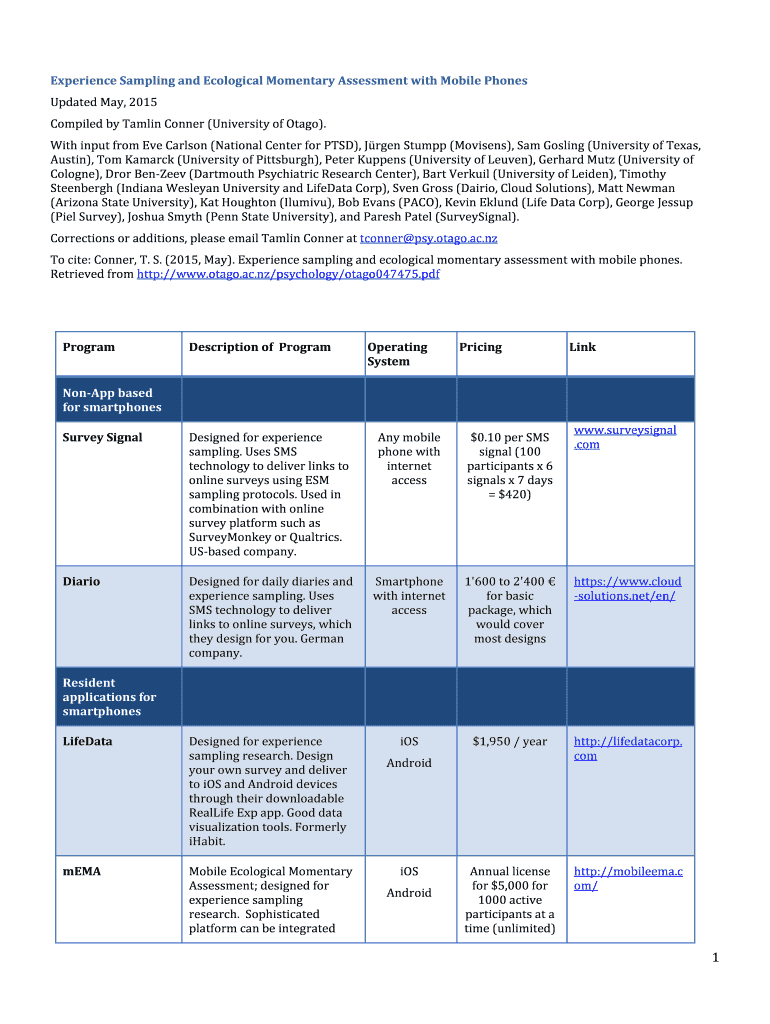







Definition & Meaning
The form "See a summary of the software reviews here - University of Otago" is likely designed to provide a concise overview of software reviews conducted or collated by the University of Otago. This type of form is intended to offer users a quick reference guide to assess various software applications relevant to their needs, presumably within an academic or research context. The form's name suggests it includes evaluations, ratings, and the utility of different software solutions, potentially focusing on educational tools or platforms used by the university community.
How to Use the Form
Using the form involves navigating through different reviews to find software that meets your criteria. The main steps include:
- Access the Form: Find the form either through the University of Otago's website or through provided resources.
- Review Software Listings: Look through the listed software applications to identify those of interest.
- Detailed Assessment: Click on individual reviews for more comprehensive insights into the software's features, pricing, and usability.
- Comparison: Compare different software based on ratings and comments to make informed decisions.
The form likely features an interactive component that allows users to filter or search based on specific categories, such as functionality or department usage.
How to Obtain the Form
The "See a summary of the software reviews here - University of Otago" can be obtained directly from the University of Otago's official channels. Here’s how you can go about it:
- University Website: Search for the software summary form under the library or IT services section.
- Academic Portal: Check if the form is accessible through student or staff portals.
- Contact Information Services: If web access is limited, reaching out to the university’s helpdesk or IT support may facilitate obtaining the form. They can provide guidance on locating or downloading it.
Steps to Complete the Form
While this form is oriented towards providing information rather than collecting it, users may need to engage with it in a structured way:
- Identify Needs: Determine what type of software solutions are required.
- Select Criteria: Use any available fields to set criteria for reviews you’re interested in, such as cost or platform compatibility.
- Navigate Sections: Move through sections systematically to ensure no important review is missed.
- Gather Comparative Data: Note down specific features or ratings of software that could fulfill your requirements.
By systematically working through the form, users can gather all necessary insights effectively.
Important Terms Related to the Form
It's crucial to be familiar with the terminology used in software reviews. Common terms include:
- User Interface (UI): Refers to how users interact with the software.
- Compatibility: Concerns whether the software can run on different hardware or operating systems.
- License Type: Defines whether software use is subscription-based, open-source, or requires a one-time purchase.
- Feature Set: Lists the technical capabilities and tools a software offers.
- User Support: Describes help and resources provided to users for troubleshooting.
These terms help in accurately understanding and comparing software reviews.
Key Elements of the Form
The form likely incorporates several key elements to improve usability and the depth of information offered:
- Software Categories: Organizes reviews according to fields such as education, research, and administration.
- Ratings and Scores: Provides quick visual insights into software performance and user satisfaction.
- Reviewer Comments: Offers qualitative data that can highlight specific strengths or weaknesses.
- Comparison Tools: Allows users to contrast different software applications side-by-side.
Such elements ensure users receive comprehensive evaluations that cover both quantitative and qualitative aspects.
Examples of Using the Form
Practical applications of the form could include:
- Academic Projects: Selecting the best project management tools based on peer reviews.
- Administrative Efficiency: Identifying software that automates paperwork, reducing the time spent on manual tasks.
- Research Applications: Evaluating data analysis software to ensure it meets specific scholarly needs.
Users can tailor their software selections to suit a wide variety of academic and operational requirements at the university.
Software Compatibility Considerations
The form might include compatibility information, highlighting software designed to work within specific ecosystems or with certain specifications:
- Operating Systems: Information about support on Windows, macOS, or Linux.
- Device Compatibility: Indicates if software is optimized for computers, tablets, or smartphones.
- Integration: Reviews may note how well software integrates with other systems, such as email clients or cloud storage services.
This ensures users can select software that aligns with existing IT infrastructure.
Business Entity Types that Benefit
While the focus is academic, the form may also address how different business types, like the university itself or its partners, benefit from the software:
- Educational Institutions: Utilize software for enhancing learning experiences and managing institutional data.
- Research Facilities: Require specialized software for conducting and managing research inquiries efficiently.
- Administrative Departments: Leverage tools for improved workflow and productivity in routine operations.
Diverse entities can leverage the evaluations to tailor software acquisitions that address institutional needs effectively.




