







Definition & Meaning
The 10 U.S. Code 1044b outlines the provisions and requirements for creating a military power of attorney, specifically designed for military personnel in the United States. This legal document allows a designated attorney-in-fact to manage various personal and financial affairs on behalf of the service member, also known as the principal. Importantly, these powers of attorney are recognized under federal law, and they remain valid even if the principal becomes incapacitated or is deployed overseas. This legal framework ensures that military members have a reliable mechanism to designate responsibility for critical tasks during their service.
How to Use the 10 U.S. Code 1044b - Military Powers of Attorney
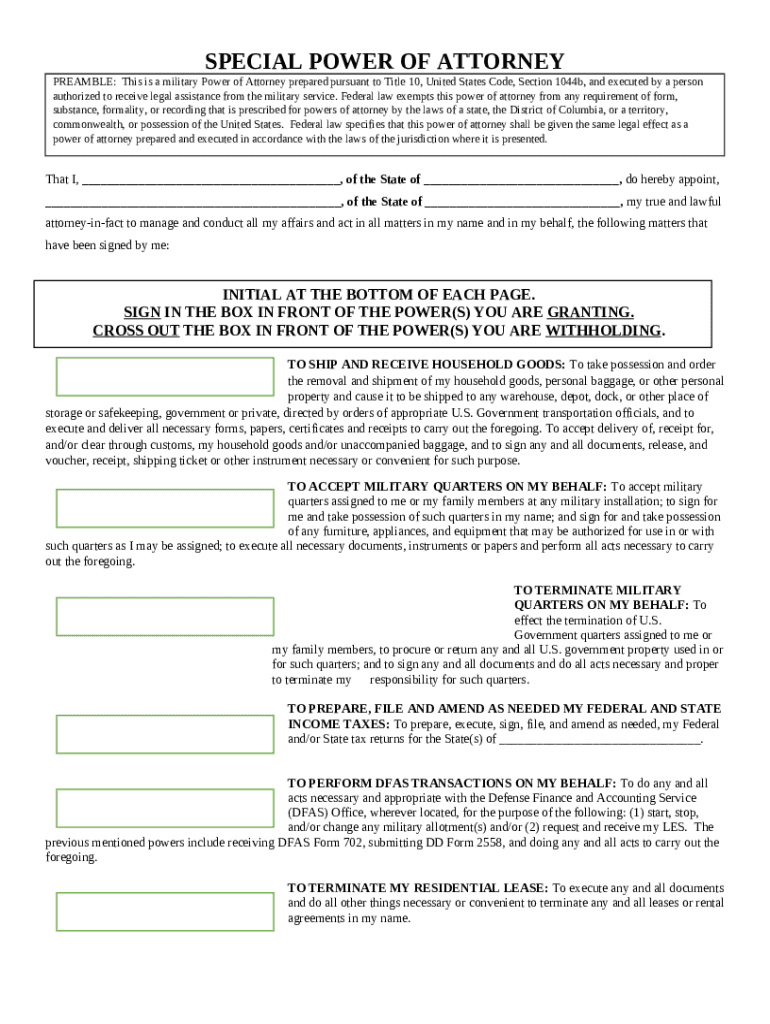
Military powers of attorney under 10 U.S. Code 1044b are used for a broad range of purposes, and understanding how to apply them is crucial. They can authorize actions such as:
- Shipping and receiving household goods.
- Managing residential leases or real estate transactions.
- Conducting financial transactions with Defense Finance and Accounting Service (DFAS).
- Enrolling dependents in military benefits programs.
- Operating motor vehicles on behalf of the principal.
Service members must clearly define the specific powers granted to the attorney-in-fact to ensure that their affairs are managed according to their wishes during deployment or incapacitation.
Steps to Complete the 10 U.S. Code 1044b - Military Powers of Attorney
-
Identify the Attorney-in-Fact: Choose a trusted individual to whom you will grant authority. This person will act on your behalf according to the powers specified.
-
Select Specific Powers: Clearly outline the tasks and responsibilities you wish to delegate. These can include handling specific financial transactions, managing property, and fulfilling legal obligations.
-
Draft the Document: Use a standardized form available through military legal assistance offices, which ensures compliance with 10 U.S. Code 1044b requirements.
-
Obtain Legal Assistance and Notarization: Consult with a legal assistance attorney on the base to finalize the document, ensuring it meets all legal criteria and is properly notarized.
-
Store and Distribute Copies: Keep the original in a secure location and provide copies to relevant parties, such as the attorney-in-fact, financial institutions, or family members.
Key Elements of the 10 U.S. Code 1044b - Military Powers of Attorney
The military powers of attorney must include several critical elements to be valid:
- Principal and Attorney-in-Fact Information: Full names and contact details for both parties.
- Specific Powers Granted: A detailed list of actions the attorney-in-fact is authorized to perform.
- Duration of Validity: The timeline during which the power of attorney is effective, including any conditions for early termination.
- Legal Safeguards: Provisions ensuring the document is compliant with federal law and applicable military regulations.
Why You Need a 10 U.S. Code 1044b - Military Powers of Attorney
Military service members face unique challenges, such as frequent deployments and relocations. The 10 U.S. Code 1044b military power of attorney provides peace of mind by ensuring their affairs are managed seamlessly in their absence. This can include managing financial assets, real estate holdings, or legal obligations. Establishing a military power of attorney ensures that personal and family needs are addressed without disruption, even in unforeseen situations like medical emergencies or rapid deployments.
Legal Use of the 10 U.S. Code 1044b - Military Powers of Attorney
These powers of attorney are legally binding and must be recognized by all states, thanks to their foundation in federal law. Unlike typical state-regulated powers of attorney, the 10 U.S. Code 1044b provides uniformity and certainty for military members, preventing conflicts that might arise due to differing state laws. It also simplifies processes involving federal agencies, as the validity is inherently acknowledged.
State-Specific Rules for the 10 U.S. Code 1044b - Military Powers of Attorney
Although the 10 U.S. Code 1044b ensures federal recognition, service members should be aware of nuances in how state laws might interact with these powers of attorney. For example, some states have specific rules regarding real estate transactions or health care directives that may necessitate additional documentation or clauses. Consulting with a legal assistance attorney on base can help clarify these requirements, ensuring the power of attorney functions smoothly across different jurisdictions.
Examples of Using the 10 U.S. Code 1044b - Military Powers of Attorney
Consider a service member who is deployed overseas but has a property lease ending stateside. The designated attorney-in-fact can manage leasing decisions, such as extending the lease or finding new tenants, without interruption. In another scenario, a family might need to enroll children in DEERS (Defense Enrollment Eligibility Reporting System) during the service member's absence. The power of attorney ensures continuity in managing benefits and supports the family’s seamless operation in the principal's absence.




