01. Edit your form online
Type text, add images, blackout confidential details, add comments, highlights and more.

Type text, add images, blackout confidential details, add comments, highlights and more.

Draw your signature, type it, upload its image, or use your mobile device as a signature pad.

Send it via email, link, or fax. You can also download it, export it or print it out.
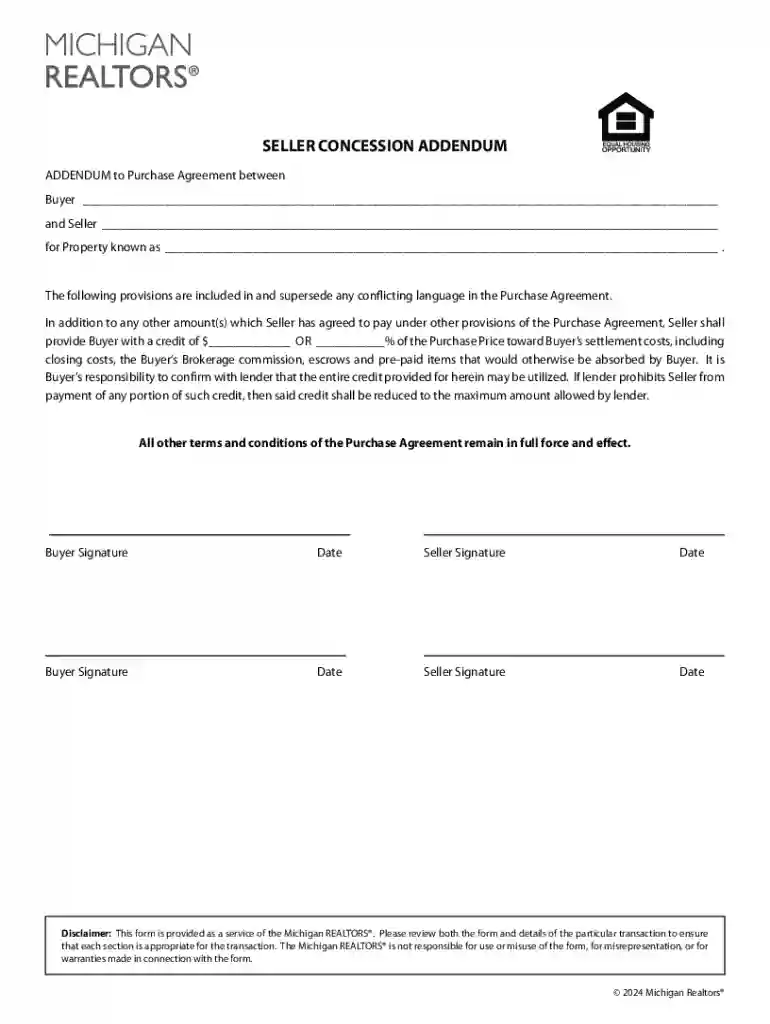
The Seller Concession Addendum is a critical document in real estate transactions, outlining the financial agreements related to specific costs borne by the seller for the buyer's benefit. It is typically attached to a Purchase Agreement, clearly specifying the seller's obligation to credit the buyer toward settlement expenses. This can include various costs such as closing fees and brokerage commissions.
In practice, the Seller Concession Addendum is employed when a buyer requests assistance from the seller to alleviate some of the financial burdens associated with closing a real estate deal. For instance, buyers can negotiate to have the seller cover some percentage of the closing costs, allowing for better financial management on their part. This strategic concession often plays a role in closing agreements, particularly in markets where buyers have less bargaining power.
The document must contain specific elements to be valid and enforceable. It should detail the credit amount, which could either be a fixed dollar figure or a percentage of the purchase price. Moreover, it must receive the lender's approval as the credit can impact the loan-to-value ratio. It's essential for both parties to ensure these elements are precisely stated to avoid future disputes.
Negotiate the Terms: Both buyer and seller must agree on the concession details before drafting the document.
Draft the Addendum: This involves clearly specifying the amount and purpose of the concessions.
Lender Approval: Submit the terms to the lender for their review and approval.
Signatures: Both buyer and seller need to sign the addendum to formalize the agreement.
Attachments: Attach the addendum to the Purchase Agreement and submit it as part of the closing documents.
The Seller Concession Addendum must comply with federal housing regulations and state laws governing real estate transactions. It should explicitly state that all other terms of the original Purchase Agreement remain unchanged. This clarity ensures that there is no ambiguity surrounding the transaction's financial arrangements.
While the Seller Concession Addendum is used nationwide, the specific rules and customary usage can differ by state. For example, maximum concession limits might vary, often defined by local real estate boards or state law. It is vital to consult with a real estate attorney or local agent to ensure compliance with state-specific requirements.
The primary benefit of the Seller Concession Addendum is its role in making homes more affordable for buyers by decreasing their upfront cash requirements. This not only stands as an incentive for prospective buyers but also accelerates the transaction process by resolving potential financial obstacles upfront.
Primarily, this addendum is used by buyers, sellers, and real estate agents involved in property sales. Buyers and sellers utilize it to reach mutual financial agreements, while agents ensure that the agreed terms align with broader transaction objectives and legal requirements.
While the Seller Concession Addendum follows a general template, variations may exist based on specific lender requirements or unique transaction conditions. Real estate brokers often have proprietary versions tailored to common local practices.
In summary, the Seller Concession Addendum is a versatile and powerful tool in real estate transactions, offering financial flexibility and facilitating smoother closings by providing clarity and resolving upfront cost negotiations. It remains a crucial component in aligning the interests of both buyers and sellers under mutually agreeable terms.
At DocHub, your data security is our priority. We follow HIPAA, SOC2, GDPR, and other standards, so you can work on your documents with confidence.