Irs-letter-to-request-installment-agreement-and-appeal docx 2026

Get Form
irs-letter-to-request-installment-agreement-and-appeal docx Preview on Page 1

Here's how it works

01. Edit your form online
Type text, add images, blackout confidential details, add comments, highlights and more.

02. Sign it in a few clicks
Draw your signature, type it, upload its image, or use your mobile device as a signature pad.

03. Share your form with others
Send it via email, link, or fax. You can also download it, export it or print it out.

Definition & Meaning

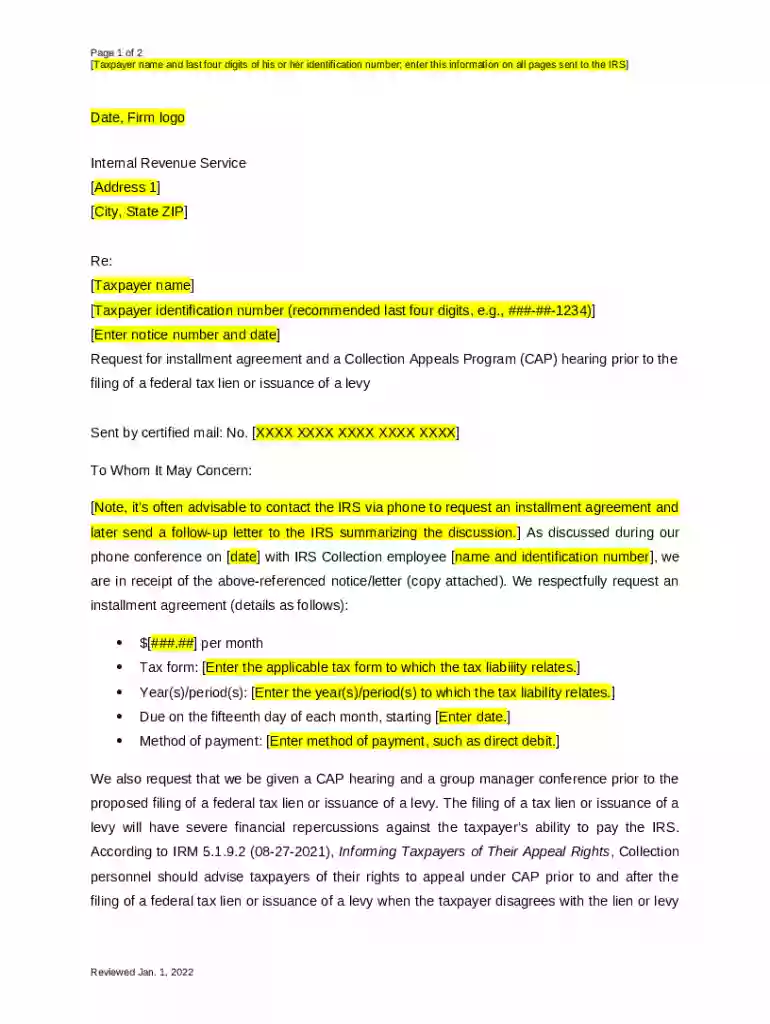
The IRS Letter to Request Installment Agreement and Appeal, commonly referenced as an "Installment Agreement Request Letter," is a formal document designed to communicate with the Internal Revenue Service (IRS) regarding unpaid tax liabilities. It serves two key purposes: to propose a structured payment plan for outstanding taxes and to invoke the taxpayer's right to a Collection Appeals Program (CAP) hearing, which prevents the IRS from initiating liens or levies until the appeal process concludes. This document is crucial for individuals or businesses seeking to manage their tax arrears without facing immediate collection actions.

Examples of Use

  • A self-employed individual who has accumulated back taxes due to underestimated quarterly payments could use this letter to negotiate a feasible installment plan with the IRS.
  • Small businesses experiencing temporary cash flow issues can submit this letter to delay enforcement actions and formalize a payment schedule that aligns with their financial capacity.

How to Use the IRS Letter Effectively

Successfully utilizing the IRS Installment Agreement Request Letter involves clearly articulating your financial situation and proposed payment plan. This requires a factual presentation of your income, expenses, existing debt, and any exceptional circumstances impacting your ability to pay.

  1. Compile Financial Information: Prepare a detailed report of your income, expenses, and assets to support your request.
  2. Draft the Letter: Introduce your request succinctly, outline your payment proposal, and state your appeal for a CAP hearing if necessary.
  3. Include Supporting Documents: Attach pay stubs, bank statements, and prior correspondence with the IRS to substantiate your claims.
  4. Submit via Designated Channels: Ensure your submission reaches the appropriate IRS address as indicated in your latest tax notice or IRS correspondence.

Fictitious Example

John Doe, a graphic designer with inconsistent monthly earnings, used the letter to propose a $300 monthly installment, backed by detailed accounts of his irregular income from freelance projects.

Steps to Complete the Letter

To ensure your Installment Agreement Request is comprehensive and compelling, follow these steps:

  1. Gather Required Personal Information: Name, address, and Social Security Number.
  2. Explain Financial Hardship: Detail why immediate full payment is not feasible.
  3. Propose a Reasonable Payment Plan: Based on your financial analysis, suggest an installment amount that you can consistently meet.
  4. State Your Interest in a CAP Hearing: If applicable, express your intention to appeal any potential IRS enforcement actions.
  5. Proofread and Validate: Check for accuracy and completeness, as errors might delay processing.
  6. Secure Signatures: Ensure that the document is signed and, if shared, countersigned by a representative.

Key Elements of the Document

The effectiveness of your IRS Installment Agreement Request Letter heavily relies on including essential components:

  • Identification Details: Ensure correct taxpayer name and TIN (Taxpayer Identification Number).
  • Statement of Intention: Clearly outline the request to enter an installment plan.
  • Income and Expense Analysis: A detailed breakdown that provides insight into financial constraints.
  • Proposed Payment Details: Specify the start date, frequency, and mode of payment.
  • Request for a Hearing: Affirm the desire for a CAP hearing to preempt adverse IRS actions.

Eligibility Criteria

Not everyone qualifies to file an IRS Installment Agreement Request Letter. Key eligibility criteria include:


  • Outstanding tax debt must not exceed $50,000 for individuals.
  • Filers should have up-to-date tax returns up to the current year.
  • Financial data should demonstrate an inability to pay the full amount immediately.
decoration image ratings of Dochub

Variations and Exceptions

  • Businesses might face different caps or requirements based on their tax filing status.
  • Individuals with back taxes from prior years should confirm whether accumulation impacts their eligibility.

IRS Guidelines and Compliance

Understanding IRS guidelines in relation to installment agreements is crucial to compliance:

  • Form 9465: Often accompanies the letter for streamlined processing.
  • Penalty Reduction: Timely installment agreements can reduce accumulated penalties.
  • Interest: Be prepared to continue accruing interest until the debt is fully settled.
  • Ongoing Monitoring: Maintain consistent payments to retain eligibility.

Required Documents

When submitting the IRS Installment Agreement Request, the following documents enhance your submission’s credibility:

  • Personal Identification: Copy of a government-issued ID.
  • Proof of Income: Latest pay stubs or a financial statement for businesses.
  • Tax Returns: Filed federal tax returns for applicable years.
  • Debt Statements: Summary of outstanding liabilities.

Penalties for Non-Compliance

Failure to adhere to the terms of an installment agreement can lead to significant penalties:

  • Reversion to Immediate Payment: IRS may demand full payment at once.
  • Enforcement Actions: Potential for lien or levy initiation, negatively impacting credit.
  • Penalty Accruals: Additional penalties for non-payment may accrue, exacerbating the financial burden.

Compliance with both the procedural and financial agreements within the letter’s scope is imperative for maintaining the integrity of the arrangement.

be ready to get more

Complete this form in 5 minutes or less

Get form

Got questions?

We have answers to the most popular questions from our customers. If you can't find an answer to your question, please contact us.
Contact us
6 Essential Tips for Writing a Letter to the IRS Follow the business letter format. Explain why you qualify for a penalty abatement. Include a copy of the IRS notice you received. Identify additional enclosures. Close the letter on a friendly note. Send your letter as soon as possible.
Use Form 9465 to request a monthly installment plan if you cannot pay the full amount you owe shown on your tax return (or on a notice we sent you).
A recorded federal tax lien establishes the governments right to your assets over other creditors. The IRS waits to record most tax liens until after it has sent all five notices in the collection notice stream and hasnt received payment. Youll want to avoid a Notice of Federal Tax Lien.
Lenders or creditors are required to issue Form 1099-C, Cancellation of Debt, if they cancel a debt owed to them of $600 or more. Generally, an individual taxpayer must include all canceled amounts (even if less than $600) on the Other Income line of Form 1040.
A Collection Appeals Program (CAP) refers to a series of procedures that allows you, the taxpayer, to challenge an IRS decision during the collection process. You can usually utilize the CAP: Before or after the IRS files a Notice of Federal Tax Lien. Before or after the IRS serves you a Notice of Intent to Levy.

Security and compliance

At DocHub, your data security is our priority. We follow HIPAA, SOC2, GDPR, and other standards, so you can work on your documents with confidence.
Learn more
ccpa2
pci-dss
gdpr-compliance
hipaa
soc-compliance

People also ask

Let the Collection office know within two (2) business days after the conference with the Collection manager that you plan to submit Form 9423. The Form 9423 must be received or postmarked within three (3) business days of the conference with the Collection manager or collection action may resume.
In your formal protest, include a statement that you want to appeal the changes proposed by the IRS and include all of the following: ∎ Your name, address, and a daytime telephone number. ∎ List of all disputed issues, tax periods or years involved, proposed changes, and reasons you disagree with each issue.
1. If you disagree with the decision regarding your installment agreement, you should appeal by completing a Form 9423, Collection Appeal Request. 2. You should provide it to the office or revenue officer who took the action regarding your installment agreement, within 30 calendar days.

Related links