






Definition & Meaning
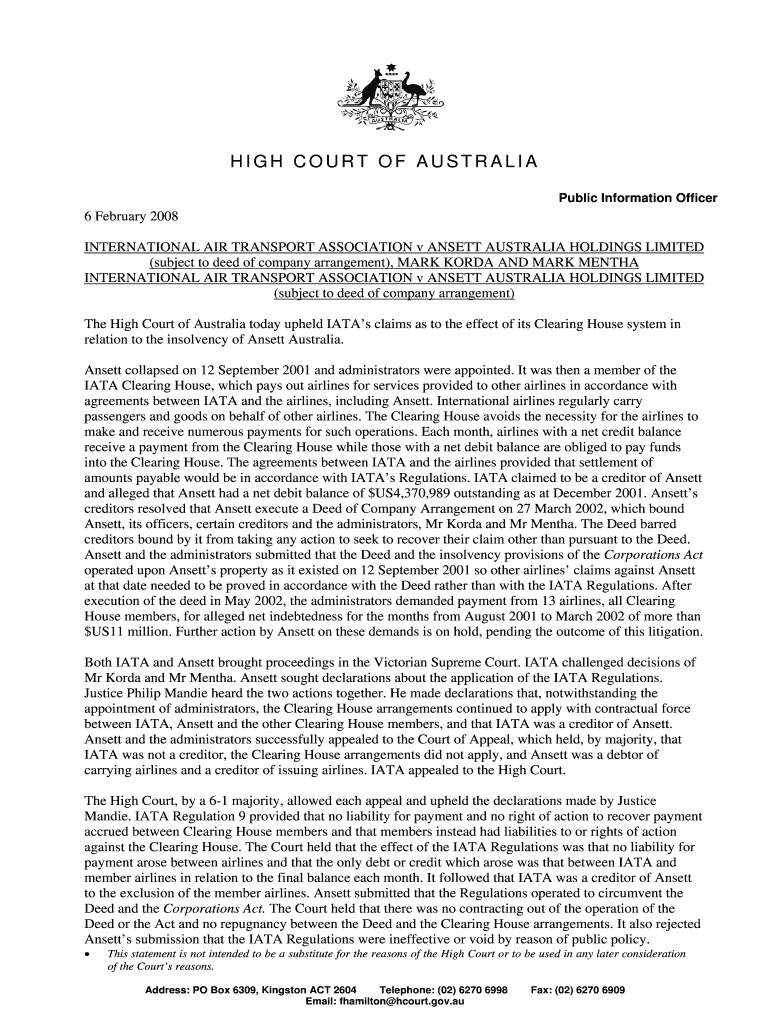
The case "International Air Transport Association v Ansett Australia Holdings Limited" involves the legal dispute over the clearing house system used by IATA in the context of the insolvency of Ansett Australia. The High Court of Australia's ruling confirmed that IATA's claims as a creditor were valid, highlighting the nature of liabilities within the clearing house being strictly between IATA and its member airlines. This case serves as a significant point of reference in understanding creditor rights and the function of the clearing system in aviation insolvency scenarios.
Key Elements of the Case
- Clearing House System: Central to the case was IATA's clearing house, which facilitated the financial transactions between member airlines. The court's decision clarified that the liabilities arise between IATA and the members, rather than among the members themselves.
- Creditor Status: The case confirmed IATA's status as a creditor, which was crucial for determining the order of payments during insolvency proceedings.
- Deed of Company Arrangement: Despite Ansett's Deed of Company Arrangement, which aimed to restructure its debts, the court maintained that IATA's clearing arrangements remained applicable.
Legal Use of the Clearing House
The IATA clearing house serves a significant legal function by standardizing and simplifying the payment processes between airlines. It ensures that financial exchanges occur smoothly and helps protect members' interests during economic disputes or insolvencies. This case underlines the legal obligations and protections afforded to members within this system, reaffirming the binding nature of such arrangements.
How to Use the System
- Membership Enrollment: Airlines must first become members of IATA to engage in the clearing house system.
- Transaction Process: Upon membership, airlines can conduct transactions through the clearing house, which centralizes payments and receipts.
- Dispute Resolution: In case of financial disagreements, the system provides a structured framework for resolving disputes under IATA’s established guidelines.
Who Typically Uses the IATA Clearing House
- Airlines: Primarily used by airlines engaged in international and domestic flights to facilitate financial transactions.
- Financial Controllers: These professionals within airlines leverage the clearing house to manage revenue and expenses efficiently.
- Accountants: Responsible for ensuring the accuracy and legality of financial exchanges within the system.


Important Terms
- Deed of Company Arrangement: A legal arrangement aimed at restructuring a company’s debts.
- Insolvency: The state of being unable to pay debts owed, which was central to Ansett Australia’s case.
- Creditor: A party to whom money is owed, as IATA was determined to be in this instance.
Step-by-Step Process to Participate
- Application for Membership: Eligible airlines must apply to IATA for membership.
- Acceptance and Onboarding: Once accepted, airlines must integrate the clearing system into their financial operations.
- Operational Use: Begin submitting and reconciling transactions through the clearing house.
Examples of Using IATA’s Clearing House
- Routine Financial Settlements: Regular financial exchanges between airlines for services rendered, such as passenger carriage and cargo handling.
- Dispute Management: The system effectively manages financial disputes arising between airlines within the member network.
Software Compatibility
IATA’s clearing system integrates with various accounting and financial management software, facilitating seamless data exchange. While not explicitly compatible with consumer-level tax software like TurboTax or QuickBooks, integrations with enterprise solutions are typically supported.
Application Process & Approval Time
The approval process for becoming a member of IATA and utilizing the clearing house necessitates comprehensive documentation and can take several weeks, depending on the completeness of the application and adherence to membership criteria.
Business Types Benefiting the Most
Airlines, especially those with extensive global networks, derive significant benefits from participation in the IATA clearing house due to improved cash flow management and reduced transaction complexity in cross-border operations.